AI Customer Support for E-commerce: Answer Fast Without Losing Trust
Learn how e-commerce brands can use AI customer support to answer product, shipping and checkout questions faster while keeping trust, handoff and data rules clear.
Speed matters in e-commerce support, but speed on its own is not enough. A shopper who asks about sizing, delivery, returns, bundles, warranty, or compatibility is usually not making small talk. They are trying to decide whether it is safe to buy.
That is where AI customer support can help. Used well, it answers the repetitive questions fast, keeps the tone consistent, and hands over the awkward cases before the conversation turns into a refund, a chargeback, or a lost order.
Used badly, it feels like a chatbot blocking the door. That difference matters. Salesforce found that 72% of customers say it is important to know when they are communicating with an AI agent. Nearly half of business buyers in the same research said they would work with an AI agent for faster service. People are not allergic to AI. They are allergic to guessing, dead ends, and fake confidence.
What shoppers ask before they buy
Most support tickets are not dramatic. They are practical. A customer wants to know whether a jacket runs small, whether a supplement is safe with a certain diet, whether a gift will arrive before Friday, or whether a product works with the device they already own.
If that answer is buried in a product tab, policy page, or old email thread, the shopper has to hunt. Many will not. Baymard calculates the average documented online cart abandonment rate at 70.22%, based on 50 studies. Not every abandoned cart is a support problem, of course. But unanswered questions near checkout are one of the easiest problems to fix because the customer is already telling you what is missing.
A good AI support agent should be able to answer questions like:
- “Which size should I choose if I am between two sizes?”
- “Can this arrive by Thursday?”
- “Is this product suitable for sensitive skin?”
- “What is the difference between these two models?”
- “Can I return it if it does not fit?”
That is not a generic FAQ. It is sales support at the moment the buyer needs it.
The trust problem: AI must know when to stop

The fastest answer is not always the best answer. If an AI agent invents a return rule, recommends the wrong product, or promises delivery that operations cannot meet, the store pays for that mistake later.
For e-commerce, the safe rule is simple: the agent can answer from approved store knowledge, product data, policy pages, order status, and connected tools. When the answer depends on judgment, missing data, a complaint, a payment issue, or a sensitive case, it should hand the conversation to a person with the full context attached.
This is where many cheap chatbots fail. They either answer everything with too much confidence, or they give the same apology loop until the customer leaves. Neither is support.
Where AI support creates revenue
AI support is not only a cost-cutting tool. For an online store, the money usually appears in four places.
Product confidence: The agent explains fit, use cases, compatibility, bundles, and alternatives without forcing the buyer to browse five pages.
Checkout rescue: The agent answers shipping, return, payment, discount, and delivery questions while the customer is still close to buying.
Post-purchase calm: The agent handles order status, setup instructions, care tips, warranty basics, and return steps before the inbox fills up.
Better handoff: When a human takes over, they should not start with “How can I help?” They should already see what the customer asked, what the AI answered, and where the risk is.
If you want the lead qualification angle, read our guide on AI lead qualification for e-commerce. If the problem is checkout drop-off, start with abandoned cart recovery with AI chat.
What to connect before turning it on
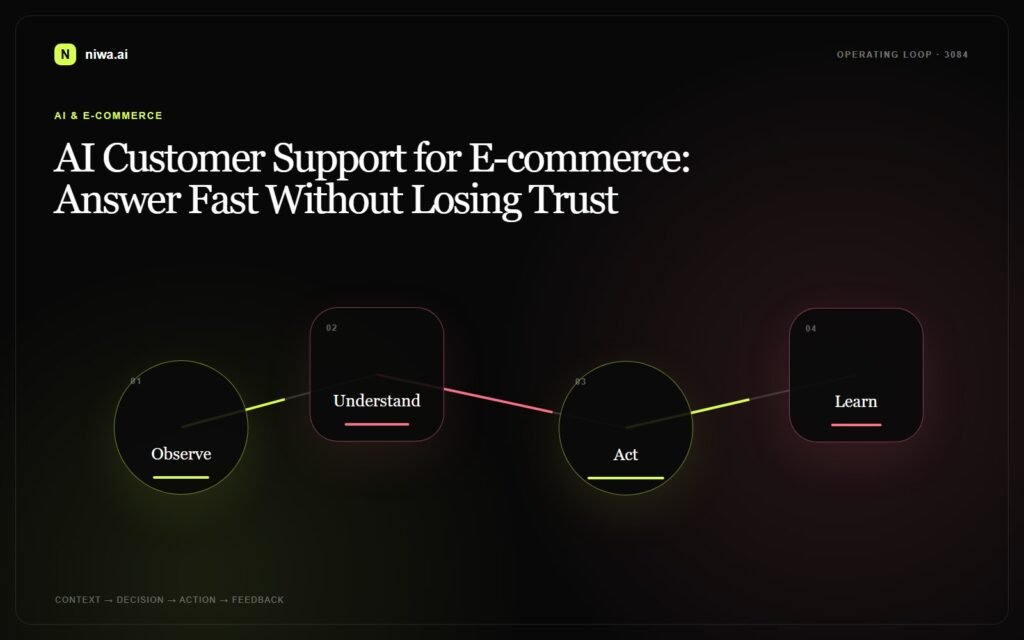
An AI support agent is only as useful as the information it can safely use. Before launching it on a live store, prepare the basics:
- Current product catalog, including variants, availability, and product relationships.
- Shipping rules, delivery regions, return policy, warranty policy, and payment options.
- Brand tone examples, including phrases the agent should avoid.
- Escalation rules for complaints, refunds, damaged items, legal questions, and high-value customers.
- CRM or helpdesk handoff, so the conversation does not disappear when a human joins.
For WooCommerce stores, this usually means connecting product data, order lookup, policy content, and the support inbox. For service businesses, the same idea applies to pricing pages, booking rules, qualification questions, and calendar handoff.
A practical rollout plan
Do not launch AI support by letting it answer everything on day one. Start smaller.
First, give it product and policy questions. Watch the conversations for one week. Rewrite weak answers. Add missing knowledge. Then add order-status questions, lead qualification, and handoff rules.
After that, measure the boring numbers. How many conversations were resolved without a ticket? How many produced a qualified lead? How many happened on product or checkout pages? How often did the agent hand over correctly? Which questions keep repeating?
Those repeated questions are useful. They tell you what your product pages, shipping copy, and checkout flow fail to explain. The AI agent answers the customer today, but the conversation data shows what the site should fix next.
What Niwa AI does differently
Niwa AI is built for sales and support conversations on business and e-commerce sites. It is not meant to be a cute widget in the corner. It is there to qualify visitors, answer product questions, reduce hesitation, and hand over when a human should take control.
For stores, that means the agent can guide shoppers toward the right product, explain policies in plain English, collect useful lead details, and support post-purchase questions without making your team copy-paste the same answer all day.
For a closer look at the setup, see how Niwa works or the page on turning website visitors into leads.
When AI support is the wrong move
If your product data is outdated, your policies change every week, or nobody owns support quality, AI will not magically fix the mess. It will just make the mess answer faster.
Clean the source material first. Decide what the agent can say, what it cannot say, and when it must hand over. Then launch it where it can win: product questions, delivery questions, lead capture, checkout hesitation, and post-purchase support.
Want to see how this would work on your store or business site? Book a Niwa AI demo and we will map the first support flows worth automating.