Multilingual AI Customer Support for Ecommerce: Sell Across Languages Without Losing Trust
Multilingual AI customer support helps ecommerce stores answer shoppers in their own language, reduce checkout doubt, and hand off complex cases safely.
Multilingual ecommerce support is no longer a “nice to have” for stores that sell across regions. It is a revenue and trust problem: shoppers ask pre-sale questions in the language they are most comfortable using, and every slow or awkward answer gives them a reason to compare another store.
CSA Research found that, in a survey of 8,709 consumers across 29 countries, 76% of online shoppers prefer buying products with information in their own language. That does not mean every small store needs a full support team for every market on day one. It does mean language friction can quietly reduce conversion, increase refund risk, and make paid traffic more expensive.
A multilingual AI support agent helps bridge that gap. It can answer product questions, explain shipping and returns, collect order details, and hand off complex cases to a human with context already attached.
Why language friction costs ecommerce stores sales
Many ecommerce teams notice the symptom before they notice the cause. International visitors browse, add products to cart, then disappear. The product is right, the ad worked, and the price is acceptable, but the shopper still hesitates.
Common causes include:
- Product uncertainty: The shopper is not sure which size, bundle, compatibility option, or variant is right.
- Policy confusion: Shipping time, customs, returns, refunds, and warranty rules are not clear enough.
- Payment anxiety: The shopper wants reassurance before entering card details or choosing a local payment method.
- Support doubt: If the store cannot answer a simple question before purchase, the shopper assumes post-purchase support will be slow too.
Translated product pages help, but they are static. Real shoppers ask messy questions: “Will this fit my older model?”, “Can it arrive before Friday?”, “What happens if the size is wrong?”, “Is this safe for sensitive skin?” A multilingual AI assistant can answer those questions inside the buying session instead of sending the shopper away.
What a multilingual AI support agent should handle
A strong ecommerce AI agent does not simply translate a FAQ. It understands the intent behind the question and uses your store context to give a useful answer.
1. Product questions in the customer’s language
For fashion, beauty, supplements, electronics, home goods, and specialty food, shoppers often need guidance before they buy. The assistant should be able to explain differences between products, ask a clarifying question, and recommend a next step.
Example: A visitor asks in German whether a skincare product is suitable for sensitive skin. The AI agent checks the product notes, asks about fragrance sensitivity if needed, and points the shopper to the safest option instead of giving a generic “yes”.
2. Shipping, returns, and order questions
International customers care about delivery expectations. A multilingual assistant should explain shipping windows, return conditions, exchange rules, and support next steps in plain language.
This is especially useful after purchase. Customers do not want to search for policy pages when they are worried about an order. They want a direct answer and a clear next action.
3. Checkout reassurance
Some questions happen right before payment: “Is this secure?”, “Can I pay on delivery?”, “Can I change the address later?”, “Will I get tracking?” If the answer is not immediate, the cart often stays unfinished.
An AI support agent can provide reassurance, link to the right policy, and escalate to a human when a case affects payment, personal data, or a special promise.
4. Human handoff with context
Multilingual automation should not trap customers in a bot loop. The best setup is simple: the AI solves repetitive questions and passes complex issues to a human with the customer’s language, question, product, order details, and previous answers included.
Salesforce’s State of the AI Connected Customer highlights why transparency matters: 72% of customers say it is important to know if they are communicating with an AI agent. For ecommerce, that means the assistant should be helpful, but also honest about when a human should step in.
Where multilingual AI support creates the fastest ROI
Not every store needs to automate every language immediately. Start with the points where language friction blocks money or creates support pressure.
- Paid traffic landing pages: Visitors arrive from ads with buying intent but need quick clarification before moving forward.
- Product detail pages: The assistant can explain variants, compatibility, usage, ingredients, sizing, or bundles.
- Cart and checkout: The AI can answer shipping, return, payment, and delivery questions before abandonment.
- Post-purchase support: Customers can ask about order status, tracking, returns, exchanges, or setup without opening a ticket.
For a store selling in two or three markets, even a basic multilingual AI layer can reduce repetitive support work and protect high-intent sessions. For a store already buying international traffic, it can also make campaigns easier to scale because fewer visitors hit a language wall after clicking the ad.
How to keep AI translation from damaging trust
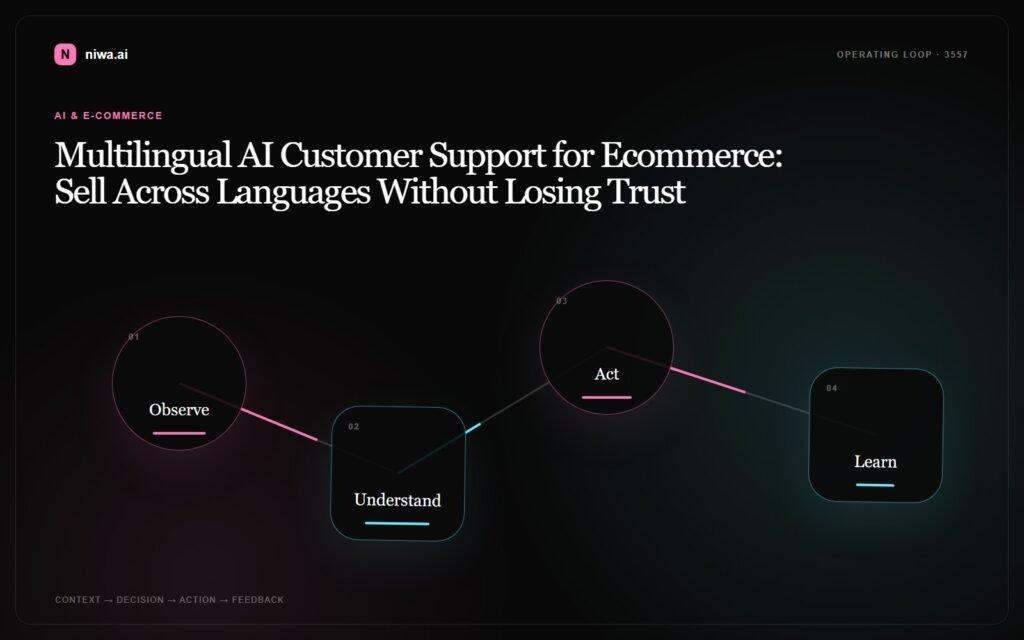
The risk is not that AI answers in another language. The risk is that it answers confidently when the store data is incomplete or the promise is sensitive.
Use these guardrails:
- Ground answers in approved store content: Product data, policy pages, shipping rules, and support instructions should be the source of truth.
- Use escalation rules: Refund disputes, damaged products, legal claims, medical advice, and unusual delivery promises should move to a human.
- Show that the assistant is AI: Do not hide the nature of the conversation. Transparency builds more trust than pretending.
- Log unanswered questions: Missing answers reveal where product pages, policies, and translations need improvement.
- Review conversations by language: A few checks per week can catch confusing phrasing before it becomes a conversion problem.
A practical rollout plan
Here is a simple way to launch without overbuilding:
- Pick the first two languages: Use analytics, ad spend, customer emails, and sales data to identify the markets with real demand.
- Prepare the knowledge base: Product FAQs, shipping rules, returns, payment options, sizing, compatibility, and warranty details should be clean before automation.
- Launch on high-intent pages first: Start with product pages, cart, and the request/demo page before expanding everywhere.
- Measure business outcomes: Track assisted conversions, lead quality, ticket reduction, cart recovery, and the questions that still need humans.
- Improve weekly: Add missing answers, adjust handoff rules, and refine recommendations based on real conversations.
What Niwa AI can do for multilingual ecommerce support
Niwa AI is built for ecommerce and business websites where chat is not just a support widget. It can qualify visitors, answer product and policy questions, guide shoppers toward the right item, and create a cleaner handoff when a human needs to take over.
For multilingual stores, that means your site can respond to more buyers in the moment they are deciding. The goal is not to replace your brand voice. The goal is to make sure a qualified shopper does not leave just because the next answer was hard to find.
The practical test: If a customer can ask a pre-sale question in their own language and get a clear, policy-safe answer in under a minute, your store has removed one more reason not to buy.
If your ecommerce site is already getting traffic from multiple countries, now is the time to turn multilingual chat from a support cost into a conversion layer.
Book a Niwa AI demo and see how an AI sales and support agent can help your store answer more shoppers, recover more intent, and hand off the right conversations to your team.