AI FAQ Automation for Ecommerce: Answer Repetitive Questions Before They Cost You Orders
Use AI FAQ automation to answer repetitive ecommerce questions, reduce buying friction, qualify leads, and hand off complex cases with context.
Most ecommerce FAQ pages are treated like storage: shipping policy here, returns policy there, a few product questions at the bottom of the page. Shoppers do not experience them that way. They have one live question at a specific moment, and if the answer is slow, vague, or hidden, the order can stall.
That is why AI FAQ automation is becoming more than a support shortcut. For online stores, it is a conversion layer. The goal is not to replace every human conversation. The goal is to answer repetitive questions instantly, guide shoppers to the right next step, and hand off cleanly when the conversation needs a person.
Why repetitive questions are a revenue problem
FAQ questions usually look small in isolation:
- “Will this fit my model?”
- “How long does delivery take?”
- “Can I return it if the size is wrong?”
- “Is this product good for beginners?”
- “Do you ship to my country?”
But these questions often appear right before the buying decision. If the answer is not available in the moment, the shopper may postpone the purchase, open another tab, message support, or leave entirely.
Baymard Institute calculates the average documented online shopping cart abandonment rate at 70.22%. Not every abandoned cart is caused by unanswered FAQs, of course. Still, the number is a useful reminder: ecommerce conversion is fragile, and friction does not need to be dramatic to be expensive.
What AI FAQ automation actually means
AI FAQ automation is not just a chatbot that repeats your help center. A useful ecommerce AI agent connects product information, policies, common objections, and customer context into a guided answer.
For example, instead of saying:
“You can find shipping information on our delivery page.”
A better AI answer sounds like:
“For this item, standard delivery usually takes 3 to 5 business days. If you need it faster, choose express shipping at checkout. Here is the product page again, and I can also help you compare it with the next model.”
The second answer does three things: it answers the question, keeps the shopper in the buying flow, and offers a relevant next step.
Where static FAQ pages fail
Traditional FAQ pages are useful, but they have structural limits:
- They require the shopper to search manually: A visitor has to know where to click and how the store phrases the answer.
- They separate support from shopping: The shopper leaves the product or checkout context to hunt for information.
- They cannot ask follow-up questions: A sizing question, compatibility question, or B2B quote request often needs one extra detail.
- They do not qualify urgency: “Where is my order?” and “Can you make a custom quote?” should not receive the same workflow.
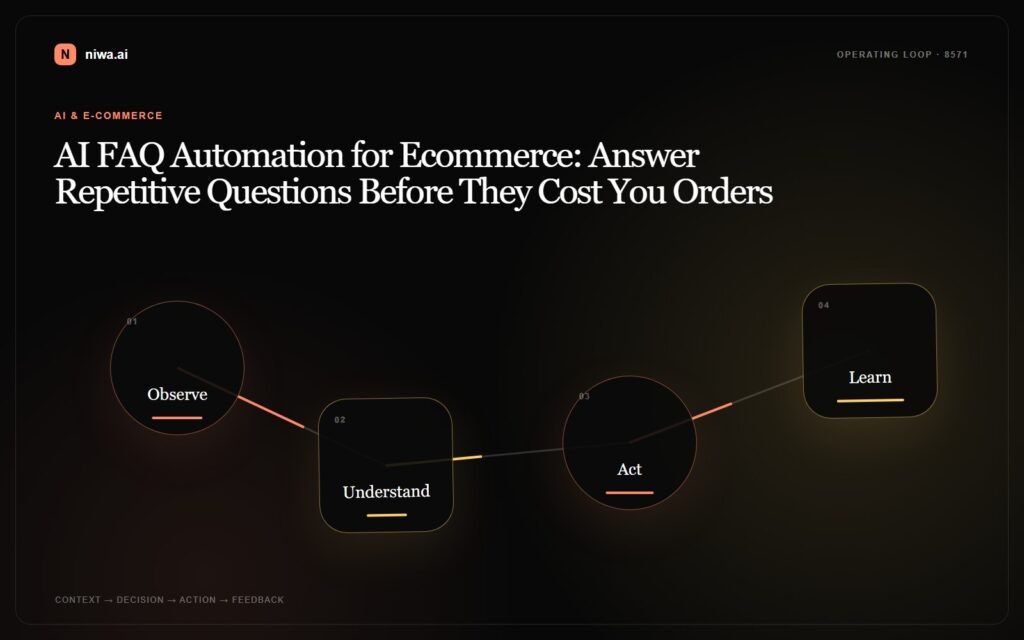
An AI agent turns the FAQ from a static library into an active conversation. The difference matters most when the customer is close to buying.
The first FAQ flows to automate
Start with the questions that either block a purchase or consume the most support time. For most ecommerce teams, these are the best first candidates:
1. Shipping and delivery questions
Customers want delivery answers before checkout, not after. The AI agent should explain delivery windows, shipping zones, free shipping thresholds, express options, and what happens after the order is placed.
Example: “If you order today, delivery to Germany is usually 4 to 7 business days. Orders over €80 qualify for free standard shipping.”
2. Returns, exchanges, and warranty
Return uncertainty quietly kills confidence. An AI agent can explain the policy in plain English and point the shopper to the right product or size before the wrong item is purchased.
Example: “You can exchange the size within 14 days if the item is unused. If you are between two sizes, I recommend checking the size guide or telling me your usual size.”
3. Product compatibility
Compatibility questions are common in electronics, parts, beauty, supplements, accessories, and B2B ecommerce. This is where a simple FAQ article often fails because the answer depends on the product, variant, or customer use case.
Example: “This charger works with the Pro X model from 2023 and 2024, but not the older Lite version. Do you want me to show you the compatible alternative?”
4. Product recommendations
FAQ automation becomes especially valuable when it connects answers with recommendations. If a shopper asks, “Which one is best for oily skin?” the agent should not only define oily skin. It should guide the customer toward the right product group.
For a deeper recommendation flow, connect the FAQ layer with a guided product finder. Niwa’s How Niwa Works page explains how an AI sales agent can understand intent and move the conversation toward a useful next step.
5. Lead qualification for higher-ticket purchases
Some questions are not support tickets. They are sales opportunities. A shopper asking about bulk pricing, custom plans, integrations, or enterprise delivery should be qualified and routed differently from a basic FAQ request.
Example: “How many units do you need, and when do you need delivery? I can pass the details to the team so they can prepare a better quote.”
Customers expect speed, but they also expect transparency
Speed is now part of the customer experience. Zendesk’s CX Trends 2026 report says 74% of consumers expect customer service to be available 24/7 due to AI. That does not mean every answer should be automated blindly. It means customers increasingly expect immediate help when the question is simple.
At the same time, trust matters. Salesforce reports that 72% of customers say it is important to know if they are communicating with an AI agent. A good ecommerce AI assistant should be clear about what it is, helpful in what it answers, and honest about when a human should step in.
Where the AI should hand off to a human
The safest AI FAQ workflow includes clear handoff rules. Do not force the agent to handle conversations that require judgment, negotiation, or sensitive customer data.
Good handoff triggers include:
- Payment or refund disputes: The AI can collect context, but a human should review the case.
- Complex complaints: If the customer is frustrated, the agent should acknowledge the issue and escalate.
- Custom pricing: The AI can qualify the request and send the details to sales.
- Unclear product safety or medical claims: The AI should avoid guessing and route the question to the right team.
- Repeated failed answers: If the customer asks the same question twice, the agent should stop looping and offer help from a person.
This is also where CRM handoff becomes important. A useful AI agent does not just say, “Someone will contact you.” It sends the question, product context, email, urgency, and conversation summary to the team.
How to measure whether FAQ automation is working
Do not measure AI FAQ automation only by the number of conversations handled. That can reward the wrong behavior. Measure the business outcome behind the conversations.
- Question resolution rate: How many common questions were answered without a support ticket?
- Click-through to product pages: Did the answer move the shopper back to a buying page?
- Checkout continuation: Did shoppers continue after asking shipping, returns, or compatibility questions?
- Qualified leads created: How many high-intent conversations were passed to sales with useful context?
- Human handoff quality: Did the team receive enough information to respond quickly?
If your current FAQ page gets traffic but does not influence these metrics, it may be informational but not commercial. AI automation should make the FAQ useful at the moment of decision.
A practical rollout plan for ecommerce teams
The best way to start is narrow. Pick one high-friction product category or one repetitive support theme. Then build a focused AI FAQ flow around it.
- Export your top 30 support questions: Use chat logs, email tickets, WhatsApp messages, and sales objections.
- Mark each question by intent: Pre-purchase, checkout, post-purchase, technical, complaint, or sales lead.
- Write approved answers: Keep them short, specific, and connected to products or policies.
- Add handoff rules: Decide when the AI should stop answering and route to a human.
- Connect the right next step: Product page, cart, delivery policy, contact form, demo, or sales follow-up.
- Review real conversations weekly: Improve answers based on what customers actually ask.
This is the kind of workflow Niwa AI is designed for: answering repetitive ecommerce questions, recommending the next step, qualifying serious buyers, and handing the conversation to your team when automation is no longer enough.
FAQ automation should feel like better service, not cheaper support
The strongest ecommerce AI agents do not make customers feel deflected. They make the store feel responsive. They answer quickly, stay close to the buying context, and know when to involve a human.
If your store receives the same questions every week, those questions are not just support noise. They are signals. They show where customers hesitate, what they do not understand, and what they need before they feel safe buying.
Want to turn repetitive ecommerce questions into faster sales conversations? Book a Niwa AI demo and see how an AI sales and support agent can answer FAQs, recommend products, qualify leads, and hand off to your team with context.