AI Inventory Assistant for Ecommerce: Turn Stock Questions Into Sales
Use AI to answer stock, availability, variant, and restock questions while capturing buyer intent before shoppers leave the store.
Why inventory questions are sales conversations
When shoppers ask about stock, they are usually closer to purchase than they look. “Is this available in black?” “When will Medium be back?” “Do you have this in store?” “Can I reserve one?” These are not casual questions. They are signals of intent.
The problem is that many ecommerce stores treat inventory questions as support tickets. A buyer asks, waits, leaves, and maybe returns later. By the time a human answers, the moment may be gone. An AI inventory assistant changes that by responding immediately with useful next steps based on live availability, variants, restock expectations, and alternatives.
This makes it different from a generic chatbot. The assistant is not just saying “we will notify you.” It helps the shopper decide what to do now: buy the available variant, join a restock list, choose a similar product, request a quote, or ask for human help when the order value justifies it.
Inventory guidance connects naturally with an AI personal shopper, an AI product comparison assistant, and an AI quote assistant. All three flows depend on the same truth: buyers need accurate product availability before they commit.
What an AI inventory assistant should answer
A useful assistant should handle more than “in stock” or “out of stock.” Real shoppers ask messy, specific questions. They want to know whether a size is available, whether a bundle can be split, whether a product will return, whether another warehouse has it, and whether a substitute will work.
Strong inventory conversations include answers to:
- current stock status by product and variant
- expected restock windows when available
- low-stock urgency without fake pressure
- alternative products with similar use cases
- preorder or reservation options
- store pickup or local availability
- compatibility between available accessories and unavailable main products
- whether a human should step in for bulk or high-value requests
The assistant should also avoid one of the biggest ecommerce mistakes: pushing a random alternative just because the desired item is unavailable. A good alternative should match the buyer’s intent. If someone wants a compact product because they have limited space, the alternative should preserve that constraint. If someone wants a premium version, the assistant should not downgrade them without explaining the trade-off.
Turning out-of-stock into captured demand
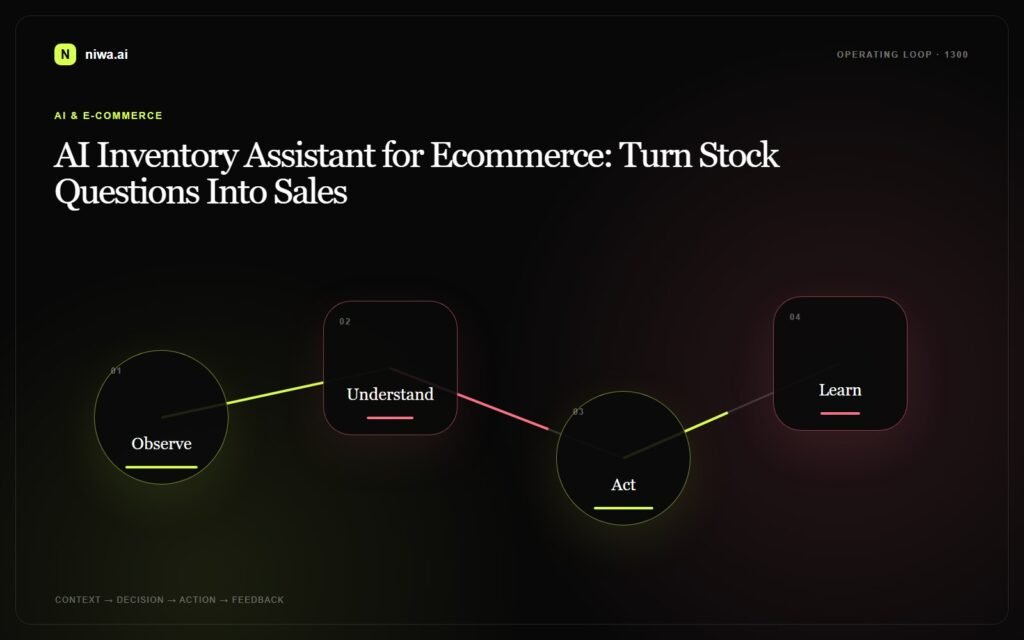
An out-of-stock page does not have to be a dead end. It can become a demand signal. The assistant can ask whether the shopper wants an alert, what variant they need, how soon they need it, and whether they would consider a similar item. That information is useful for both sales and operations.
Instead of a plain email field, the conversation can capture structured intent:
- desired variant
- quantity
- urgency
- budget range
- acceptable alternatives
- location or shipping constraints
- whether the customer is buying for personal use, team use, or resale
That is far more valuable than a passive waitlist. It helps the store prioritize restocks, understand lost revenue, and follow up with a message that actually fits the buyer.
Using inventory signals to improve merchandising
An AI inventory assistant is also a learning tool. If many shoppers ask for a missing size, that may reveal a buying pattern. If they ask whether an accessory works with a sold-out product, the store may need clearer cross-sell logic. If they repeatedly ask when a product returns, the page should show restock expectations more clearly.
This is where conversation data becomes operational intelligence. Similar to AI conversation intelligence, inventory chats show what shoppers cannot solve from the current page. Every repeated question is a merchandising clue.
The store can use those clues to improve product descriptions, reorder levels, variant naming, collection pages, and email campaigns. The assistant solves the immediate buyer problem, while the aggregated patterns help the team improve the store.
How to keep stock answers trustworthy
Inventory is one of the worst areas for AI hallucination. If an assistant invents availability, the customer experience breaks immediately. That is why it must rely on current catalog and stock data, not memory or guesswork.
The assistant should be careful with language. If the stock system is exact, it can be specific. If restock timing is uncertain, it should say so. If an item is discontinued, it should not imply it will return. And when a shopper wants multiple units or a business order, the assistant should route that as a sales opportunity instead of giving a shallow answer.
The same principle applies during checkout. If availability, shipping, or delivery timing may affect the purchase decision, the assistant should coordinate with the AI checkout assistant flow instead of treating the question as isolated support.
Bottom line
An AI inventory assistant helps ecommerce stores stop losing high-intent shoppers to unanswered stock questions. It answers availability quickly, recommends relevant alternatives, captures restock demand, and gives the team better insight into what buyers actually want.
For stores with many variants, seasonal products, fast-moving inventory, or expensive items, this is not a minor convenience. It is a sales recovery layer. The shopper came with intent. The assistant’s job is to keep that intent alive.