AI Agents for E-commerce: How Stores Save Time and Sell More
A guide for e-commerce teams: where AI agents save time fastest, improve support, and increase sales.
Introduction: e-commerce can no longer wait for manual work
Online stores today do not lose money only because of weak ads or prices that are too high. They often lose it because of slow replies, unanswered messages, unused inquiries, poor customer segmentation, and decisions that are made only after the problem is already visible in revenue. This is where AI agents become a major advantage: not as “just another chatbot”, but as an operational layer that understands the goal, follows context, and executes tasks.
For a Niwa, AI, and e-commerce audience, the most important question is not whether artificial intelligence is interesting, but where it returns invested time and money the fastest. If you already have an online store, catalog, orders, customer support, and marketing, an AI agent can connect those points into a system that works faster than a classic manual process. You can learn more about our approach on the home page, through the overview of AI automation, or via the contact and consultation page.
What an AI agent is in an e-commerce context
An AI agent is a software teammate that does not simply wait for one question and return one answer. It can follow a goal, keep context, call tools, check data, and execute steps in the right order. In an e-commerce store, this means it can help with support, catalog work, recommendations, product descriptions, SEO content, order analysis, and customer communication.
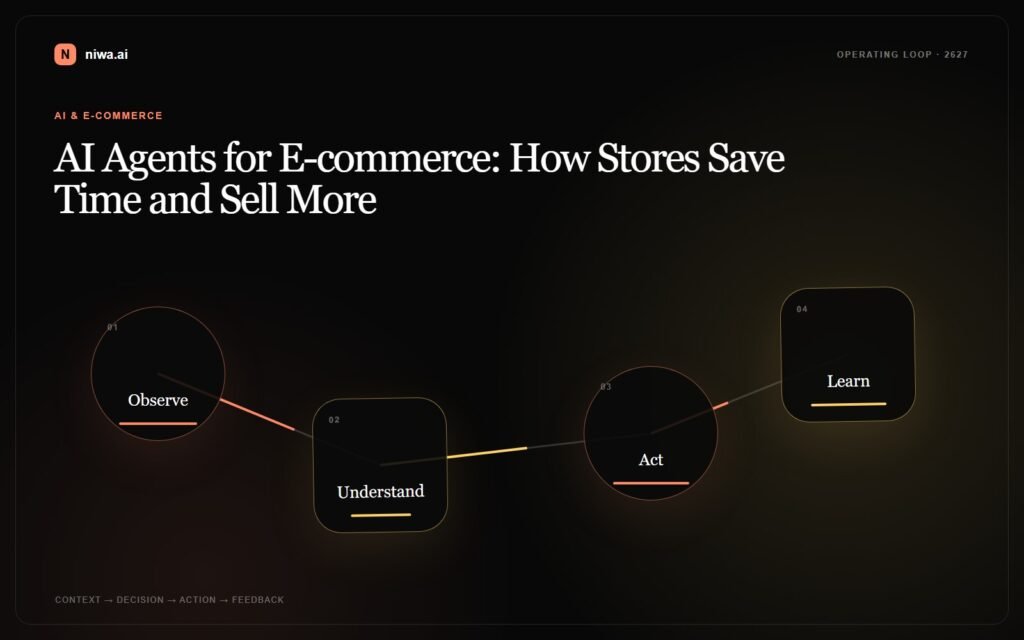
The difference between a regular chatbot and an AI agent is the depth of action. A chatbot mostly answers. An agent can notice that a customer is asking about size, check availability, suggest an alternative, record a signal for the sales team, and trigger the next step. In internal processes, an agent can identify products without strong descriptions, create a priority list, write a draft SEO text, and prepare a post for review.
Where an AI agent delivers results fastest
The first area is customer support. Customers often ask the same questions: delivery time, exchanges, sizes, compatibility, order status, and payment methods. If the answer is late, the customer loses interest. An AI agent can reply quickly, but also escalate cases that require a human decision. This reduces pressure on the team, while the customer gets the feeling that the store truly works.
The second area is the catalog. Many stores have hundreds or thousands of products with inconsistent descriptions. An AI agent can find products without meta descriptions, weak titles, duplicated wording, and categories that do not have enough textual context. This directly affects SEO, conversion, and ad quality.
The third area is marketing. Instead of preparing campaigns from scratch every time, an agent can use existing data: best-selling products, seasonal demand, customer questions, and previous results. This creates more relevant emails, blog posts, landing pages, and ads. If you want to connect content and sales more deeply, a useful next step is reviewing your blog strategy and the page about solutions for online stores.
A practical flow: from customer question to sale
Imagine a customer asking: “Is this product suitable for beginners, and can it arrive by Friday?” In a manual process, someone has to read the message, check the product, check the delivery time, and think of a response. If the message arrives in the evening or over the weekend, the chance of purchase decreases.
An AI agent can recognize the intent, check the information that is available, answer in a clear tone, and suggest an additional product that solves the same problem. If there is not enough information, the agent does not have to invent an answer; it can ask for clarification or forward the case to a person on the team. The greatest value is not only speed, but consistency: every customer receives help at the same standard.
How to introduce an AI agent without chaos
The best approach is not “automate everything at once”. It is better to start with one process that has high volume and clear rules. For example: the most common customer questions, optimization of product descriptions, or preparation of blog content for SEO. Once that process becomes stable, the agent can receive additional permissions and new tasks.
A good implementation has three layers. The first is knowledge: store rules, communication tone, delivery terms, exchange policy, and the catalog. The second is tools: WordPress, WooCommerce, CRM, email, analytics, or an internal panel. The third is control: what the agent may do on its own and what it must send for approval. Without control, automation becomes a risk. With good control, it becomes a scalable system.
What to measure after implementation
For an AI agent to be a business investment, specific indicators need to be measured. The most important ones are response time, number of inquiries resolved without escalation, conversion rate from conversations, number of optimized products, organic traffic growth, and team hours saved. If the agent writes content, you should also measure indexing, keyword positions, clicks, and sales that come from that content.
In practice, the best results come when the agent does not work in isolation. It should be part of a wider system: sales, support, marketing, and catalog management. That is why AI should not be treated as an experiment, but as new operational infrastructure.
Conclusion: the advantage belongs to stores that learn faster
AI agents will not replace a good product, a clear offer, or customer trust. But they can help deliver all of that faster, explain it better, and turn it into sales more consistently. For e-commerce teams that want growth without proportional growth in operational chaos, agents are one of the most practical steps.
If you want to assess which process in your store has the highest automation potential, start with three questions: where does the team lose the most time, where do customers wait most often, and where does data already exist but is not used well enough? That is usually where the first AI agent with measurable impact can be found.
Build the agent around four operational layers
A reliable ecommerce agent needs more than a prompt. Build the workflow around four layers:
- Knowledge: approved policies, product facts, communication tone, and escalation rules.
- Data: current products, prices, stock, orders, and the customer context needed for the task.
- Control: explicit boundaries for what the agent may complete and what requires human review.
- Measurement: response time, resolution, assisted conversion, hours saved, and the quality of handoffs.
Track negative signals too: wrong recommendations, long or unclear answers, repeated questions, and failed escalations. Sensitive complaints, legal exceptions, large B2B deals, and decisions that directly affect margin should remain under appropriate human supervision.