Sentient AI vs Niwa AI: WordPress Chatbot or Business Operator?
Compare Sentient AI and Niwa AI for WordPress chatbots, WooCommerce, administration, publishing, messaging, reporting, leads, and conversions.
Sentient AI and Niwa AI both push WordPress beyond simple text generation. Each can connect artificial intelligence with real website data, customer conversations, and administrative actions. But they approach the problem from different directions.
Sentient AI is strongest as a feature-rich WordPress chatbot, semantic search system, privacy-conscious knowledge layer, and on-site administrator tool. Niwa AI is designed as a broader business operator that works with the owner through messaging channels while connecting WordPress and WooCommerce actions to reporting, publishing, lead capture, monitoring, and conversion workflows.
This comparison uses the capabilities publicly documented by Sentient AI as of July 16, 2026. It distinguishes confirmed features from functions that are simply not prominently documented, because a fair comparison should not turn missing public information into an unsupported claim.
Quick verdict
Choose Sentient AI if your priority is an advanced customer-facing WordPress chatbot with semantic search, local FAQ matching, multiple model providers, confidence scoring, MCP access, and a useful set of administrator commands inside WordPress.
Choose Niwa AI if you want an AI operator that works closer to the owner’s daily business workflow: managing WordPress and WooCommerce, publishing content, receiving instructions through Telegram or WhatsApp, preparing business reports, monitoring competitors, capturing leads, and supporting conversion-focused follow-up.
The shortest distinction is:
Sentient AI combines a sophisticated WordPress chatbot with on-site AI administration. Niwa AI connects website administration with the wider commercial operation of the business.
For a broader explanation of Niwa’s operating model, see How Niwa Works.
What is Sentient AI for WordPress?
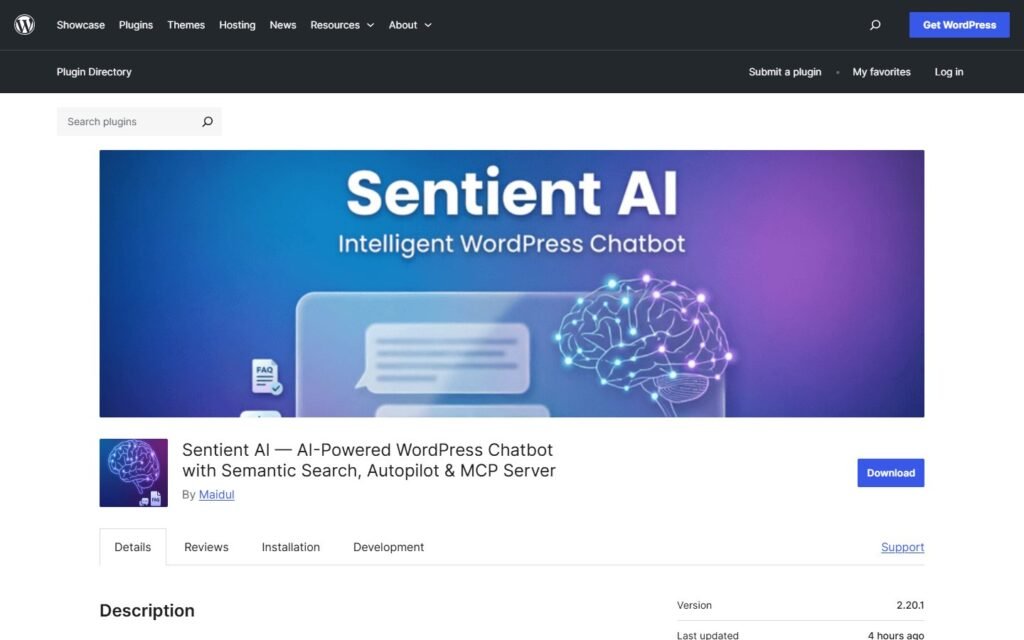
Sentient AI’s official WordPress plugin listing describes a platform combining AI conversations, semantic search, WordPress management, WooCommerce data, and external AI-agent integration.
Its customer-facing chatbot can use OpenAI, Anthropic Claude, Google Gemini, OpenRouter, or Hugging Face. Site owners are therefore not locked into one model provider. The plugin also supports semantic vector search through a local MySQL engine or cloud services such as Pinecone and Supabase.
One of Sentient AI’s most distinctive features is its local processing option. Browser-based FAQ matching and its Local Brain mode can answer known questions without sending every request to an external model. For privacy-conscious sites, predictable FAQ traffic, and teams watching API costs, that is a meaningful advantage.
Sentient AI also includes several specialized layers:
- WordPress Autopilot for administrator chat commands.
- MCP Server support for connecting external AI clients and agents.
- GEO Scanner for evaluating content for generative-search visibility.
- Empathy Engine for adapting tone and escalating frustrated visitors.
- Glass Box Transparency with confidence scores and source attribution.
- WooCommerce support for product lookup, order status, recommendations, cart information, product indexing, and documented commerce workflows.
The official listing documents administrator commands for creating posts and pages, listing content, checking updates, finding broken images, clearing plugin cache, and retrieving site statistics. Actions are logged for review.
What is Niwa AI?
Niwa AI is built around a different product idea: the website owner should be able to describe a business outcome, not merely open a plugin panel and operate one AI feature at a time.
Niwa connects natural-language instructions with WordPress, WooCommerce, publishing, reporting, customer conversations, and owner communication. An owner can work through Telegram or WhatsApp rather than depending exclusively on wp-admin.
The operating layer matters because many real requests cross several systems. “Create a post” is a WordPress action. “Research a competitor, identify a useful search opportunity, create a comparison article, publish it, verify it, and report the result” is a business workflow.
Niwa is intended to handle that wider chain while keeping the owner informed. On the storefront side, she can also support product questions, lead capture, guided selling, and follow-up. The AI lead capture guide explains why useful context is more valuable than collecting an email address without understanding buyer intent.
Sentient AI vs Niwa AI comparison table
| Capability | Sentient AI | Niwa AI |
|—|—|—|
| Customer-facing WordPress chatbot | Yes | Yes |
| Semantic search across site content | Yes, with local and cloud vector options | Uses website and business context for conversational workflows |
| Local FAQ matching without an external AI request | Yes | Not the primary documented differentiator |
| Multiple AI model providers | Yes | Model configuration depends on the Niwa setup |
| Natural-language WordPress administration | Yes, through Autopilot and MCP tools | Yes, through owner-facing operator workflows |
| Create WordPress posts and pages | Yes | Yes, including researched publishing workflows |
| WooCommerce product lookup and recommendations | Yes | Yes |
| WooCommerce order and cart context | Yes | Yes, within broader store-management workflows |
| Telegram administration for the owner | Not prominently documented | Yes |
| WhatsApp administration for the owner | Not prominently documented | Yes |
| Connected website chat and WhatsApp follow-up | Not prominently documented as a core workflow | Yes |
| Business-focused reports for the owner | Site statistics are documented | Yes, with operational and commercial reporting workflows |
| Competitor research and monitoring | Not prominently documented | Yes |
| Lead capture and qualification | Pre-chat forms and contact data are supported | Yes, with buyer-intent and follow-up workflows |
| Content publishing based on live research | Content creation is supported | Yes, as an end-to-end operator workflow |
| GEO/content optimization scanner | Yes | SEO research and publishing workflows rather than a dedicated GEO scanner |
| MCP server for external AI clients | Yes | Not the primary product positioning |
| Confidence score and answer-source visibility | Yes | Not the primary documented differentiator |
| Conversion-focused store workflows | Product discovery and conversational commerce features are documented | Yes, including lead, checkout, recovery, and follow-up workflows |
Public products change quickly. “Not prominently documented” means that the capability was not clearly presented in the official material reviewed for this comparison; it does not claim that the feature could never exist.
Where Sentient AI is especially strong
1. Semantic search and local knowledge retrieval
Sentient AI has a technically specific answer to a common chatbot problem: how to retrieve relevant website information without depending entirely on keyword matching or sending every query to a paid external model.
Its local MySQL vector option is notable for ordinary WordPress hosting because it does not require a specialized vector database. Larger sites can use Pinecone or Supabase. Combined with browser-based FAQ matching, this gives site owners flexibility over cost, privacy, and scale.
Niwa’s strength is broader operational context, but Sentient AI has the clearer publicly documented specialization in local semantic retrieval infrastructure.
2. Privacy-conscious FAQ automation
The ability to answer known FAQ questions locally can be valuable for organizations with strict data preferences. Sentient AI states that FAQ-matched and Local Brain interactions can stay on the site, while external providers are used when configured and needed.
That architecture may appeal to documentation sites, membership organizations, support-heavy businesses, and teams that want a controlled first layer before escalating to generative AI.
3. Transparency and confidence signals
Sentient AI’s Glass Box feature provides confidence scoring and source attribution for answers. Administrators can review low-confidence queries and improve the knowledge base.
This is a strong product decision. Chatbot quality improves when a team can see where the system is uncertain instead of treating every fluent response as equally reliable.
4. MCP and external-agent connectivity
The documented MCP server allows external tools such as compatible desktop clients, development environments, or custom agents to interact with WordPress resources and tools using authenticated access.
For technical users building their own AI stack, that openness is a meaningful advantage. Sentient AI can function as both a website chatbot and a bridge between WordPress and outside AI clients.
5. Dedicated GEO scanning
Sentient AI includes a scanner focused on generative engine optimization. It evaluates factors such as structure, citations, FAQs, metadata, and schema, then offers recommendations and selected fixes.
Niwa can research and publish SEO content, but Sentient AI’s dedicated scoring interface is more specialized for teams that want to audit individual posts from inside WordPress.
Where Niwa AI is different
Owner control through Telegram and WhatsApp
Sentient AI’s official workflow centers on its WordPress interfaces, chatbot, Autopilot, and MCP connections. Telegram or WhatsApp as the owner’s main administration channel is not prominently documented.
Niwa is designed around that messaging-first relationship. The owner can request work, receive results, approve sensitive steps, and stay informed without keeping wp-admin open. This can be especially useful for founders managing a store from a phone, warehouse, meeting, or sales floor.
Customer communication also matters. Niwa’s website chat and WhatsApp ecommerce guide describes how the website conversation can continue after a visitor leaves, with useful context preserved for follow-up.
End-to-end content publishing
Sentient AI documents the ability to create posts and pages through administrator commands. That is useful and efficient.
Niwa’s publishing workflow is designed to go further when instructed: inspect existing content, research current search results, avoid topic duplication, verify sources, write an optimized article, add internal links, publish it, verify publication, and report the final post ID to the owner.
The difference is not whether both systems can create content. It is the scope of the surrounding workflow.
Business reporting rather than only site statistics
Sentient AI documents site statistics, query logs, analytics resources, and WooCommerce event handling. Those are valuable inputs.
Niwa’s positioning emphasizes owner-facing interpretation: what happened, why it matters commercially, and what action should follow. A business report can connect orders, stock, content, leads, customer questions, and competitor movement rather than presenting one plugin’s analytics in isolation.
That distinction is important for small teams. Data is useful, but an owner often needs a prioritized next action more than another dashboard.
Competitor monitoring and market research
Sentient AI’s public documentation highlights website knowledge, customer conversations, WordPress actions, GEO analysis, and MCP. Ongoing competitor monitoring is not prominently documented as a core capability.
Niwa can be tasked with researching competing offers, tracking changes, identifying content gaps, and turning findings into publishing or conversion actions. This moves the agent outside the boundaries of the local WordPress database and into continuous business research.
Conversion workflows and lead context
Sentient AI has substantial commerce functionality. Its documented features include product discovery, recommendations, cart information, order status, gift guidance, semantic product matching, pre-chat forms, and emotion-aware escalation. It would be unfair to describe it as only a basic FAQ bot.
Niwa’s difference is the connection between the visitor conversation and the owner’s subsequent workflow. A high-intent question can become a qualified lead, a WhatsApp follow-up, a product-page improvement, a conversion report, or a task for the founder.
For businesses focused on turning existing traffic into opportunities, the Turn Website Visitors Into Leads page outlines the commercial objective more directly.
Which is better for WooCommerce?
The answer depends on what “better” means for your store.
Sentient AI may be the stronger fit when you want:
- a sophisticated on-site shopping and support chatbot;
- semantic product discovery;
- local FAQ and privacy options;
- order-status and cart-aware conversations;
- product recommendations and gift discovery;
- MCP access for a custom technical stack;
- detailed confidence and query-review tools.
Niwa AI may be the stronger fit when you want:
- WooCommerce administration through Telegram or WhatsApp;
- product, stock, price, coupon, and content workflows tied together;
- researched content publishing and verification;
- commercial reports delivered to the owner;
- competitor monitoring and market research;
- lead capture connected to follow-up;
- conversion workflows that continue after the initial website chat.
Sentient AI has meaningful WooCommerce depth. Niwa’s advantage is not that Sentient lacks commerce features; it is that Niwa is designed to connect commerce activity with the wider operating rhythm of the business.
Which WordPress AI agent should you choose?
Choose Sentient AI when the website itself is the center of the AI experience. It offers an unusually broad combination of chatbot features, semantic retrieval, privacy controls, WordPress commands, WooCommerce discovery, GEO analysis, and MCP connectivity.
Choose Niwa AI when the owner’s business workflow is the center. Niwa is a better conceptual fit for founders who want to run website tasks from messaging apps, combine research with action, receive business-level reports, publish content, manage commercial operations, and connect visitor intent with follow-up.
Neither product is universally better. Sentient AI is more specialized in chatbot infrastructure, local knowledge retrieval, transparency, and open agent connectivity. Niwa AI is more focused on becoming an ongoing operator across the website, messaging channels, customers, content, and commercial decisions.
If your priority is seeing how Niwa would fit your own WordPress or WooCommerce workflow, you can book a Niwa demo.
Frequently asked questions
Is Sentient AI only a WordPress chatbot?
No. Its official plugin documentation includes WordPress Autopilot commands, WooCommerce functionality, semantic search, a GEO scanner, analytics, and an MCP server. Calling it only a chatbot would understate its scope.
Can Sentient AI manage WordPress content?
Yes. Its documented administrator tools include creating posts and pages, listing content, checking updates, finding broken images, clearing plugin cache, and retrieving site statistics. The exact available commands and safeguards can change with plugin updates.
Does Sentient AI support WooCommerce?
Yes. The official listing documents product lookup, order status, recommendations, cart information, product vectorization, WooCommerce events, and conversational-commerce functions.
Does Sentient AI support Telegram or WhatsApp administration?
Telegram and WhatsApp as primary owner-administration channels were not prominently documented in the official sources reviewed on July 16, 2026. Sentient AI instead documents its WordPress chat interfaces, Autopilot, chatbot, and MCP connections.
Is Sentient AI better than Niwa AI for privacy?
Sentient AI has a clearly documented advantage for local FAQ matching and privacy-focused processing modes. The better overall choice still depends on the required workflow, data configuration, model provider, hosting setup, and operational controls.
Is Niwa AI better for content publishing?
Niwa is designed for end-to-end publishing workflows that can include current research, duplication checks, source verification, SEO structure, internal linking, publication, and reporting. Sentient AI also documents post and page creation, but its public positioning emphasizes administrator commands rather than the same research-to-publication workflow.
Which tool is better for a WooCommerce founder?
Sentient AI is compelling for advanced on-site product discovery, support, semantic search, and privacy controls. Niwa AI is likely the better fit when the founder wants messaging-based administration, business reporting, competitor research, publishing, lead follow-up, and conversion work in addition to store management.
Final verdict
Sentient AI is one of the more ambitious WordPress AI chatbot plugins in the category. It combines several features that are often sold separately: semantic retrieval, local FAQ handling, multi-model support, confidence visibility, WordPress commands, WooCommerce assistance, GEO scanning, and MCP connectivity.
Niwa AI takes a wider operating view. Her goal is not only to answer questions or execute isolated WordPress commands, but to work with the owner across administration, content, customer intent, reporting, research, and commercial follow-through.
For a privacy-aware, technically flexible WordPress chatbot and knowledge platform, Sentient AI deserves serious consideration. For an owner who wants a messaging-first WordPress and WooCommerce business operator, Niwa AI is the more natural fit.