AgentMod vs Niwa AI: Native WordPress Agent or Business Operator?
Compare AgentMod and Niwa AI for WordPress abilities, WooCommerce operations, messaging, publishing, reporting, leads, and conversions.
AgentMod and Niwa AI both fit the growing WordPress AI agent category, but they approach it from different directions.
AgentMod is a native WordPress orchestration layer built around the WordPress 7.0 AI Client and Abilities API. It gives an AI agent access to abilities registered by WordPress plugins, while adding an admin chat interface, confirmation controls, content-reading limits, and developer hooks.
Niwa AI is designed as a broader owner-facing business operator. It connects conversational instructions with WordPress and WooCommerce administration, messaging channels, publishing, reporting, competitor research, lead capture, and conversion workflows.
This comparison explains where AgentMod is especially promising, where its current scope differs from Niwa AI, and which approach is likely to fit your business.
Quick verdict
Choose AgentMod if you want a developer-friendly, provider-agnostic agent inside wp-admin that can discover and call abilities exposed through WordPress’s native AI infrastructure. It is especially relevant for agencies, developers, and technical site owners building around WordPress 7.0.
Choose Niwa AI if you want an owner-facing WordPress business agent that can work through Telegram or WhatsApp, handle broader WooCommerce and content workflows, prepare business reports, monitor competitors, capture demand, and support conversion-focused customer journeys.
The simplest distinction is:
AgentMod orchestrates registered WordPress abilities from an admin-side agent. Niwa AI is designed to operate across the website, owner communication, content, commerce, reporting, leads, and conversions.
What is AgentMod?
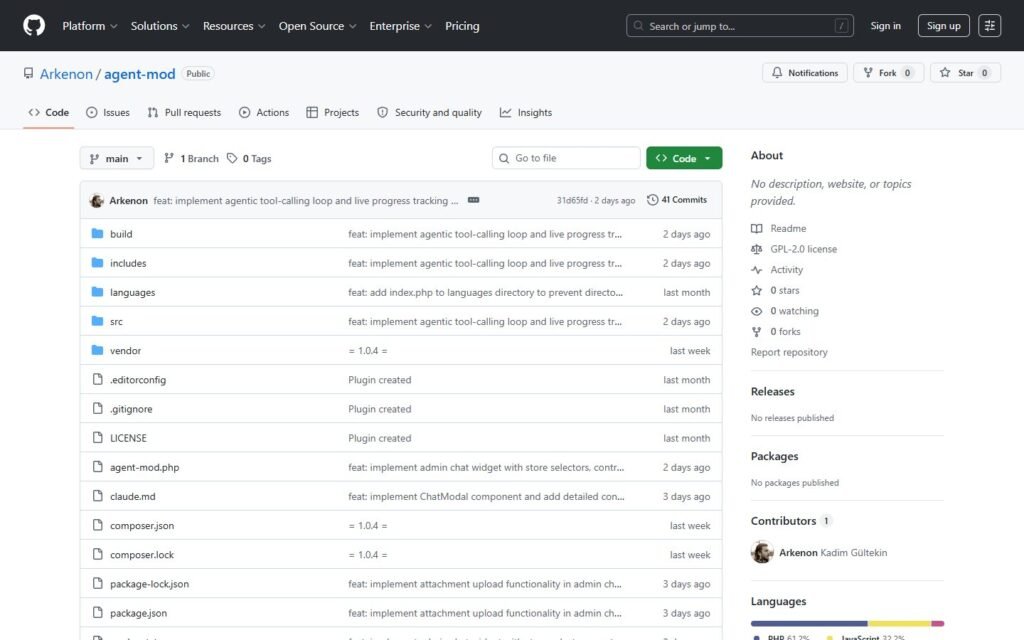
AgentMod is an open-source AI agent platform for WordPress. Its official documentation describes it as an orchestration layer built on the WordPress AI Client and Abilities API introduced with WordPress 7.0.
Rather than hard-coding every integration, AgentMod reads callable abilities registered by WordPress or compatible plugins. The documentation uses examples such as an ecommerce plugin exposing an order ability, a CRM exposing a contact ability, or a booking plugin exposing an appointment ability. The actual actions available on a site therefore depend on what its installed plugins register in the WordPress abilities registry.
AgentMod’s documented free features include:
- An admin chat widget opened from the WordPress Admin Bar
- A stateless, provider-agnostic orchestration engine
- Sequential and parallel ability calls
- A context selector that controls whether the agent can read site data
- Search and content-reading tools with defined limits
- A confirmation modal before database-changing actions
- An ability registry browser
- Markdown and code response rendering
- A “Create Draft” action for generated text
- PHP and JavaScript hooks for extending prompts, tools, lifecycle events, and the chat interface
Its official requirements currently include WordPress 7.0 or newer, PHP 7.4 or newer, and a provider plugin compatible with the WordPress AI Client. The reviewed repository lists stable version 1.0.6.
What AgentMod does well
It follows WordPress’s native agent direction
AgentMod is not trying to build a completely separate automation standard. It uses the native WordPress AI Client and abilities registry. That is attractive to developers who want future integrations to expose reusable, machine-callable actions through a common WordPress layer.
It is provider agnostic
AgentMod does not lock the site to one model vendor. According to its documentation, it can work with providers supported through compatible WordPress AI Client provider plugins, including OpenAI, Anthropic, and others.
It gives users control over write actions
When an agent requests a modifying action such as creating a post or sending an email, AgentMod displays an approval modal and does not execute the operation until the user confirms it. Its prompt directives also prohibit direct delete, erase, and trash operations.
That conservative approach is valuable for teams that want an agent to assist with WordPress while keeping a human approval step in wp-admin.
It exposes clear developer extension points
AgentMod documents filters and actions for prompt modification, ability execution, agent configuration, and interface customization. For a developer or agency building its own specialized WordPress agent experience, this extensibility may be more important than an out-of-the-box commercial workflow.
It limits potentially expensive content operations
The plugin documents limits of up to 20 post titles or excerpts per search, five full post bodies per content-processing cycle, and ten ability calls per message cycle. Those limits may reduce uncontrolled token consumption and excessive site processing.
What is Niwa AI?
Niwa AI starts with a different goal: helping a founder or business owner operate a WordPress or WooCommerce business through natural conversation.
As described on How Niwa Works, Niwa connects owner requests with real operational workflows. Depending on the configured capabilities, those workflows can include products, prices, inventory, coupons, pages, posts, research, reporting, customer assistance, lead handling, and conversion activity.
Niwa’s public positioning includes:
- WordPress and WooCommerce administration
- Telegram and WhatsApp owner communication
- Content creation, editing, and publishing
- SEO research and competitor monitoring
- Business and sales reporting
- Product discovery and customer assistance
- Lead and buyer-intent capture
- Cart recovery and follow-up workflows
- Product recommendations, bundles, and upsells
- Supplier and operational communication where configured
The emphasis is not merely on exposing technical tools. It is on completing business outcomes and reporting the result to the owner.
AgentMod vs Niwa AI comparison table
| Capability | AgentMod | Niwa AI |
|—|—|—|
| Primary role | Native WordPress ability orchestrator | Owner-facing WordPress business operator |
| Main interface | Chat widget inside wp-admin | Conversational operation, including Telegram and WhatsApp |
| AI provider approach | Provider agnostic through compatible WordPress AI Client providers | Managed according to the Niwa deployment and configured integrations |
| WordPress requirement | Currently requires WordPress 7.0+ | Depends on the supported Niwa installation and configuration |
| Available site actions | Depends on abilities registered by compatible plugins | Purpose-built WordPress and business workflows exposed by Niwa |
| Write approvals | Documented confirmation modal for modifying abilities | Supervised execution and approval-oriented workflows where appropriate |
| Destructive actions | Direct delete, erase, and trash actions are prohibited by documented directives | Safety controls depend on the specific task and configured capability |
| Content reading | Documented per-cycle limits | Research and publishing workflows designed around the requested outcome |
| Content publishing | Can create a draft when a suitable ability is available and approved | Full content research, creation, editing, and publishing workflows |
| WooCommerce operations | Possible only where relevant abilities are registered and compatible | Core part of Niwa’s business-operator positioning |
| Telegram administration | Not documented as a built-in interface | Yes |
| WhatsApp administration | Not documented as a built-in interface | Yes |
| Business reporting | Not a central documented feature | Yes |
| Competitor monitoring | Not a central documented feature | Yes |
| Lead capture | Depends on third-party abilities and custom orchestration | Built into Niwa’s customer and conversion positioning |
| Storefront customer assistance | Not the primary documented interface | Yes |
| Conversion workflows | Requires appropriate abilities and additional business logic | Product guidance, intent capture, follow-up, cart recovery, and related workflows |
| Best fit | Developers and agencies building on native WordPress AI infrastructure | Owners wanting one agent across operations, growth, and customer journeys |
This comparison reflects official information reviewed on July 18, 2026. Both products can evolve, so verify any deployment-critical feature before making a decision.
The key difference: available abilities vs completed business workflows
AgentMod’s central idea is elegant: inspect the WordPress abilities registry, make compatible actions available to the agent, and orchestrate them safely from an admin chat.
That architecture can become powerful as more plugins expose useful abilities. However, AgentMod cannot automatically create a complete business workflow from abilities that do not exist. If a WooCommerce, CRM, messaging, reporting, monitoring, or publishing action is not registered by a compatible plugin, the agent needs another integration or custom extension.
Niwa is organized around finished owner outcomes rather than the registry itself. A request might combine several steps:
- Research a competitor’s current positioning.
- Check whether that intent has already been covered on the site.
- Write and publish an SEO comparison.
- Report the published title and post ID to the owner in Telegram.
Or:
- Review sales and product signals.
- Identify stock, pricing, or conversion issues.
- Make an approved WooCommerce change.
- Notify the owner and continue monitoring the result.
The advantage is orchestration across technical and commercial context. The owner asks for the outcome, not an individual registry function.
WordPress and WooCommerce operations
AgentMod can call abilities exposed by compatible plugins, including multiple abilities in sequence or parallel. This makes it a flexible foundation, particularly when a site’s plugin stack has broad Abilities API support.
Its current documentation should not be read as a promise that every WooCommerce operation is available by default. The examples illustrate how registered abilities could work; the real inventory is visible in AgentMod’s ability browser and depends on the site.
Niwa is more suitable when the requirement is specifically commercial: manage products, stock, prices, categories or coupons; publish supporting pages; analyze store signals; and connect the work with customer or conversion activity.
For a clearer overview of that operating model, see How Niwa Works.
Telegram and WhatsApp administration
AgentMod’s built-in experience lives inside WordPress administration. That can be ideal for teams that already spend their day in wp-admin and want explicit confirmation before an action runs.
Its official documentation does not describe Telegram or WhatsApp as built-in owner administration channels.
Niwa is designed to let the owner communicate with the business from messaging apps. This matters when the founder wants to request a report, adjust a product, approve content, or check an operational issue from a phone without opening the WordPress dashboard.
The difference is less about chat technology and more about where the owner works. AgentMod brings the agent into wp-admin; Niwa brings website operations into the owner’s conversation.
Content publishing and competitor monitoring
AgentMod can render generated content and offers a “Create Draft” action. When a relevant creation ability is invoked, the user sees a confirmation step before the database changes. This is useful for assisted editorial work.
Niwa’s publishing workflow is broader. It can connect current research, search intent, duplicate-content checking, article creation, WordPress publishing, and publication verification in one task. Competitor monitoring can also feed future content and commercial decisions.
For growth teams, that distinction is important. Producing text is only one step. Reliable publishing also requires choosing a non-duplicate topic, checking current facts, using real internal links, applying SEO metadata, publishing successfully, and reporting the result.
Reporting, leads, and conversion workflows
AgentMod is an orchestration framework rather than a packaged reporting or conversion platform. It could potentially call relevant reporting, CRM, or commerce abilities where compatible plugins expose them. Its extensibility makes that a credible development path, but buyers should verify the exact abilities available on their stack.
Niwa treats business reporting and conversion activity as part of the operating loop. It can help the owner understand sales trends, demand signals, product opportunities, and competitor activity. On the website, it can answer buying questions, guide product selection, collect intent, and support follow-up workflows.
The page Turn Website Visitors Into Leads explains why this matters: useful website intelligence should lead to a next action, not remain trapped in a chat transcript.
When AgentMod is the better choice
AgentMod may be the better option when:
- You are already adopting WordPress 7.0’s native AI infrastructure.
- You want a provider-agnostic orchestration layer.
- Your plugins expose the abilities your workflow needs.
- You prefer the agent to operate inside wp-admin.
- Human confirmation before modifying actions is essential.
- You want developer hooks for a customized agent interface.
- You are an agency or technical team building a specialized stack.
- You want to inspect exactly which abilities are registered on the site.
AgentMod’s greatest strength is that it is a framework with clear boundaries. It does not pretend that every business action exists when no compatible ability has registered it.
When Niwa AI is the better choice
Niwa AI may be the better option when:
- You want a WordPress AI agent that is already oriented around business outcomes.
- You need WooCommerce operations rather than only generic ability orchestration.
- You want to administer the site from Telegram or WhatsApp.
- You need current research connected to SEO publishing.
- You want competitor monitoring and commercial reporting.
- You want the agent to assist customers as well as the site owner.
- You need lead capture, buyer-intent collection, follow-up, or cart-recovery workflows.
- You do not want to assemble messaging, reporting, publishing, commerce, and conversion logic from separate plugins.
Businesses can evaluate those workflows against their own store by booking a Niwa demo.
Can AgentMod and Niwa AI be complementary?
Potentially, yes. AgentMod is a native ability-orchestration layer, while Niwa is a broader business operator. As WordPress’s abilities ecosystem grows, a business agent could benefit from well-defined plugin abilities and transparent confirmation controls.
A specific integration should never be assumed without testing. However, the product roles are not inherently incompatible: AgentMod can help standardize callable WordPress actions, while Niwa can organize actions around owner, growth, reporting, and customer outcomes.
Final verdict
AgentMod is one of the more interesting examples of the new native WordPress AI architecture. Its provider independence, abilities browser, write confirmation, hard processing limits, admin chat, and extension hooks make it relevant to developers and agencies preparing for a WordPress-native agent ecosystem.
Niwa AI addresses the broader operating problem. It is built for owners who want one conversational agent to connect WordPress and WooCommerce work with messaging, content, competitor research, reports, leads, customer assistance, and conversions.
Choose AgentMod when you want a customizable agent orchestration framework inside wp-admin and your required actions are available through registered WordPress abilities.
Choose Niwa AI when you want a business-facing WordPress operator that can coordinate the website, the owner, content growth, commercial insight, and customer journeys.
Frequently asked questions
Is AgentMod a WordPress chatbot?
It includes an admin chat widget, but its purpose is broader than ordinary question answering. AgentMod orchestrates callable abilities registered through WordPress’s native AI infrastructure.
Does AgentMod work with WooCommerce?
It can use relevant abilities when compatible plugins register them. Its documentation gives ecommerce actions as examples of the ability model, but the actual WooCommerce operations available must be verified in the site’s abilities registry.
Does AgentMod require WordPress 7.0?
Yes. The reviewed official repository lists WordPress 7.0 or newer, PHP 7.4 or newer, and a compatible WordPress AI Client provider plugin as requirements.
Can AgentMod publish posts?
Its documentation describes content tools, a “Create Draft” action, and confirmation before a modifying ability such as create_post executes. Availability still depends on the relevant ability and configuration.
Does AgentMod support Telegram or WhatsApp administration?
Those channels are not documented as built-in AgentMod interfaces. Its documented user interface is the chat panel inside WordPress administration.
Which product is better for developers?
AgentMod is attractive for developers who want provider independence, native WordPress abilities, and extension hooks. Niwa is more appropriate when the desired result is an already coordinated owner and business workflow rather than a framework to assemble.
Which product is better for content marketing?
Niwa is the stronger fit for research-to-publication workflows, competitor monitoring, internal-link validation, SEO metadata, publishing, and verification. AgentMod can assist with content and drafts but is not positioned as a complete competitor-monitoring and SEO publishing system.
Which product is better for leads and conversions?
Niwa is specifically designed to connect customer conversations with product guidance, intent capture, follow-up, and conversion workflows. AgentMod would need the necessary third-party abilities and additional orchestration to cover those outcomes.
Sources reviewed
AgentMod facts were checked against the project’s official GitHub repository and plugin readme. Niwa capabilities and internal links were checked against current published pages on niwachat.com. No unverified third-party feature claims were used.