

How to Calculate Cost per Lead
Calculate cost per lead using a clear spend scope and genuine leads. Compare qualified CPL, weighted totals and an affordable lead-cost limit.
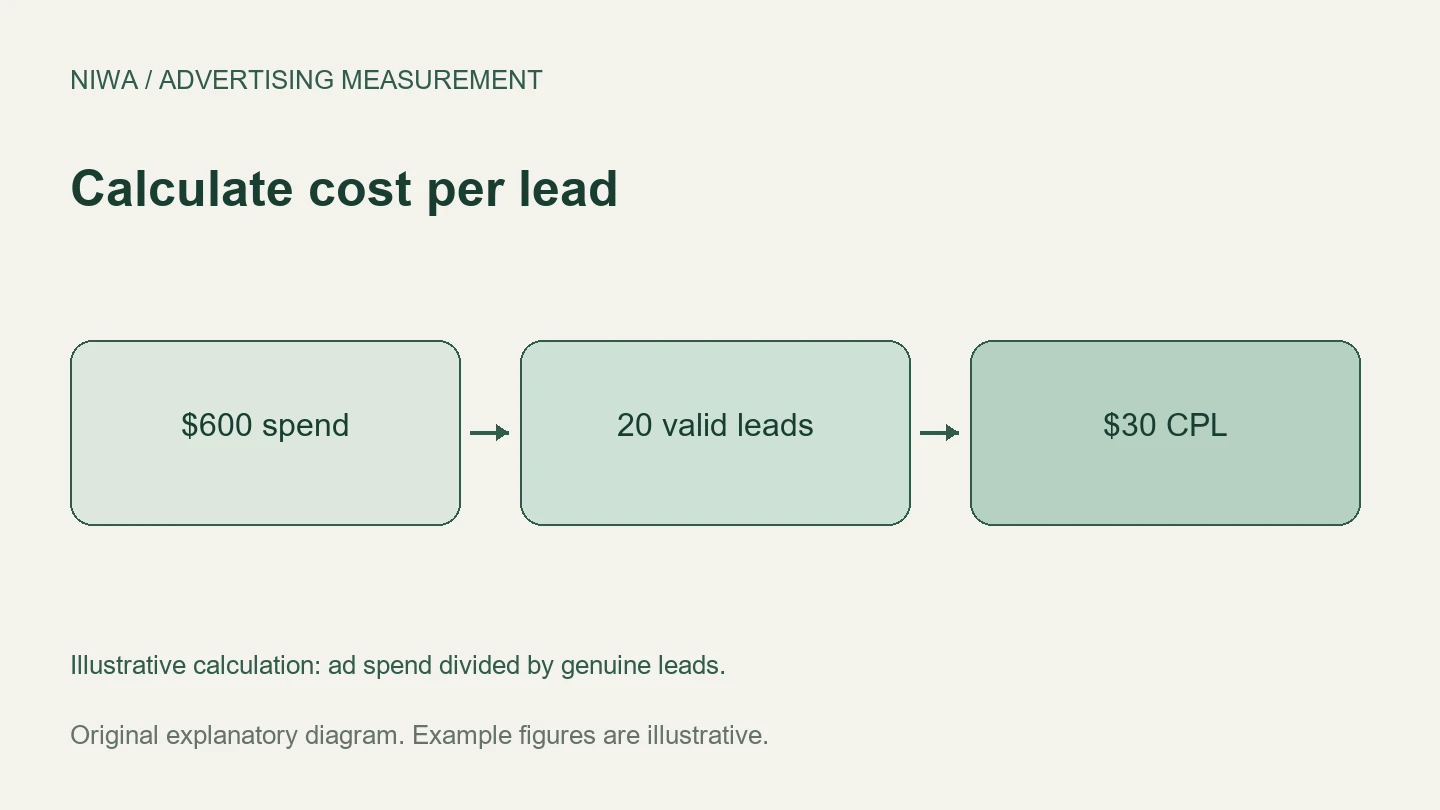
Calculate cost per lead by dividing the advertising spend assigned to a campaign by the number of genuine leads it produced. If a campaign spends $600 and generates 20 valid enquiries, its advertising cost per lead is $30. Use the same period, lead definition and cost scope on both sides of the calculation.
Niwa can help visitors on your WordPress site clarify what they need and reach an enquiry or booking step. Measure those genuine outcomes, not every conversation. How Niwa works shows the assistance that can sit between an ad visit and a useful customer action.
Choose which cost you are reporting
For advertising CPL, use media spend from the relevant campaign or group of campaigns. For a broader acquisition-workflow cost per lead, you might include creative production, agency work and allocated software costs. That is a different measure, so label it clearly.
Do not compare one channel’s media-only cost with another channel’s fully loaded cost. It makes the comparison look precise while answering two different questions.
Use one currency. If costs come from accounts in different currencies, apply and document a consistent conversion basis before combining them. A currency mismatch cannot be fixed by dividing the totals.
Define a lead before counting it
A valid lead might be a contactable person asking about a service you actually provide. Exclude spam, failed submissions, internal tests and duplicates from that definition. Keep the original submission count available so filtering is transparent.
Then define a qualified lead separately. Perhaps the person needs a service in your area and has a suitable timeframe. Use the business context and an appropriate review process, not a list of English or Serbian words to decide quality.
| Measure | Calculation |
|---|---|
| Raw submission cost | Ad spend / all successful submissions |
| Genuine CPL | Ad spend / valid, deduplicated leads |
| Qualified CPL | Ad spend / leads meeting qualification criteria |
| Ad cost per customer | Ad spend / paying customers |
Those denominators serve different decisions. Preserve them instead of quietly changing the lead definition when a report looks expensive.
Work through the numbers
Suppose an illustrative campaign spends $600. It receives 30 submissions, but 10 are spam or duplicates, leaving 20 genuine leads. Eight meet your qualification criteria, and four eventually become paying customers.
The raw submission cost is $20. Genuine CPL is $30. Qualified CPL is $75. Advertising cost per customer is $150. Each calculation is correct, but only when its label is correct.
If there are no valid leads, report “no valid leads” with the spend. Do not show a zero-dollar CPL. Division by zero is undefined, and a zero cost would imply the opposite of what happened.
Use a weighted calculation for combined campaigns
Campaign A spends $200 for 10 valid leads, giving a $20 CPL. Campaign B spends $800 for 20 valid leads, giving a $40 CPL. Combined CPL is $1,000 divided by 30, or about $33.33.
The simple average of $20 and $40 is $30 and does not represent the combined spend and leads. Sum the costs and valid leads first, then divide. The same principle applies when combining weeks, sources or ad variations.
Make sure the underlying campaigns do not count the same person twice. A duplicate that appears once in each platform is still a duplicate in your combined business ledger.
Connect affordable CPL to customer economics
There is no universal good CPL. A $50 enquiry may be affordable for a high-margin service and too expensive for a low-margin purchase. Compare the lead cost with the probability of becoming a customer and the contribution available to acquire that customer.
For an illustrative planning calculation, assume you can spend $100 to acquire a customer and one in five genuine leads becomes a customer. An allowable CPL is $100 multiplied by 20%, or $20. That customer acquisition allowance should already leave room for fulfilment, overhead and the return the business requires.
Use observed, mature close rates rather than optimistic guesses. If new leads have not had time to buy, their current close rate understates what may happen later. Keep cohort calculations separate from a cash-received report for this week.
Make sure the reported lead really arrived
Test the form or booking process. A submit-button click is not a confirmed enquiry. Check the stored record, the source label and the team’s receipt of the lead. Google documents offline outcome measurement for campaigns whose sales happen later, but that connection must be configured separately.
Prepare Niwa with accurate services, availability and product data using the setup guidance. A useful assisted conversation can move a prospect forward; the enquiry and payment records tell you what that movement was worth.
Existing WordPress owners can use the standalone Niwa plugin. Niwa Business is USD 150 for a custom WordPress website or migration, hosting, maintenance and AI adaptation. Contact Niwa with your website and lead definition to discuss the customer workflow behind your CPL calculation.

