

How to Calculate Return on Ad Spend
Calculate ROAS from attributed revenue and ad spend. Choose a consistent revenue basis, account for refunds and use margin to assess profitability.
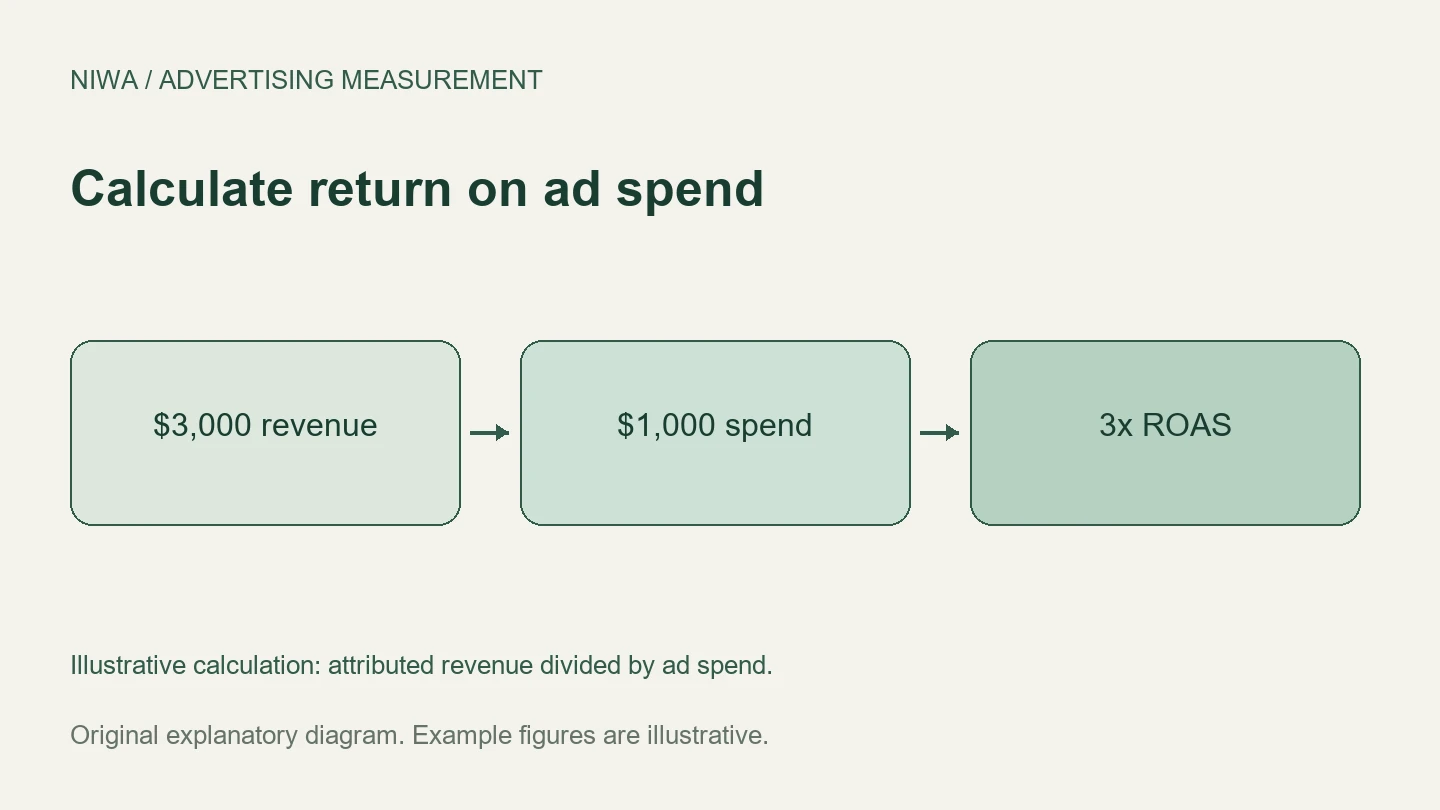
Calculate return on ad spend by dividing the revenue attributed to advertising by the corresponding ad spend. If ads cost $1,000 and produce $3,000 in attributed revenue, ROAS is 3, usually written as 3x or 300%. This measures revenue per advertising dollar. It does not show profit on its own.
On a WordPress business website, Niwa can help customers understand products or services and move toward a purchase or booking. Measure the resulting paid outcome using your order and sales records. See how Niwa works to identify the assisted journey; do not count the assistant’s conversation volume as advertising revenue.
Match the revenue and spend scope
Use revenue credited to the campaign or group of campaigns you are assessing. Divide by that same group’s ad spend. If you divide all store revenue by paid-media cost, call the result a blended revenue-to-spend measure. It includes other sources and is not a campaign-specific ROAS.
Keep currency and dates consistent. If a campaign uses euros and your store reports dollars, convert on a documented basis before calculating. Also decide whether the report follows the ad interaction date, the sale date or a cohort of leads. Those views serve different jobs.
An immature lead cohort can show low ROAS simply because sales have not closed yet. A payment report can show strong revenue from leads acquired months ago. Keep both views available rather than silently switching between them.
Define what revenue includes
Choose whether the measure includes tax, shipping charges and discounts. For business profitability decisions, a consistent net sales basis often gives a clearer view, but the important first step is to label the calculation.
Deduct refunds under a documented policy. An order that was later refunded should not remain full-value success in a final campaign evaluation. Keep gross attributed sales and net attributed sales as separate fields if both are useful.
Google’s ecommerce measurement guide explains purchase value, currency and transaction identity. An event value is only useful when it corresponds to the real transaction you intend to measure.
Calculate a simple example
| Item | Illustrative amount |
|---|---|
| Ad spend | $1,000 |
| Gross attributed sales | $3,200 |
| Refunds allocated to those sales | $200 |
| Net attributed sales | $3,000 |
Gross ROAS is $3,200 / $1,000 = 3.2x. Net ROAS is $3,000 / $1,000 = 3x. Neither number is a profit figure. The example contains no Niwa customer performance data.
For combined campaigns, sum attributed revenue and spend before dividing. Do not take the simple average of campaign ROAS figures unless their spend weights are equal. A small campaign with high ROAS should not carry the same weight as a large campaign spending much more.
Use contribution margin to judge the result
Suppose the $3,000 in net sales leaves a 40% contribution margin before advertising after product and relevant variable fulfilment costs. That is $1,200 available before ads. Subtract $1,000 advertising cost and $200 remains before any additional overhead or uncounted costs.
In that simplified model, break-even ROAS is 1 / 0.40 = 2.5x. At 2.5x, advertising uses all the contribution available under those assumptions. It does not leave a profit allowance or cover omitted costs.
If margin falls to 25%, the same simplified break-even ROAS becomes 4x. This is why a universal claim that 3x is profitable is unreliable. Use the actual margins, returns and service-delivery costs of your business.
Distinguish ROAS from ROI and acquisition cost
ROAS relates attributed revenue to advertising spend. ROI requires a defined investment cost and the return after the relevant costs. Advertising cost per paying customer divides spend by customers rather than revenue.
A business can have high ROAS from repeat customers while acquiring few new customers. It can also have strong revenue but poor margin because discounts or fulfilment are expensive. Keep new-customer counts and contribution alongside the revenue measure.
Check attribution before trusting the total
Two platforms may claim the same sale. Adding their attributed revenue can exceed the revenue your business actually received. Keep a consistent business-ledger attribution rule alongside the platform reports you use to operate campaigns.
WooCommerce order attribution can help connect source information to placed orders, but its current-session limits matter. Missing data and cross-device journeys require careful interpretation rather than guessed sources.
Google’s target ROAS documentation explains the use of conversion values in bidding. A bidding target is an instruction to the platform, not a guarantee that your business will receive profitable revenue.
Improve the customer journey with a measurable outcome
Prepare Niwa with accurate products, services and next steps using the setup guidance. Then evaluate assisted visitors using confirmed sales and consistent cost definitions.
Existing WordPress owners can install the standalone plugin. Niwa Business is USD 150 for a custom WordPress website or migration, hosting, maintenance and AI adaptation. Contact Niwa with your website and sales process to discuss the customer workflow you want to measure.

