Post-Purchase AI Support for Ecommerce: Keep Customers Informed After Checkout
Learn how AI post-purchase support answers order tracking, returns, delivery and repeat-purchase questions so your team protects trust after checkout.
Most ecommerce teams treat the order confirmation page as the finish line. For the customer, it is the beginning of a new set of questions: “Where is my order?”, “Can I change the address?”, “What happens if the size is wrong?”, “When should I reorder?”, and “Can I talk to someone if this gets delayed?”
Post-purchase AI support turns that nervous gap after checkout into a managed customer experience. Instead of waiting for tickets to pile up, an AI sales and support agent can answer routine questions, explain the next step, collect context, and hand the conversation to a human when the issue needs judgement.
This matters because customer expectations are moving faster than most support teams can hire. Zendesk’s customer experience research reports that 74% of consumers now expect customer service to be available 24/7 because of AI. Salesforce’s State of the Connected Customer also highlights a trust gap around AI: 72% of customers say it is important to know when they are communicating with an AI agent.
What post-purchase AI support actually handles
A useful post-purchase AI agent is not just an FAQ box. It should understand the moment a customer is in and respond with the next useful action.
- Order tracking: “Where is my order?” should not become a manual ticket if the shipping status is already available.
- Delivery changes: The agent can collect the new address, phone number, or preferred delivery window before escalation.
- Returns and exchanges: It can explain the return policy, ask for the order number, and route the customer to the correct flow.
- Product usage questions: For cosmetics, supplements, electronics, apparel, or premium food products, the support moment often decides whether the buyer becomes a repeat customer.
- Repeat-purchase prompts: When a customer asks about usage, refills, accessories, or compatibility, the agent can recommend the next product naturally.
The goal is not to hide humans. The goal is to keep simple questions instant and make the human handoff cleaner when the customer genuinely needs help.
Why the after-checkout moment affects revenue
A customer who just paid is paying attention. They are checking the email confirmation, looking for delivery details, and deciding whether the store feels reliable. If the next interaction is slow, vague, or confusing, the brand loses the emotional benefit of the sale.
Many stores only measure support as a cost center. That misses the commercial point. Post-purchase support influences:
- Repeat purchase rate: A customer who gets fast, helpful answers has fewer reasons to try a competitor next time.
- Refund pressure: Clear return and exchange guidance reduces panic, repeated emails, and angry messages.
- Review quality: Delivery issues happen, but silent delivery issues create one-star reviews.
- Team capacity: Every automated order-status answer protects your team’s time for complex cases.
- Upsell timing: The right accessory or refill suggestion after purchase feels helpful when it is tied to the customer’s actual order.
The sale is not finished when checkout succeeds. It is finished when the customer feels safe about what happens next.
A practical AI support flow for online stores
Here is a simple flow an ecommerce store can deploy without turning the whole support operation upside down.
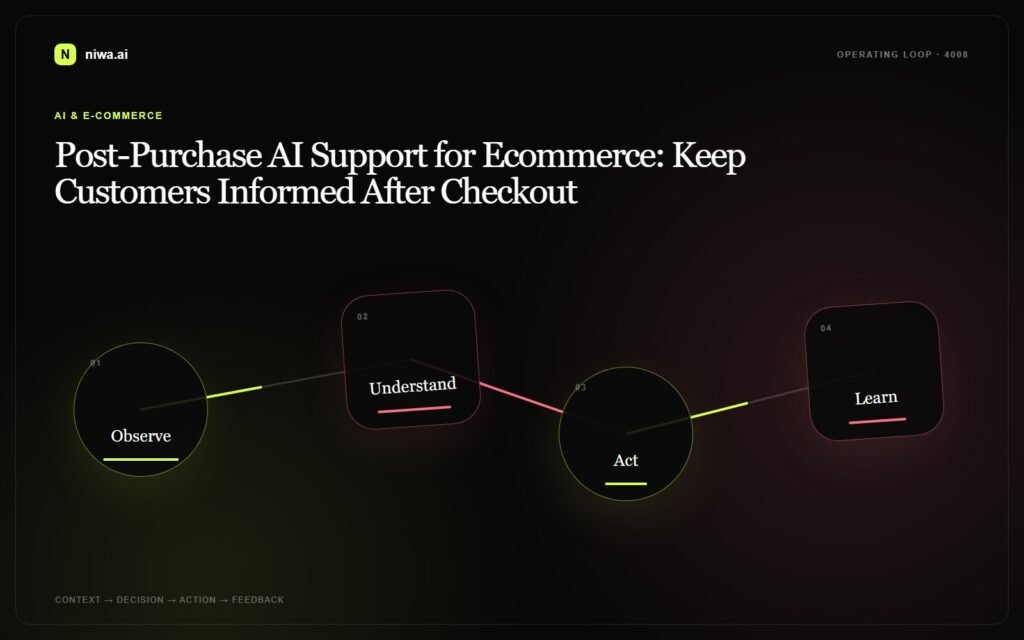
- Recognize the customer’s intent: The agent separates “track my order” from “change my order”, “return my order”, “buy again”, and “speak to someone”.
- Ask for the minimum useful detail: Order number, email, product name, or delivery postcode should be enough to start.
- Answer from approved information: Shipping times, return rules, warranty details, payment methods, and product care instructions should come from the store’s own source of truth.
- Escalate with context: If a human needs to step in, the agent should pass the summary, customer details, and the requested outcome instead of forcing the customer to repeat everything.
- Close with the next step: The customer should leave knowing what will happen, when, and where to continue the conversation.
This is where Niwa AI fits naturally for ecommerce and business sites. Niwa is designed to guide visitors, answer customers, track deliveries, help with store operations, and move conversations toward action. If you want to see the broader flow, read How Niwa Works.
Where AI should hand off to a human
Good automation has boundaries. Customers should never feel trapped inside a bot when the issue is sensitive, emotional, or commercially important.
- Payment disputes: Refund disagreements, duplicate charges, and chargeback warnings need human ownership.
- Damaged or missing orders: The AI can collect photos and order details, but a person should approve the resolution path.
- VIP or wholesale buyers: High-value customers should be routed quickly to the right team member.
- Medical, legal, or regulated product claims: The agent should stay inside approved wording and escalate anything risky.
- Angry customers: Speed matters, but empathy and judgement matter more.
The handoff is part of the experience. A strong AI agent says what it can do, what it cannot do, and what will happen next. That transparency supports the trust expectations Salesforce highlights around AI-assisted customer conversations.
How to measure whether post-purchase AI is working
Do not judge the system only by how many chats it handles. Measure whether it improves the parts of the business that matter.
- First response time: How quickly does the customer get a useful answer?
- Ticket deflection: Which repetitive questions no longer reach the support inbox?
- Escalation quality: Are human agents receiving cleaner summaries and fewer “what is your order number?” loops?
- Repeat purchase rate: Are supported customers coming back more often?
- Refund and return reasons: Are policy misunderstandings, sizing confusion, and delivery anxiety becoming less common?
- Customer sentiment: Do reviews and follow-up messages mention faster help?
Start with a narrow use case, such as order tracking and return policy questions. Once the answers are reliable, expand into product education, replenishment reminders, and personalized recommendations. If your main bottleneck is before checkout instead, the related guide on AI customer support for ecommerce trust is a useful next read.
The best post-purchase AI feels like an operator, not a pop-up
Cheap chat widgets wait for the customer to complain. A real AI operator helps the store act sooner. It knows which questions deserve an instant answer, which ones should become a task, and which ones should go directly to a person.
For store owners, that means fewer repetitive messages, cleaner handoffs, and more chances to turn a support moment into a repeat sale. For customers, it means they do not have to wonder whether the brand disappeared after taking payment.
If you want to see how an AI support and sales agent could work on your own website, Book a Niwa AI demo. We can walk through your post-purchase questions, handoff rules, lead capture paths, and the customer moments where automation should protect trust instead of damaging it.
Use post-purchase questions to improve product success
Post-purchase support can help customers succeed with the product, not only track an order or open a return. Setup guidance, care instructions, compatible accessories, replacement parts, and sensible replenishment timing can reduce frustration when they are tied to the product and the customer’s actual question.
Keep recommendations relevant: a care kit after a maintenance question can be useful; an unrelated promotion during a damaged-item complaint is not. Sensitive issues should move to a human with the order, evidence requested, customer mood, and next decision already summarized.
Review recurring questions for operational causes such as confusing instructions, weak packaging, late carrier updates, or product pages that set the wrong expectation. Fixing those sources is part of the support workflow.