AI Website Chat and WhatsApp for Ecommerce: Keep Buyer Conversations Connected
Connect website chat, WhatsApp follow-up, and human handoff so ecommerce shoppers get faster answers without repeating themselves.
Most ecommerce teams treat website chat, WhatsApp, email, and social DMs as separate support channels. Customers do not. They ask a product question on the site, leave to compare prices, come back from mobile, and expect the next conversation to remember what they already said.
That is why an AI sales and support agent should not be “just a chatbot widget.” For ecommerce, the real value is a connected conversation layer: website chat for high-intent browsing, WhatsApp for follow-up and repeat questions, and a clean handoff to the right human, CRM, or order workflow when automation should stop.
This guide explains how to use AI across website chat and WhatsApp without creating a messy support maze.
Why channel switching costs ecommerce stores sales
A shopper rarely abandons a cart because of one single problem. More often, a few small doubts stack together:
- “Will this fit my use case?”
- “How fast can it arrive?”
- “Can I return it if it is wrong?”
- “Is this bundle actually worth it?”
- “Can I pay the way I prefer?”
If the shopper asks one of these questions on live chat and gets told to email support, the momentum drops. If they start a WhatsApp thread and the agent cannot see what product they were viewing, the conversation becomes repetitive. Every repeated explanation adds friction.
Baymard Institute calculates the average documented online shopping cart abandonment rate at 70.22%. That does not mean chat alone fixes checkout, but it does show how much money sits inside unfinished purchase journeys. Faster, more contextual conversations are one practical way to reduce avoidable drop-off.
Website chat is best for live buying intent
Website chat should be optimized for moments when the shopper is actively comparing, filtering, or hesitating. The AI assistant can see the page context, product category, cart value, and the question being asked at the exact point of intent.
Good website chat use cases include:
- Product matching: “Which size should I choose?” or “Which plan is right for a small clinic?”
- Objection handling: shipping time, warranty, returns, compatibility, setup, and price concerns.
- Bundle recommendations: explaining why two products work better together.
- Checkout rescue: answering the final question before the shopper leaves.
- Lead qualification: collecting business type, budget range, timeline, and urgency before a sales call.
The key is not to make the bot talk more. The key is to make it ask fewer, better questions and move the buyer to the next useful step.
WhatsApp is best for follow-up, continuity, and repeat conversations
WhatsApp is not a replacement for the website. It is a stronger follow-up channel when the buyer has already shown intent but is not ready to complete the action in that session.
The official WhatsApp Business Platform is built for business messaging APIs, which makes it relevant for stores that want structured customer conversations rather than manual one-off replies. For ecommerce, the important part is not simply “being on WhatsApp.” It is deciding which conversations deserve to continue there.
Practical WhatsApp follow-up examples:
- A shopper asks about sizing and wants the answer saved for later.
- A customer needs delivery status but does not want to open a ticket.
- A B2B lead wants pricing details after comparing a service page.
- A returning customer asks whether a previous order can be reordered or upgraded.
- A high-value cart needs a human callback or demo scheduling step.
Website chat handles the immediate buying moment. WhatsApp keeps the conversation alive when the buyer leaves the site.
The mistake: adding more channels without one conversation memory
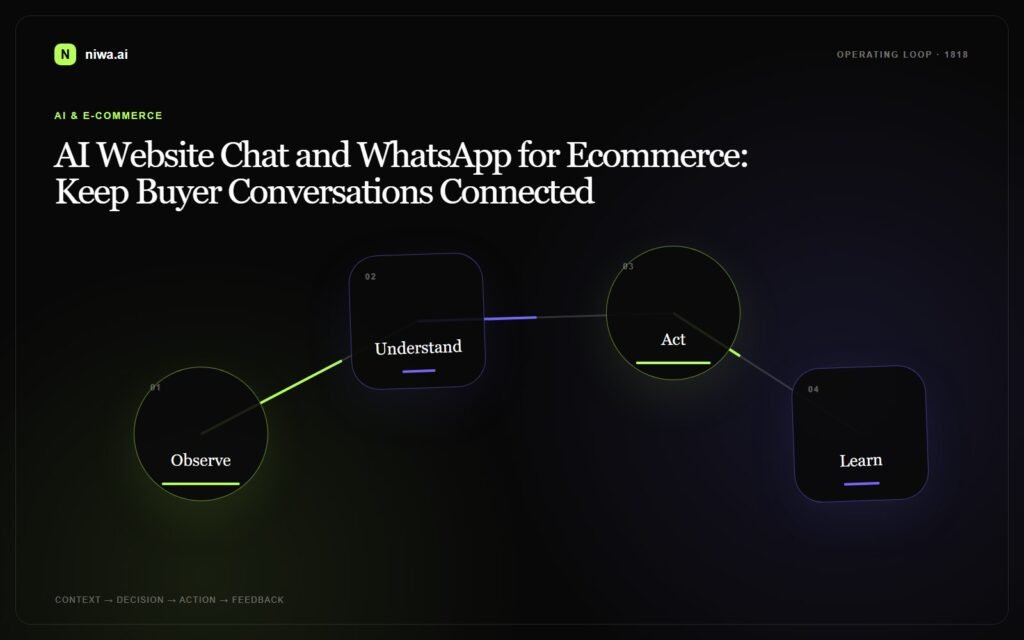
The common failure is to add a chat widget, a WhatsApp button, a contact form, and a support inbox without deciding how information moves between them. The customer experiences that as a reset.
For example, imagine a shopper asks on-site chat whether a product works for a specific skin type, then switches to WhatsApp to ask about delivery. If the WhatsApp conversation starts with “How can we help?” and no context, the store has technically offered another channel but practically lost continuity.
A better AI setup stores the useful context:
- the product or service page viewed;
- the last question asked;
- the cart or quote stage;
- the shopper’s stated concern;
- whether the conversation should stay automated or go to a human.
That context lets the next channel feel like a continuation, not a new ticket.
How Niwa AI should route conversations
A practical ecommerce AI agent needs routing rules. Without them, automation either interrupts too early or keeps talking when a human should take over.
Use a simple routing model:
- Answer instantly: FAQs, delivery estimates, return policy, compatibility, simple product comparisons, and order status questions.
- Recommend: product finder questions, bundles, accessories, plan selection, and category navigation.
- Capture lead data: B2B inquiries, custom quotes, implementation requests, and demo interest.
- Move to WhatsApp: follow-up conversations, saved recommendations, delivery updates, and longer decision cycles.
- Escalate to a human: angry customers, payment problems, legal questions, sensitive complaints, high-value deals, or anything outside approved knowledge.
This is where an AI assistant becomes more than a support cost saver. It becomes a sales operations layer that knows when to answer, when to recommend, when to collect data, and when to stop.
What a good website chat to WhatsApp flow looks like
Here is a clean example for an ecommerce store selling higher-consideration products:
- The shopper opens a product page and asks whether the product fits their use case.
- Niwa AI asks one clarifying question, then recommends the best option and one alternative.
- The shopper says they need to check with a partner before buying.
- Niwa AI offers to send the recommendation summary through WhatsApp.
- The WhatsApp message includes the product link, the reason for the recommendation, and a clear next step.
- If the shopper replies with a buying signal, Niwa AI either answers or routes the lead to a human sales rep.
Notice what is missing: no generic “hello,” no forced ticket form, no repeated product discovery, and no dead-end button that only says “contact us.”
What to measure before you call it successful
Do not judge AI chat only by the number of conversations. A bot can create a lot of noise and still fail commercially.
Track metrics that connect conversations to outcomes:
- Conversation-to-product-click rate: how often chat sends shoppers to relevant products or service pages.
- Qualified lead rate: how many conversations include budget, timeline, business type, or buying intent.
- Human handoff quality: whether the sales or support team receives context instead of a vague “please help” message.
- Cart recovery influence: whether checkout questions get answered before the customer leaves.
- Repeat question reduction: whether the AI reduces repetitive support without lowering customer confidence.
The goal is not to automate every message. The goal is to automate the right parts of the buying journey and make the rest easier for humans.
Implementation checklist for ecommerce teams
Before connecting website chat and WhatsApp, define the operating rules:
- Which product, pricing, shipping, and policy information is approved for AI answers?
- Which questions must always be escalated?
- What context should be passed from website chat into WhatsApp or CRM?
- What is the fallback when the AI is not confident?
- Which CTA should each conversation type push toward: product page, checkout, quote request, or demo?
If those rules are clear, AI becomes a reliable assistant. If they are not, it becomes another channel the team has to manage.
Final takeaway
Website chat captures the buying moment. WhatsApp extends the relationship after the shopper leaves the site. The commercial advantage comes from connecting the two with memory, routing, and clear handoff rules.
Niwa AI is built for exactly that kind of sales and support flow: answer common questions instantly, recommend the right next step, qualify serious leads, and escalate when a human should take over.
Book a Niwa AI demo: If you want an AI agent that connects website chat, ecommerce support, lead qualification, and follow-up conversations, request closed beta access to Niwa AI.