AI CRM Handoff for Ecommerce: Turn Chat Conversations Into Follow-Up Revenue
AI CRM handoff turns ecommerce chat into structured follow-up for sales, support, checkout recovery, and post-purchase retention instead of forgotten transcripts.
Most ecommerce chat projects fail at the same quiet point: the conversation looks useful, but nothing happens after it ends. A shopper asks about sizing, delivery, a bundle, a return window, or a B2B bulk order. The answer is good. The buyer is interested. Then the context disappears into a chat transcript nobody opens again.
That is why AI chat should not be treated as a floating FAQ widget. For a serious store, it needs a clean CRM handoff: the moment where a buyer conversation becomes a follow-up task, customer record, support ticket, sales opportunity, or post-purchase note your team can actually use.
This article explains how an AI CRM handoff works for ecommerce, which conversations should trigger it, and how Niwa AI can help teams turn live chat intent into revenue instead of letting it die in the inbox.
What “AI CRM handoff” means in an ecommerce store
An AI CRM handoff is the structured transfer of useful chat context into the system where your team manages customers and follow-up. That system might be a CRM, helpdesk, order dashboard, email platform, or sales pipeline. The important part is not the software name. The important part is that the next human or automation step receives the right buyer context.
A good handoff usually includes:
- Who the shopper is: name, email, phone, account status, or order number when available.
- What they wanted: product, category, size, use case, budget, urgency, delivery location, or support issue.
- Where they are in the journey: first-time visitor, cart shopper, returning customer, post-purchase customer, wholesale lead, or support case.
- What should happen next: send quote, recommend product, create ticket, follow up tomorrow, offer demo, escalate to support, or assign to sales.
- Conversation summary: a short, human-readable note instead of a raw transcript wall.
Without that structure, your team has to reconstruct intent manually. With it, the AI agent becomes a front-line revenue filter.
Why the handoff matters more than the first answer
Fast answers matter, but ecommerce revenue is often won after the first answer. A buyer may need a reminder, a comparison, a bundle suggestion, a payment clarification, or confidence that the product fits their situation. If the chat agent answers once and forgets the shopper, you lose the compounding value of the interaction.
Customer expectations are also moving quickly. Zendesk’s CX Trends 2026 report states that 74% of consumers now expect customer service to be available 24/7, and 88% expect faster response times than they did a year ago. That creates a practical problem: teams need AI speed, but they also need human-grade continuity when the issue becomes valuable, sensitive, or complex.
The CRM handoff is the bridge between those two needs. It lets AI handle the immediate conversation, then passes the right cases into a workflow your team can trust.
Which ecommerce conversations should trigger a CRM handoff?
Not every chat needs a human follow-up. If a shopper asks “What are your shipping options?” and gets a clear answer, the AI can finish the job. The handoff should trigger when the conversation contains commercial intent, risk, or customer-specific context.
1. High-intent product questions
Examples include “Which model is best for a small salon?”, “Do you have this in a larger size?”, “Can I use this for sensitive skin?”, or “What should I buy for a team of ten?” These are not generic FAQ questions. They are buying signals. The AI can answer, recommend, and then save the intent in the CRM so sales or retention campaigns can follow up with the right offer.
2. Cart hesitation and checkout friction
Baymard Institute’s cart abandonment benchmark shows an average documented online shopping cart abandonment rate of 70.22%. That does not mean chat alone fixes every abandoned cart, but it does show how much value sits inside late-stage hesitation. If a shopper asks about delivery cost, payment options, warranty, returns, or discount eligibility while items are in cart, the conversation should be saved as a high-intent event.
For a related checkout angle, read Niwa’s guide on abandoned cart recovery with AI chat.
3. B2B and bulk order leads
Some ecommerce stores sell to both consumers and businesses. A message like “We need 40 units for our office” or “Can you invoice a company?” should not be buried in a general chat history. The AI should collect the basics, qualify the lead, and create a clean CRM note for a human follow-up.
Niwa has a deeper article on AI lead qualification for ecommerce if your store receives mixed support and sales inquiries.
4. Post-purchase issues that can affect repeat revenue
“Where is my order?” is operational. “The product arrived but I am not sure it fits” is retention. “I bought the wrong version” is an exchange opportunity. Post-purchase chats should feed a customer record when they reveal satisfaction risk, replacement potential, subscription interest, or review risk.
For retention workflows, see post-purchase AI support for ecommerce.
What a useful AI handoff should look like
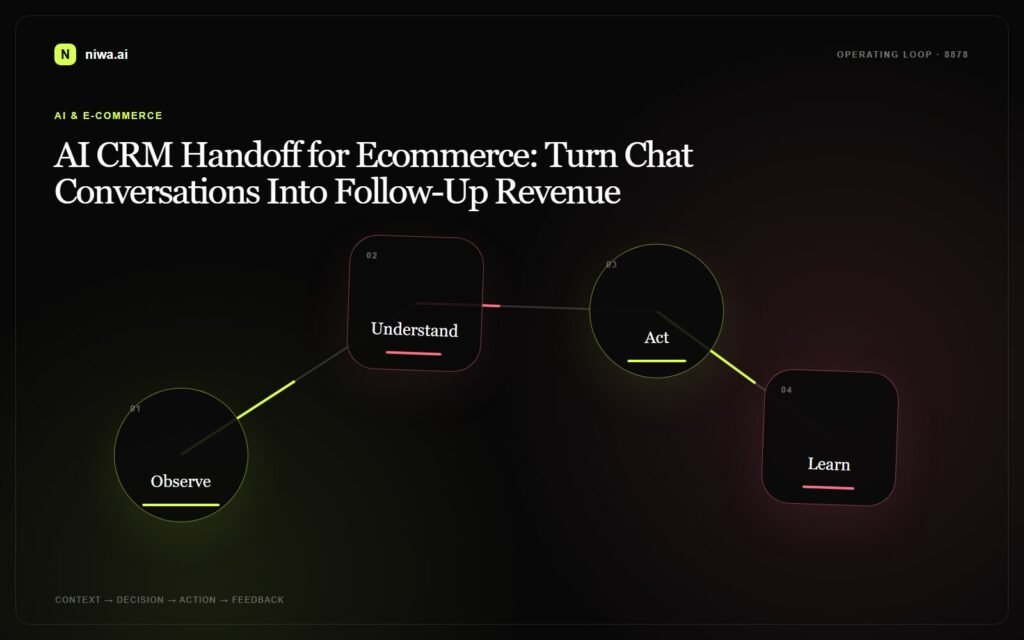
The biggest mistake is sending every transcript to the team and calling it automation. That creates more noise, not more revenue. A useful handoff is short, structured, and action-oriented.
Here is a practical example:
Customer intent: Interested in premium office chairs for a 12-person team. Asked about ergonomic differences and company invoice. Budget likely mid-to-high. Wants delivery next week. Recommended Model B and asked for email. Next action: sales follow-up with team quote and delivery confirmation.
That note is far more useful than a long transcript. The team immediately understands what matters, why the buyer is valuable, and what to do next.
How Niwa AI can decide when to escalate
Niwa AI is designed for sales, support, and conversion conversations on ecommerce and business websites. In a CRM handoff workflow, the agent can be configured to recognize patterns such as:
- Commercial keywords: quote, bulk, invoice, wholesale, discount, subscription, business, partner, urgent.
- Product-fit uncertainty: size, compatibility, comparison, “which one should I choose?”, “is this good for my use case?”
- Checkout risk: shipping cost, payment failed, return policy, delivery date, coupon, trust concern.
- Customer-specific support: order number, damaged item, exchange, refund, missing package, account issue.
- High-value signals: multiple products, repeat visit, cart value threshold, B2B quantity, or request for a human.
The goal is not to escalate everything. The goal is to escalate the conversations where follow-up has a real business outcome: saved order, larger basket, retained customer, qualified lead, or faster support resolution.
A simple CRM handoff workflow for ecommerce teams
If you are planning this workflow, keep it simple first. A strong version-one setup can follow five steps.
- Define handoff triggers. Choose 5 to 10 situations that deserve follow-up, such as bulk orders, cart hesitation, product-fit questions, refund risk, and human requests.
- Collect only necessary data. Ask for email, order number, product interest, urgency, and preferred contact channel only when it supports the next step.
- Summarize the conversation. Save a short note with intent, context, recommended product or action, and buyer urgency.
- Route by outcome. Sales leads go to sales. Returns go to support. Product questions can go to a product specialist or follow-up automation.
- Measure follow-up results. Track recovered carts, qualified leads, average response time, resolution speed, repeat purchases, and conversations that required human help.
CRM platforms exist to keep customer activity in one place. HubSpot describes CRM software as a way for businesses to organize customer relationships and track leads on a centralized platform, which is exactly why raw chat history should become structured customer context rather than a forgotten conversation log. See HubSpot’s CRM overview here: HubSpot CRM.
Common mistake: making the human handoff too late
A lot of stores only escalate when the AI fails. That is backwards. The best handoff is not just a failure path; it is a value path.
If a customer says, “I need this for an event next Friday,” the AI may be able to answer shipping questions. But the business may still want a follow-up because urgency creates both conversion opportunity and risk. If a buyer asks for five units instead of one, the AI may answer the product question, but the team may want to offer a bundle or business discount. If a returning customer is frustrated, the AI may solve the issue, but retention might still deserve a human touch.
Escalation should happen when the conversation becomes valuable, not only when the AI becomes confused.
What to measure after launching AI-to-CRM handoff
Start with metrics that connect chat activity to business outcomes:
- Qualified conversations: how many chats contain real buying or support intent.
- Handoff rate: how often AI escalates to CRM, support, or sales.
- Follow-up speed: how quickly the team acts on qualified handoffs.
- Recovered revenue: orders saved after checkout or product-fit conversations.
- Lead quality: percentage of handoffs that become quotes, calls, demos, or orders.
- Resolution quality: whether post-purchase customers get faster, clearer outcomes.
If the handoff rate is too high, tighten triggers. If it is too low, check whether the AI is missing important phrases. If follow-up is slow, the problem may not be AI at all; it may be internal ownership.
Final takeaway
AI chat can answer questions. AI CRM handoff turns those questions into a sales and support system. For ecommerce teams, that difference matters. The value is not only in responding faster; it is in remembering buyer intent, routing the right conversations, and making sure the next step happens while the customer is still warm.
If your store already gets product questions, cart hesitation, support requests, or B2B inquiries through chat, Niwa AI can help you turn those conversations into structured follow-up instead of scattered transcripts.
Book a Niwa AI demo and see how an AI sales and support agent can connect buyer conversations to the next revenue action.