

AI Shipping Assistant for Ecommerce: Answer Delivery Questions Before They Block Checkout
Turn shipping cost, delivery time, and return-policy questions into clear buying guidance with an AI assistant that protects trust and margin.
Shipping questions usually look small: “Will it arrive by Friday?”, “How much is delivery to my city?”, “Can I return it if the size is wrong?” In reality, they are conversion questions. If the answer is hidden in a policy page, a shopper who was ready to buy can quietly leave the cart.
An AI shipping assistant gives buyers a clear answer while they are still deciding. It does not replace your logistics rules or overpromise delivery dates. It turns your existing shipping policy, delivery zones, cut-off times, free-shipping thresholds, and return rules into a fast conversation that helps the customer choose the next step.
Why shipping questions block orders
Baymard’s 2026 cart abandonment benchmark reports an average documented online shopping cart abandonment rate of 70.22%: Baymard Institute calculates this from 50 ecommerce studies. The same page lists practical checkout reasons shoppers abandon: 39%: extra costs are too high, including shipping, tax, and fees; 21%: delivery is too slow; and 14%: shoppers cannot see or calculate the total order cost up front.
Those are not abstract UX problems. They show up as chat messages and silent exits:
- “Do you deliver to my area?”
- “If I order two items, do I get free shipping?”
- “Will this arrive before the birthday/event/trip?”
- “Can I pay extra for express delivery?”
- “What happens if the package is delayed?”
If the store answers these questions only through static FAQ text, the shopper has to do the work. A good AI assistant makes the next buying decision easier.
What an AI shipping assistant should answer
The goal is not to sound clever. The goal is to be useful, accurate, and honest. A shipping assistant for ecommerce should handle questions such as:
- Delivery availability: “Yes, we ship to Germany. Standard delivery usually takes 3–5 business days after dispatch.”
- Free-shipping thresholds: “Your cart is €12 away from free delivery. Adding one accessory could remove the shipping fee.”
- Cut-off times: “Orders placed before 14:00 are usually processed today. Orders after that are processed the next business day.”
- Express options: “Express delivery is available for this address at checkout. It costs more, but it is the safer option if you need the item this week.”
- Returns confidence: “If the size is wrong, you can start a return within the stated return window. Here is the returns policy.”
For Niwa AI, this is where chat becomes commercial. The assistant can read the context of the current product, cart value, language, and customer question, then guide the buyer without forcing them to search through multiple pages.
The margin-safe way to use shipping incentives
Many stores try to save carts with a generic discount. Shipping is often a better lever because it answers a specific objection. But it has to be margin-aware.
A simple example:
- Cart value: €43
- Free-shipping threshold: €50
- Customer question: “Why is delivery €6?”
- Bad answer: “Here is 10% off.”
- Better answer: “You are €7 away from free shipping. These low-cost add-ons are eligible and ship with your order.”
The second answer protects margin, increases average order value, and keeps the conversation tied to the shopper’s actual objection. It also feels more helpful than a random coupon.
Where AI should hand off to a human
Shipping questions are sensitive because they affect trust. The assistant should not invent a delivery date, guarantee a carrier result, or override your policy. It should hand off when the question involves:
- lost packages or carrier disputes;
- high-value B2B or wholesale orders;
- unusual addresses or restricted regions;
- customers asking for exceptions to return or delivery rules;
- anything the shipping data cannot confirm.
This matters because speed alone is not enough. Zendesk’s CX Trends 2026 report says 74%: consumers now expect customer service to be available 24/7, and 88%: customers expect faster response times than they did a year ago: Zendesk CX Trends 2026. The safe pattern is fast AI for clear questions, human escalation for risky edge cases.
How to prepare your store data before adding AI
An AI shipping assistant is only as good as the rules it can trust. Before launching it, clean up these inputs:
- Shipping zones: countries, regions, excluded areas, and special delivery rules.
- Delivery promises: processing time, carrier time, cut-off time, and weekend handling.
- Thresholds: free-shipping rules, minimum order values, bundle rules, and excluded products.
- Product constraints: heavy, fragile, perishable, custom, or preorder items.
- Escalation rules: when the AI should collect details and pass the conversation to a team member.
If those rules are messy, AI will amplify the mess. If they are clear, AI can turn shipping from a hidden checkout surprise into a sales support moment.
A practical Niwa AI flow for shipping questions
Here is a simple flow a store can use with Niwa AI:
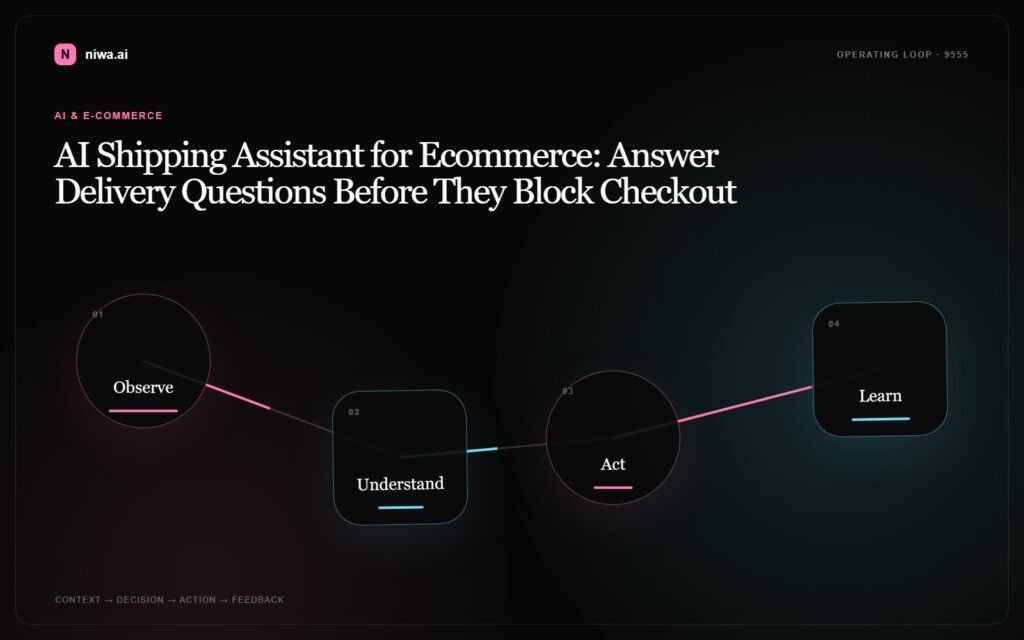
- Detect intent: the shopper asks about shipping cost, delivery time, pickup, returns, or urgency.
- Read context: current product, cart value, destination if known, and free-shipping threshold.
- Answer clearly: give the policy-based answer in plain language.
- Suggest the next step: continue to checkout, add an eligible item for free shipping, choose express delivery, or request help.
- Escalate safely: hand off when the answer depends on a carrier exception or custom promise.
This connects directly with other conversion work, including AI checkout assistance, abandoned cart recovery, and CRM handoff. Shipping is not a separate support silo. It is part of the buying decision.
Book a Niwa AI demo
If shipping questions are costing your store orders, Niwa AI can help answer them before the buyer disappears. Book a Niwa AI demo and see how an AI sales and support agent can turn delivery doubts into clearer checkout decisions.

