AI Discount Assistant for Ecommerce: Save Hesitant Buyers Without Killing Margin
Learn how an AI discount assistant can answer price objections, suggest the right incentive, and protect margin before shoppers abandon checkout.
Discounts are useful, but they are also dangerous. If every hesitant shopper receives the same coupon, the store may recover a few orders while quietly teaching buyers to wait, search for codes, or ask support for a better price.
An AI discount assistant gives ecommerce teams a cleaner path: handle price objections in the chat, explain value, recommend the smallest useful incentive, and escalate only the cases that deserve a human decision. Instead of making “10% off” the default answer, the assistant treats discounts as one tool inside a broader conversion conversation.
This matters because checkout hesitation is rarely only about price. Baymard Institute reports a 70.22% average documented online shopping cart abandonment rate, and when it removes “just browsing” from the reasons, cost and clarity problems still dominate: 39% cite extra costs that are too high, while 14% say they could not see or calculate the total order cost up front. A smart assistant should reduce that uncertainty before it reaches the coupon field.
What an AI discount assistant actually does
An AI discount assistant is not just a chatbot that gives away promo codes. It is a sales-support layer that understands the shopper’s question, the cart context, the store’s rules, and the business margin behind the offer.
In practice, it can help with situations like:
- Price objection: “Is this worth it compared with the cheaper version?”
- Shipping hesitation: “How much more do I need for free shipping?”
- Bundle decision: “Should I buy the starter kit or the full set?”
- Promo confusion: “Does this discount work on sale items?”
- VIP or repeat buyer request: “Can you do anything for returning customers?”
The goal is not to push a coupon instantly. The goal is to move the buyer from uncertainty to a confident next step: complete checkout, add the right item, choose a bundle, or ask for a custom offer when the cart value justifies it.
Why blanket coupon logic damages ecommerce margin
The sacrificial lamb here is the store that adds a giant coupon field, connects a popup discount, and calls it conversion optimization. It may see a short-term lift, but it also creates three expensive habits.
First, buyers start hunting instead of buying. A shopper who was ready to pay suddenly leaves the checkout to search Google, inboxes, influencers, and coupon extensions. Some return. Many do not.
Second, high-intent customers get discounted unnecessarily. If the same offer appears for everyone, the store gives margin away to people who would have purchased anyway.
Third, support becomes the discount desk. Human agents waste time answering “Do you have a code?” instead of solving fit, delivery, payment, or trust issues that actually block the sale.
A better system separates need from noise. Some buyers need reassurance. Some need delivery clarity. Some need a bundle suggestion. Some need a small incentive. Only a small group should receive a discount that materially affects margin.
Better discount conversations: examples
Here is how an AI discount assistant can answer without sounding robotic or careless with revenue.
Scenario 1: Shopper asks for a code before checkout.
The assistant should not immediately hand out a coupon. It can first ask what they are buying, explain the current offer, and guide them toward the best value. For example: “The free shipping threshold is €75. Your cart is at €68, so adding the care kit would cost less than paying shipping separately.”
Scenario 2: Shopper compares two products.
Instead of discounting the premium product, the assistant can explain the difference and recommend the better fit. If the buyer still hesitates and the cart value is high, the assistant can offer a controlled incentive such as free shipping, a small accessory, or a limited first-order benefit.
Scenario 3: Returning customer asks for loyalty treatment.
The assistant can identify the customer, check eligibility, and route valuable cases to a human or CRM sequence. A loyal customer with three previous orders should not receive the same generic popup as a first-time visitor who only opened the homepage.
Scenario 4: Buyer is stuck because the total is unclear.
Baymard’s abandonment data shows that extra costs and unclear total cost still hurt checkout. In that case, the assistant should calculate the total, explain shipping and fees, and show the next practical action before mentioning any discount.
Rules that keep AI discounts profitable
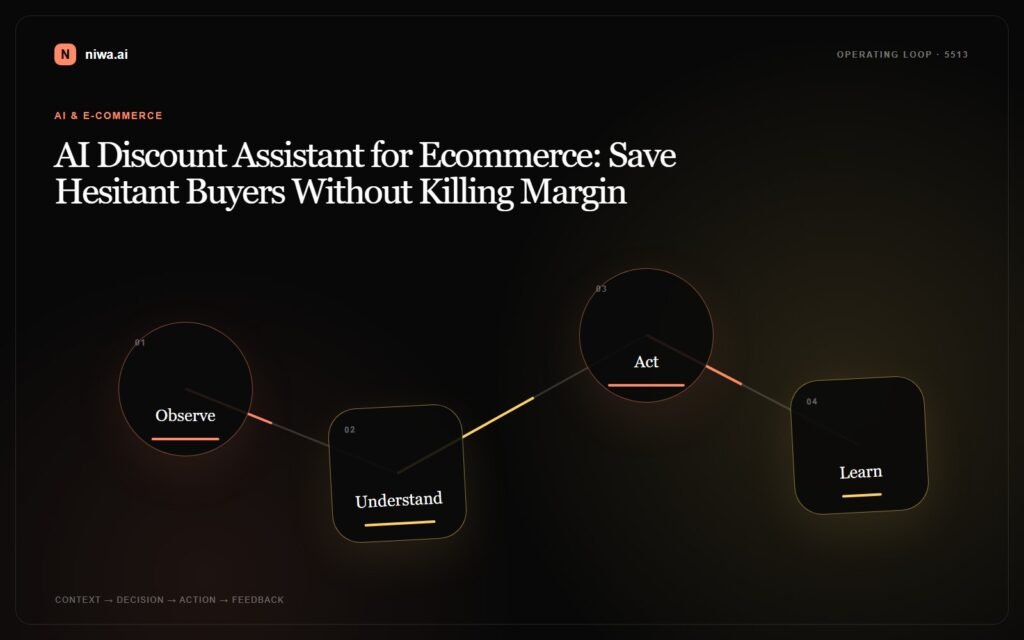
The strongest AI discount workflows are not “creative.” They are disciplined. The assistant should follow rules that reflect the store’s actual economics.
- Protect minimum margin: Never offer a discount that takes the order below the required contribution margin.
- Prefer value-add incentives: Free shipping, samples, setup help, or bundles may preserve more margin than a percentage discount.
- Use cart thresholds: Incentivize a higher order value instead of reducing an already-qualified order.
- Segment by intent: A returning customer, a high-cart buyer, and a random coupon hunter should not receive identical treatment.
- Time-box exceptions: If the assistant creates a special offer, make the conditions clear and limited.
- Escalate high-value negotiations: For B2B, wholesale, or large carts, the assistant should qualify the lead and hand it to sales.
BigCommerce’s conversion optimization guidance includes discounts and free or discounted shipping among practical CRO tactics, but the important word is “tactic.” A tactic should be triggered by context, not sprayed across every visitor.
How Niwa AI can fit into the discount workflow
Niwa AI is built for ecommerce conversations that affect revenue: support questions, product guidance, lead qualification, checkout friction, and handoff to the team. A discount assistant workflow can sit inside that same commercial layer.
For example, Niwa can be configured to:
- answer promo, shipping, and bundle questions directly on the product page or checkout path;
- recommend the lowest-risk incentive based on cart value and shopper intent;
- explain product value before using a discount as the shortcut;
- capture email or phone before issuing a special offer, when appropriate;
- send high-value or edge-case conversations to a human sales/support owner;
- feed repeated discount objections back into ecommerce and marketing decisions.
This connects naturally with other Niwa workflows. If your store already uses AI chat for lead qualification, checkout assistance, or CRM handoff, discount handling becomes another structured decision point rather than a random support answer.
What to measure after launch
A discount assistant should be judged by profit-quality metrics, not just coupon usage. Track:
- Recovered checkout sessions: How many hesitant shoppers complete an order after the chat?
- Average order value: Does the assistant increase bundle selection or only reduce price?
- Discount rate: What percentage of orders required an incentive?
- Margin per recovered order: Did the recovered sale remain profitable?
- Support deflection: Are fewer human conversations wasted on basic promo questions?
- Repeat purchase quality: Do assisted buyers return without needing a discount every time?
If discount usage rises but margin falls, the assistant is too generous. If margin is safe but recovery does not improve, the assistant may be too rigid. The right setup learns from both outcomes.
When you should not use an AI discount assistant
Do not add AI discounting if your store has no clear rules, no margin visibility, and no human owner for exceptions. The assistant should not invent offers, negotiate freely, or override policy. It should operate inside a playbook.
Start with three safe flows:
- answer “Do you have a discount?” with current public offers and value explanation;
- suggest free shipping or bundle thresholds when the cart is close;
- qualify and escalate high-value requests instead of automatically discounting them.
Once those flows work, add deeper CRM, loyalty, or segmentation logic.
Final takeaway
The best discount is not always the largest one. Often, the best discount is no discount at all: just a clear answer, a better product match, a shipping explanation, or a bundle that makes the purchase feel safer.
An AI discount assistant helps ecommerce teams recover hesitant buyers without turning every conversation into a race to the bottom. It protects margin by making discounts contextual, measurable, and connected to the full customer journey.
Want to handle price objections without giving away margin by default? Book a Niwa AI demo and see how Niwa can support smarter ecommerce discount conversations.