AI Review Assistant for Ecommerce: Turn Feedback Into Trust and Repeat Sales
Learn how an AI review assistant can request better feedback, answer review-driven objections, and turn post-purchase conversations into conversion insight.
Most ecommerce review programs fail in the same quiet way: the store asks every customer the same generic question, too late, with no context. Happy buyers ignore it. Unsure buyers leave vague feedback. Frustrated buyers go straight to support, social media, or a one-star review because nobody caught the problem early.
An AI review assistant gives the store a more useful layer between the purchase and the public review. It can ask for feedback at the right moment, help customers describe what they liked, detect problems before they become reputation damage, and feed recurring review themes back into merchandising, support, and conversion work.
This matters because reviews are not just a nice trust signal. PowerReviews reports that 70% of consumers say they will not purchase products online without reading reviews. At the same time, customer expectations around service speed keep rising: Zendesk CX Trends 2026 reports that 74% of consumers now expect customer service to be available 24/7, and 88% expect faster response times than they did a year ago.
For an ecommerce team, the practical takeaway is simple: review collection, customer support, and conversion optimization should not live in separate boxes. They are all part of the same buyer confidence system.
What an AI review assistant actually does
A good AI review assistant is not a bot that invents praise or pressures customers into leaving five stars. That would damage trust and create compliance risk. The useful version does four practical jobs:
- It asks at the right time: after delivery, after first use, after a repeat order, or after support confirms the issue is resolved.
- It helps the customer be specific: instead of “How was your order?”, it can ask about fit, delivery, packaging, product quality, setup, or the buying experience.
- It catches problems privately first: if a customer says the item arrived damaged, the assistant should route them to support before asking for a public review.
- It summarizes patterns for the team: repeated complaints about sizing, unclear product photos, missing instructions, or slow shipping become actionable conversion notes.
That makes the assistant useful even when the customer never publishes a review. The conversation still tells the business what buyers trust, what confuses them, and where the store is losing confidence.
Why review requests often underperform
Many stores already have a review email or app installed, but the execution is usually too blunt. The common third-party mistake is treating a review request like a receipt: send it once, use the same template, and hope customers do the work.
That creates avoidable friction:
- The request arrives before the customer has used the product. The buyer cannot say anything useful yet, so the message gets ignored.
- The question is too broad. “Leave a review” feels like work. “Was the size guide accurate?” is easier to answer.
- Support issues are mixed with review requests. A customer who needs help should not be pushed toward a public rating before the issue is solved.
- The feedback is never connected to product pages. If reviews mention the same objection over and over, the store should improve product copy, comparison blocks, FAQs, and chat prompts.
An AI review assistant reduces that gap by making feedback conversational. It can ask one follow-up question, classify the response, and decide whether the next step should be a review link, a support handoff, a product recommendation, or an internal note for the ecommerce team.
Where AI reviews improve conversion
Reviews influence conversion because they answer the questions buyers do not fully trust the brand to answer alone. A product page can say “true to size,” but a customer review saying “I usually wear EU 41 and EU 41 fit perfectly” feels more useful.
For Niwa AI, this is the valuable connection between review collection and sales conversations. The same review patterns can power better chat answers:
- Product fit: “Customers with wide feet usually choose the half size up.”
- Delivery confidence: “Most buyers in Germany mention delivery in two to three working days.”
- Use-case proof: “Several salon owners use this device for daily appointments, not just home use.”
- Comparison help: “Reviews mention that model A is lighter, while model B is better for long sessions.”
This works especially well alongside an AI product comparison assistant or an AI personal shopper. The review assistant collects voice-of-customer evidence; the sales assistant uses that evidence to answer future buyers with more confidence.
A practical review flow for ecommerce stores
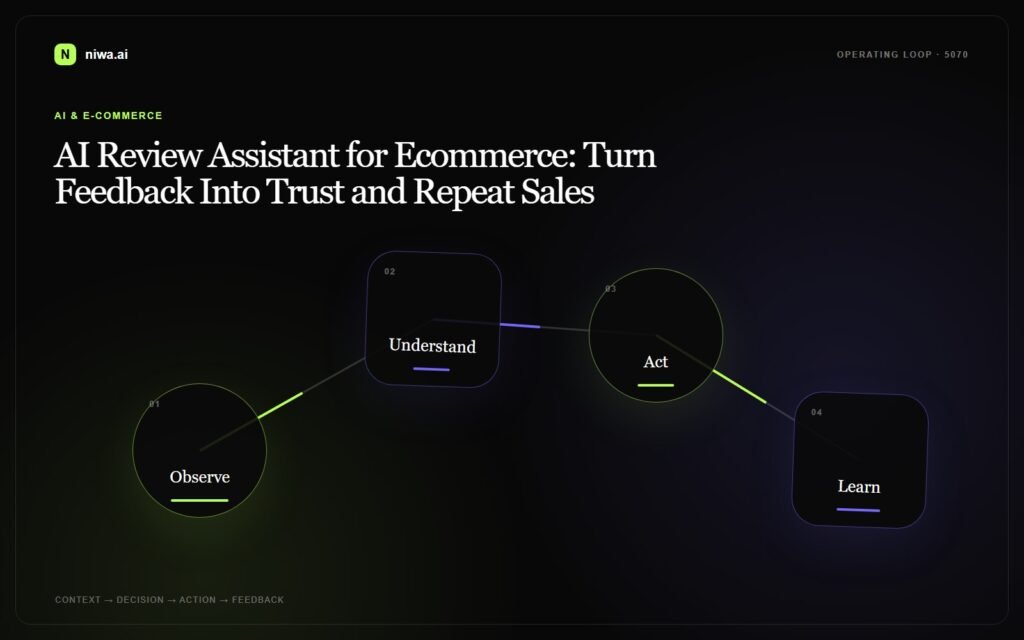
Here is a simple flow an ecommerce store can start with:
- Delivery confirmed: wait long enough for the customer to actually inspect or use the product.
- First feedback question: ask one specific question based on the product category, not a generic rating request.
- Sentiment check: if the customer sounds unhappy, route to support or create a CRM task instead of pushing for a public review.
- Review request: if the customer is satisfied, send the review link and suggest useful details they may want to mention.
- Insight summary: tag the feedback by product, issue, customer type, and conversion theme.
- Store improvement: update FAQs, product copy, size guides, shipping explanations, or chat answers based on repeated themes.
The important part is the fork after the first response. A satisfied buyer gets a review path. A confused buyer gets help. A dissatisfied buyer gets recovery. A vague response gets one helpful follow-up question, not a seven-question survey.
What the assistant should send to CRM or support
Not every review conversation belongs in the public review tool. Some conversations should go to the team immediately. A useful AI assistant can prepare a clean handoff with:
- Customer intent: happy review candidate, unresolved support issue, replacement request, refund risk, product confusion, or upsell opportunity.
- Product context: SKU, order ID, variant, delivery date, and product category.
- Feedback summary: one short paragraph the support or ecommerce team can understand quickly.
- Recommended next action: request review, send care instructions, offer exchange, escalate to human support, or update the product page.
This is where the review assistant connects with an AI CRM handoff workflow. The goal is not just to collect more stars. The goal is to make every post-purchase conversation usable.
Guardrails: what AI should not do with reviews
Review automation needs clear rules. The assistant should never fabricate reviews, write fake customer stories, hide legitimate negative feedback, or make customers feel manipulated. It should help real customers express real experiences more clearly.
Good guardrails include:
- No fake praise: the assistant can suggest topics to mention, but the opinion must come from the customer.
- No pressure tactics: avoid guilt-based language, forced incentives, or misleading review prompts.
- No support deflection: if the customer needs help, solve the issue before asking for a public rating.
- Clear AI disclosure: if the customer is talking to an AI agent, make that clear in the experience.
- Human escalation: damaged products, refund disputes, legal complaints, or safety issues should move to a person fast.
These rules protect the brand. They also make the assistant better at its real job: turning post-purchase feedback into trust, retention, and better buying journeys.
How Niwa AI can use review conversations
Niwa AI is built for sales and support conversations across ecommerce and business websites. A review assistant is a natural extension because it starts after the order but improves what happens before the next order.
For example, Niwa can help a store:
- ask product-specific review questions after delivery;
- separate happy customers from customers who need support;
- summarize recurring feedback for product pages and FAQs;
- prepare CRM handoffs for unresolved issues;
- feed common review themes into future sales chat answers;
- identify retention, reorder, and cross-sell opportunities from post-purchase conversations.
That makes review collection more than a marketing checkbox. It becomes a feedback loop between the customer, the product page, the support team, and the sales assistant.
When an AI review assistant is worth adding
This is usually worth prioritizing if your store has any of these signs:
- customers often ask the same product questions before buying;
- reviews mention sizing, compatibility, delivery, quality, or setup confusion;
- support gets repeat questions after delivery;
- the store has enough orders but too few useful reviews;
- negative feedback often appears publicly before support has a chance to fix the issue;
- the team wants better product-page and chat insights from real customer language.
If the store has almost no sales yet, fix traffic, offer clarity, and checkout basics first. But once orders are happening consistently, review conversations become one of the cleanest sources of conversion insight.
Final takeaway
An AI review assistant should not be measured only by how many review links it sends. Measure it by how many useful conversations it creates: public reviews from happy buyers, private recovery paths for unhappy buyers, and clear insight for the ecommerce team.
When those pieces work together, reviews stop being passive social proof. They become an active part of the sales and support system.
Book a Niwa AI demo: If your ecommerce store wants to collect better reviews, catch post-purchase problems earlier, and turn customer feedback into better sales conversations, book a Niwa AI demo and map the review conversations Niwa should handle first.