AI Engine vs Niwa AI: Which WordPress AI Agent Is Better?
Compare AI Engine and Niwa AI for WordPress agents, WooCommerce, chatbots, content, messaging administration, reporting, leads, and conversions.
AI Engine and Niwa AI both bring conversational AI into WordPress, but they approach the category from different directions. AI Engine by Meow Apps is a broad, mature AI toolkit for builders who want chatbots, content tools, forms, embeddings, model choice, developer APIs, and MCP access. Niwa AI is positioned as an operating agent for site owners who want WordPress and WooCommerce work connected to messaging administration, business reporting, publishing, customer intent, and conversion workflows.
This comparison is for people searching for a WordPress AI agent, an AI Engine alternative, or a practical way to manage a WordPress business through conversation. It uses publicly documented AI Engine capabilities available on July 16, 2026, and avoids treating an undocumented feature as proof that the product cannot support it through customization.
Quick Verdict
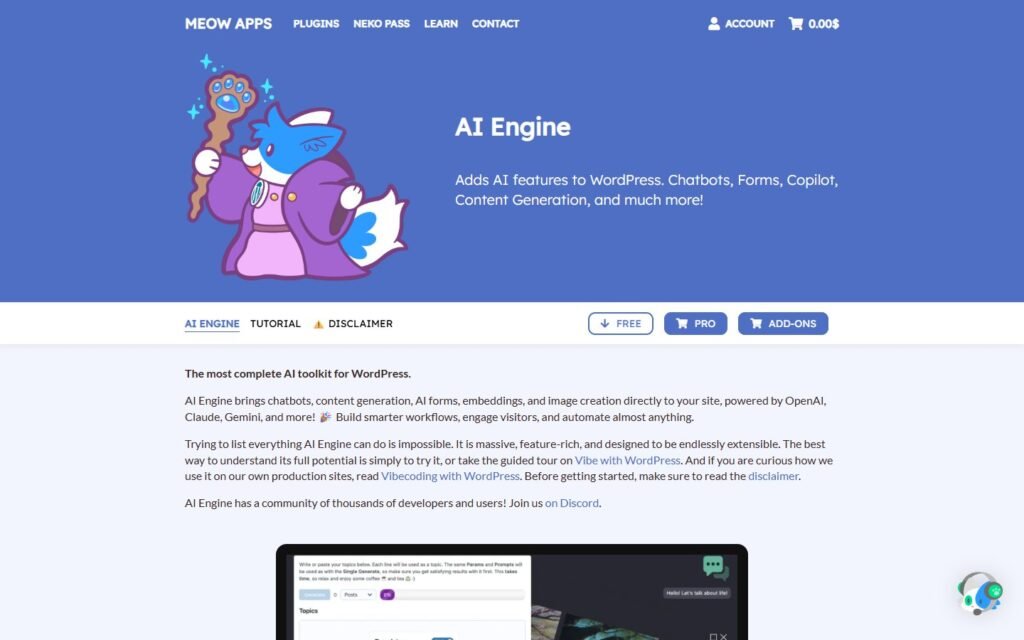
Choose AI Engine if you want a flexible AI framework inside WordPress, support for multiple model providers, customizable chatbots, AI-assisted editing, image generation, forms, embeddings, APIs, function calling, and an MCP server that can connect external AI clients to your site.
Choose Niwa AI if you want a more owner-centered operating layer: issue site and store instructions through Telegram or WhatsApp, publish content, receive business-oriented reports, monitor competitors, manage leads, and connect customer conversations with conversion actions.
The fairest summary is:
AI Engine is stronger as a configurable WordPress AI toolkit. Niwa AI is designed around ongoing business operation and owner workflows.
Neither positioning is automatically better. The right choice depends on whether you primarily want to build with AI inside WordPress or delegate business work around WordPress.
What Is AI Engine?
AI Engine is a WordPress plugin created by Meow Apps. Its official product page and WordPress.org listing describe it as a toolkit that connects WordPress to providers including OpenAI, Anthropic, Google, Mistral, OpenRouter, and others.
Its documented features include:
- Customizable website chatbots
- AI content generation
- An editor Copilot and writing tools
- Image generation and image-aware workflows
- AI-powered forms
- Embeddings and content-aware knowledge bases
- Internal and REST APIs
- Function calling for WordPress functions, WooCommerce, and custom APIs
- Usage, cost, and access insights
- A WordPress MCP server for external AI agents
- Advanced MCP tools for WooCommerce, database, theme, and plugin management
That breadth is AI Engine’s clearest advantage. A developer, agency, or advanced WordPress user can start with a chatbot and progressively add custom functions, knowledge, forms, external AI clients, or automation.
AI Engine also supports multiple AI providers rather than forcing every workflow through one model vendor. That is valuable for teams that care about model choice, pricing control, experimentation, or reducing provider lock-in.
What Is Niwa AI?
Niwa AI is designed around a different question: what if a WordPress site owner could message an AI operator in the same way they message a capable team member?
Niwa connects conversational instructions with practical WordPress and WooCommerce work. Depending on the installed tools and approved access, those workflows can include:
- Creating, updating, and publishing website content
- Managing WooCommerce products, prices, stock, coupons, and orders
- Investigating site problems and reporting the result
- Receiving owner instructions through Telegram or WhatsApp
- Preparing business and performance reports
- Researching competitors and content opportunities
- Capturing visitor intent and lead context
- Supporting product discovery and purchase decisions
- Connecting conversations to follow-up and conversion workflows
This direction builds on the same commercial problem covered in our guide to AI lead capture for ecommerce: a useful agent should not merely collect a contact field. It should preserve why the visitor is interested and help the business take the next sensible action.
Niwa therefore combines an administrative side for the owner with a customer-facing side for the storefront. The goal is not only faster dashboard work, but a shorter path between a business signal and a completed action.
AI Engine vs Niwa AI: Feature Comparison
| Capability | AI Engine | Niwa AI |
|—|—|—|
| Core positioning | Configurable WordPress AI toolkit and framework | WordPress business operator and conversion agent |
| WordPress content creation | Yes | Yes |
| Editor writing assistance | Strong documented Copilot and editor tools | Content can be researched, created, updated, and published through agent workflows |
| Website chatbot | Yes, highly customizable | Yes, with a business and conversion focus |
| Multiple AI providers | Yes, prominently supported | Model/provider flexibility depends on the Niwa deployment |
| Knowledge bases and embeddings | Yes | Supported through Niwa’s site and business knowledge workflows, depending on configuration |
| MCP support | Yes, including advanced tools | Niwa uses its own agent tool and permission architecture rather than positioning MCP as the main owner interface |
| WordPress administration | Yes through MCP and supported tools | Yes through approved operating workflows |
| WooCommerce operations | Yes through function calling and advanced MCP tools | Yes, including owner-directed store operations |
| Content publishing | Yes | Yes |
| Telegram administration | Not prominently documented as a native owner channel | Yes |
| WhatsApp administration | Not prominently documented as a native owner channel | Yes |
| AI forms | Yes, documented in Pro | Niwa focuses more on conversational lead capture than a general-purpose AI form builder |
| Lead capture | Available through forms and add-ons, including a visitor form add-on | Built around capturing intent and carrying context into business workflows |
| Usage and token reporting | Yes | Not Niwa’s primary reporting proposition |
| Business reporting | Can be custom-built from accessible data; packaged owner reporting is not the main public positioning | Yes, a core owner workflow |
| Competitor research | Web search is available through an add-on; scheduled competitor monitoring is not a prominently documented core workflow | Yes, as an owner-directed research and monitoring workflow |
| Conversion workflows | Possible through chatbots, function calling, forms, add-ons, and custom development | A central product focus connecting visitor intent, store data, and follow-up |
| Best fit | Builders, developers, agencies, and teams wanting a flexible AI stack | Owners wanting an operating relationship across site, store, messaging, and growth |
Public products change quickly. “Not prominently documented” in this table does not mean a capability is technically impossible. AI Engine is extensible, and skilled users may build custom versions of many workflows.
Where AI Engine Is Stronger
A fair AI Engine vs Niwa AI comparison should begin with the areas where AI Engine has a clear advantage.
A broader builder toolkit
AI Engine combines many AI building blocks in one plugin: chatbots, forms, content generation, editor assistance, images, embeddings, APIs, function calling, and MCP. For someone assembling a custom WordPress AI experience, that range is compelling.
Niwa is more opinionated. It is oriented toward operating tasks and business outcomes rather than exposing every AI building block as a general-purpose interface.
Model-provider flexibility
AI Engine prominently supports numerous model providers. Teams can select different environments for text, vision, or image tasks and change providers without rebuilding the whole WordPress integration.
That can matter to agencies and technical teams that actively compare model quality, latency, privacy terms, or API costs.
Content and editor tooling
AI Engine has mature, visible tools for writers working directly in the WordPress editor. Its Copilot, Magic Wand, generators, translation features, and image tools make it especially relevant to content teams that want assistance without leaving wp-admin.
Niwa can handle the broader publishing workflow, research, drafting, updating, categorization, SEO preparation, and publication, but AI Engine offers more granular editor-native tools for a human author who wants to stay hands-on.
Custom chatbot construction
AI Engine provides extensive chatbot customization, including appearance, instructions, memory options, file uploads, voice features, knowledge, forms, and function calling. It is a strong option when the primary project is to build a tailored chatbot.
Niwa’s customer-facing layer is more closely tied to commercial context: product questions, buyer hesitation, lead intent, and conversion support. For a general chatbot laboratory, AI Engine is the more flexible starting point.
MCP and developer extensibility
AI Engine’s built-in MCP server is a substantial feature. It can connect compatible external agents such as Claude or ChatGPT to WordPress, while advanced tools expand access to WooCommerce, themes, plugins, and the database.
This makes AI Engine particularly attractive to developers who already use MCP-aware clients and want WordPress to become part of that environment. Readers comparing agent architectures may also find our SiteGround AI Agent vs Niwa AI comparison useful because it examines another dashboard and administration-centered approach.
Where Niwa AI Is Different
Niwa’s advantage is not that AI Engine lacks AI functionality. AI Engine has an unusually wide feature set. The difference is how capabilities are packaged around the owner’s working day.
Telegram and WhatsApp as operating interfaces
AI Engine’s official materials focus on WordPress interfaces, website chatbots, APIs, and external MCP-compatible AI clients. They do not prominently document Telegram or WhatsApp as native owner administration channels.
Niwa treats messaging administration as a primary experience. The owner can send an instruction from a phone, receive a concise report, answer a necessary approval question, and continue without navigating multiple WordPress screens.
This distinction matters for owners who are often away from a desk. A technically powerful MCP server and a familiar mobile business conversation solve related but different usability problems.
Business reporting rather than only AI usage insights
AI Engine documents usage insights for tokens, costs, access, and limits. Those are valuable operational controls for an AI system.
Niwa’s reporting focus is broader: sales activity, store changes, content performance, customer signals, operational exceptions, and what deserves the owner’s attention next. AI Engine may be able to access data and support custom reports, but packaged business reporting is not the central promise on its official product pages.
Competitor monitoring as an owner workflow
AI Engine offers a Web Search add-on that can give a chatbot fresh search access. This is useful and should not be overlooked.
Niwa frames competitor work as an ongoing business process: research a competing offer, identify positioning or content changes, compare them with the owner’s site, and turn the finding into an article, page update, campaign idea, or report. The difference is less about whether web search exists and more about whether competitor intelligence is connected to repeatable business execution.
Conversion-centered follow-through
AI Engine can power sophisticated conversion tools. Its forms, chatbots, WooCommerce add-ons, function calling, embeddings, and custom APIs give builders the components needed to create them.
Niwa packages conversion follow-through as part of the product direction. A shopper’s question can become product guidance, captured intent, a qualified lead, a human handoff, or another approved next step. The same principle applies at checkout, where an AI checkout assistant can resolve shipping, returns, payment, or product-fit uncertainty before the buyer leaves.
In short, AI Engine gives you strong components. Niwa aims to provide the operating workflow that connects those components to a commercial outcome.
Which Is Better for WordPress Administration?
AI Engine is a strong choice for technical WordPress users who want to connect Claude, ChatGPT, or another MCP-aware client and work with posts, media, settings, plugins, themes, or WooCommerce through conversation. Its developer surface and customizability are major strengths.
Niwa is a better fit when the owner wants the agent relationship itself to be the product: send an instruction through Telegram or WhatsApp, authorize sensitive work when required, and receive confirmation in business language.
For agencies building unique AI systems for multiple client requirements, AI Engine may be the more adaptable foundation. For a founder who wants one agent to stay close to day-to-day operations, Niwa’s opinionated approach may require less workflow assembly.
Which Is Better for WooCommerce?
Both can be relevant to WooCommerce, but again the emphasis differs.
AI Engine documents WooCommerce function calling, advanced MCP tools, and add-ons such as Woo Basics for product search and order tracking. A capable implementer can use these tools to build product assistants and store automations.
Niwa combines store administration with customer and owner workflows. Product updates, stock, pricing, coupons, order context, reporting, buyer questions, lead capture, and conversion actions can be treated as parts of the same operating system.
Choose AI Engine when you want a configurable toolkit and are prepared to design the workflow. Choose Niwa when you want WooCommerce work connected to an ongoing business-operator experience.
Which Is Better for Content Publishing?
AI Engine is excellent for hands-on authors. Its editor assistant, generation tools, rewriting, translation, images, templates, and provider options give content teams fine control inside WordPress.
Niwa is better aligned with delegated publishing. The owner can request research, specify the business objective, and have the agent prepare and publish a complete article or page with appropriate structure, links, categories, tags, and SEO metadata.
If your preferred workflow is “help me write this paragraph,” AI Engine has a natural advantage. If it is “research this opportunity and publish the finished page,” Niwa is closer to that intent.
Can AI Engine Replace Niwa AI?
For a technical team, AI Engine can reproduce parts of Niwa’s functionality through MCP, function calling, forms, add-ons, APIs, and custom development. It would be unfair to call those outcomes impossible.
The practical question is how much assembly, prompting, permission design, monitoring, and workflow maintenance the business wants to own. AI Engine is a framework-rich product. Niwa is designed to reduce that assembly by providing a persistent operating model around the founder, website, store, and customers.
Likewise, Niwa does not replace every AI Engine use case. Teams that want a highly customized chatbot, broad model experimentation, a dedicated embedding laboratory, or granular editor tools may prefer AI Engine, or may use specialized tools alongside Niwa.
Final Recommendation
Choose AI Engine when your priority is flexibility. It is one of the most substantial WordPress AI toolkits available, with strong chatbots, content tools, forms, embeddings, model choice, APIs, function calling, and MCP support.
Choose Niwa AI when your priority is delegation across the business. Its differentiators are the owner relationship through Telegram and WhatsApp, practical WordPress and WooCommerce operations, delegated publishing, business reporting, competitor workflows, lead context, and conversion-oriented follow-through.
For many businesses, the decision comes down to one sentence:
Do you want to build a WordPress AI system, or do you want an AI operator to help run the WordPress business?
If the second description matches your goal, explore Niwa AI and see how conversational administration can extend beyond the dashboard.
Frequently Asked Questions
Is AI Engine a real WordPress AI agent?
Yes. AI Engine includes a WordPress MCP server that allows compatible external AI agents to work with WordPress through natural-language conversation. Its Pro offering documents advanced MCP tools for WooCommerce, database, theme, and plugin management.
Is AI Engine only a chatbot plugin?
No. Chatbots are a major feature, but AI Engine also provides content generation, editor assistance, AI forms, embeddings, images, APIs, function calling, usage controls, and MCP support.
Does AI Engine support WooCommerce?
Yes. AI Engine documents WooCommerce support through function calling, advanced MCP tools, and add-ons. The exact capabilities available depend on the edition, installed add-ons, configuration, permissions, and connected agent.
Does AI Engine support Telegram or WhatsApp administration?
Telegram and WhatsApp are not prominently documented as native owner administration channels in the official AI Engine product materials reviewed for this article. Custom integration may be possible through APIs or development. Niwa AI treats these messaging channels as a core owner interface.
Can AI Engine capture leads?
Yes. AI Engine Pro includes AI forms, and Meow Apps lists a Visitor Form add-on that can collect visitor information before chat and send email alerts. Niwa’s distinction is carrying conversational intent into broader business and conversion workflows.
Which plugin is better for content creation?
AI Engine is especially strong for interactive, editor-native writing, rewriting, translation, image creation, and model choice. Niwa is better suited to delegated end-to-end publishing workflows that begin with a business instruction and end with a completed WordPress post or page.
Which option is better for agencies?
AI Engine may suit agencies that want a flexible framework, custom chatbots, APIs, MCP, and model choice across varied client projects. Niwa may suit agencies or founders who value an ongoing operator that can execute approved site, store, reporting, and publishing tasks through conversation.
Are the two products direct substitutes?
Only partly. Their feature sets overlap in WordPress conversation, content, chatbots, and WooCommerce, but their product centers differ. AI Engine is a configurable AI toolkit; Niwa AI is an owner-oriented operating and conversion agent.