ShopBot AI vs Niwa AI: WooCommerce Chatbot or Business Operator?
Compare ShopBot AI and Niwa AI for WooCommerce product chat, WordPress operations, Telegram, WhatsApp, publishing, reporting, leads, and conversions.
ShopBot AI and Niwa AI both bring conversational AI to WooCommerce, but they solve different parts of the ecommerce workload. ShopBot AI is primarily a customer-facing product assistant chatbot. Niwa AI combines customer conversations with owner-side WordPress and WooCommerce operations.
This comparison is for store owners searching for a WordPress AI agent, WooCommerce AI chatbot, product recommendation assistant, or a broader AI operator. It reflects publicly documented capabilities checked on July 17, 2026.
Quick verdict
Choose ShopBot AI if your main requirement is a lightweight WooCommerce chatbot that answers product and policy questions, recommends products, supports many languages, and provides conversation analytics.
Choose Niwa AI if you want one system to work on both sides of the business: assisting shoppers while also helping the owner administer WordPress and WooCommerce through Telegram or WhatsApp, publish content, review business signals, capture leads, monitor competitors, and run conversion-focused workflows.
The simplest distinction is:
ShopBot AI helps customers understand the store. Niwa AI is designed to help customers and operate the WordPress business behind the store.
What is ShopBot AI?
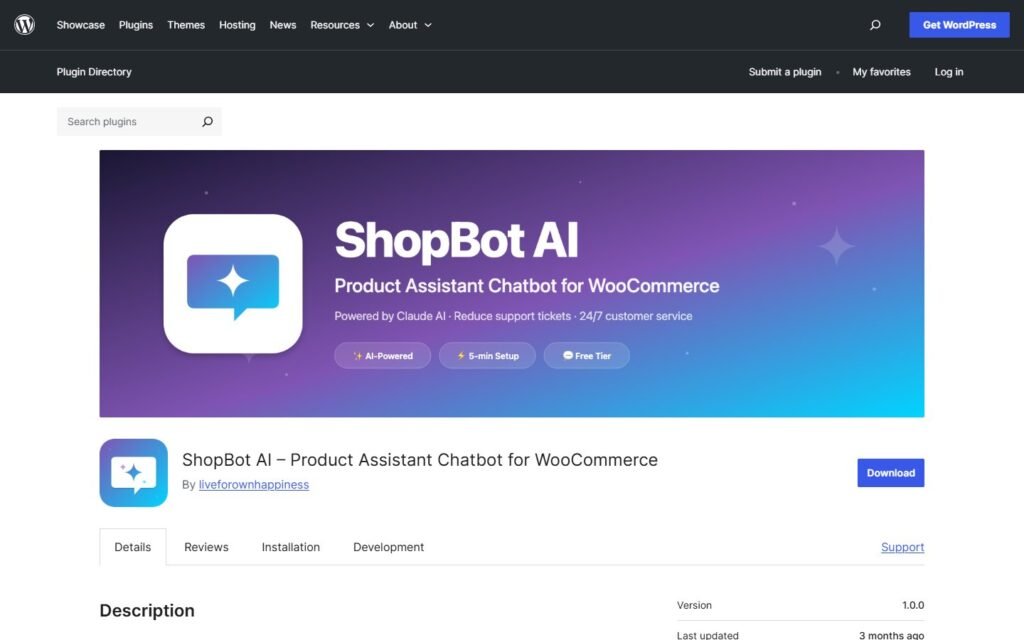
ShopBot AI is a WooCommerce product assistant chatbot powered by Claude AI. According to its official WordPress.org listing, it connects to a store through the WooCommerce REST API and receives read-only access to the product catalog.
Its documented strengths include:
- answering questions about products, specifications, dimensions, materials, prices, availability, shipping, returns, sizing, and store policies;
- recommending matching products with direct add-to-cart links;
- using custom FAQ pairs as a primary knowledge source;
- automatically detecting and replying in more than 100 languages;
- allowing the merchant to customize the chat widget, welcome message, color, position, bot name, and tone;
- reporting chat volume, popular questions, peak hours, and unresolved issues;
- loading the storefront widget asynchronously;
- synchronizing product names, prices, descriptions, categories, and variations from WooCommerce.
ShopBot AI’s privacy boundary is also clear. Its listing says product access is read-only and that it does not access customer personal data, orders, or payment information. That makes it easier to understand what the chatbot can and cannot do.
As of July 17, 2026, WordPress.org lists ShopBot AI as version 1.0.0 with fewer than 10 active installations. That does not determine product quality, but it does mean merchants should treat it as a comparatively new plugin and test it carefully on a staging site before relying on it during high-traffic periods.
What is Niwa AI?
Niwa AI is positioned as a WordPress business agent rather than only a storefront chatbot. The owner can communicate with Niwa through Telegram or WhatsApp and request real work without repeatedly navigating wp-admin.
Depending on the connected site and authorized tools, those workflows can include WordPress and WooCommerce administration, product and stock updates, content preparation and publishing, business reporting, competitor research, lead handling, and conversion tasks.
Niwa also supports the visitor-facing side of the website. She can answer buying questions, collect useful lead context, help shoppers compare products, and connect conversations with a practical next step. The broader operating model is explained on How Niwa Works.
This two-sided approach matters because a customer question often exposes an owner task. Repeated sizing questions may require a better product page. Delivery confusion may require new site copy. A low-stock conversation may require a catalog update. A promising buyer may need founder follow-up. Niwa is designed to connect the signal with the action instead of leaving the insight inside a chat dashboard.
ShopBot AI vs Niwa AI comparison table
| Capability | ShopBot AI | Niwa AI |
|—|—|—|
| Customer-facing website chatbot | Yes | Yes |
| WooCommerce catalog-based answers | Yes | Yes |
| Product recommendations | Yes | Yes |
| Direct add-to-cart links in recommendations | Documented | Supported in conversion and product-guidance workflows where configured |
| Custom FAQ knowledge | Yes | Uses authorized site and business context where configured |
| Multilingual customer conversations | 100+ languages documented | Multilingual conversations supported |
| Conversation analytics | Chat volume, questions, peak hours, unresolved issues documented | Conversation and business insights can be reported to the owner |
| WordPress administration by natural-language request | Not documented as a customer-chatbot feature | Yes |
| WooCommerce product, stock, price, or promotion operations | Product catalog access is documented as read-only | Yes, with authorized owner workflows |
| Order administration | Not supported according to the documented privacy boundary | Supported where the connected workflow and authorization allow it |
| Telegram administration for the owner | Not documented | Yes |
| WhatsApp administration for the owner | Not documented | Yes |
| Content preparation and WordPress publishing | Not documented | Yes |
| Business reporting | Storefront conversation analytics | Broader operational and commercial reporting |
| Lead capture and structured owner follow-up | Not prominently documented | Yes |
| Competitor research and monitoring | Not documented | Yes |
| Conversion workflows beyond product recommendations | Product recommendations and add-to-cart links | Product guidance, lead capture, checkout incentives, follow-up, and other configured workflows |
Public product capabilities change, so merchants should confirm current plan limits and integration requirements before purchasing either solution.
Where ShopBot AI does well
A focused WooCommerce support experience
ShopBot AI has a clear job: place an AI product assistant on the storefront and ground its responses in the WooCommerce catalog and merchant-defined FAQs. A narrow product can be attractive when the store does not need a broader operations layer.
The product-specific use cases are practical. Fashion stores can answer size and fabric questions. Electronics stores can explain specifications and compatibility. Food stores can respond to ingredient and allergen questions. B2B stores can document minimum order quantities and shipping rules.
Clear read-only access boundaries
ShopBot AI’s read-only catalog approach is a meaningful advantage for risk-conscious merchants. The chatbot is not presented as an administrator that can freely modify products or orders. Its official description states that it does not access payment information, orders, or customer personal data.
That limitation reduces its operational reach, but it also makes the security model easier to evaluate. A store that only wants pre-purchase product assistance may prefer this narrower permission scope.
Included AI infrastructure
The official FAQ says merchants do not need their own Anthropic API key because Claude usage is included in the ShopBot AI plan. This can simplify setup for a store owner who does not want to configure a separate model account.
Useful starter analytics
Popular questions and unresolved issues can reveal weak product descriptions, missing policy information, and recurring customer uncertainty. Even basic conversation reporting can help a merchant improve FAQs and product pages.
The biggest difference: storefront chatbot vs operating agent
ShopBot AI lives primarily in the customer conversation. It reads product information, answers questions, and recommends items.
Niwa’s scope extends into owner-side execution. An owner can ask her to investigate a store issue, update catalog information, prepare or publish content, summarize business activity, review competitors, or report a lead through the communication channel the owner already uses.
That difference becomes visible after a chat ends.
Imagine that several visitors ask whether a product works with a specific device. ShopBot AI can answer when the catalog or FAQ contains the information, and its analytics may reveal that the question is common. With Niwa, the owner can continue from that signal: inspect the product page, improve the compatibility copy, publish an explanatory article, and monitor whether the same objection continues.
The chatbot provides an answer. The operating agent can help change the business system that caused the question.
WordPress and WooCommerce operations
ShopBot AI’s official documentation describes catalog synchronization through read-only WooCommerce API access. That is appropriate for accurate product Q&A, but it is not the same as administering the store.
Its public listing does not document the ability to:
- update stock or prices;
- create or edit products;
- manage orders;
- publish WordPress posts or pages;
- change plugins, settings, or other site data;
- prepare owner reports that combine chat signals with wider business operations.
Niwa is the better fit when the owner’s goal is conversational administration, not only conversational shopping. This is especially useful for founders who need to make small operational changes quickly from Telegram or WhatsApp instead of opening the WordPress dashboard for every task.
Telegram and WhatsApp administration
ShopBot AI’s documented interface is a website chat widget for shoppers plus a WordPress-side setup and analytics experience. Its official listing does not present Telegram or WhatsApp as owner command channels.
Niwa is designed around those messaging channels. The distinction is not simply where chat happens. It is who the chat is for and what the conversation can authorize.
A customer asks ShopBot AI which product fits a need. An owner asks Niwa to update a product, review sales, publish an article, investigate a competitor, or report what happened. Telegram and WhatsApp become practical remote-control interfaces for the business rather than only support channels.
Content publishing and SEO workflows
ShopBot AI can expose recurring customer questions through analytics, but its official feature list does not document drafting and publishing WordPress content.
Niwa can turn a verified opportunity into a site action: research the topic, prepare the article, add internal links, create the WordPress post, and report the result to the owner. This matters when conversational data reveals a content gap that affects discovery or conversion.
For example, product compatibility questions can become a buying guide, repeated shipping objections can become a clearer policy page, and a competitor’s newly emphasized offer can trigger a fair comparison article.
Business reporting and competitor monitoring
ShopBot AI documents conversation analytics rather than broad business reporting. Its dashboard can help the merchant understand chatbot use, common questions, busy periods, and unresolved issues.
Niwa can connect those kinds of signals with wider business context. The goal is not merely to show that visitors asked 30 questions. The goal is to explain what deserves attention: a product-page gap, stock risk, new lead, repeated objection, competitor movement, or conversion opportunity.
Competitor research and monitoring are not documented ShopBot AI capabilities. They are a distinct owner-side workflow in Niwa’s operating model.
Lead capture and conversion workflows
ShopBot AI is useful near purchase intent because it answers questions and provides product recommendations with add-to-cart links. That can reduce friction without requiring a live support agent.
However, its public listing does not prominently document structured lead capture, owner notification, appointment or demo routing, abandoned-cart follow-up, or cross-channel conversion sequences.
Niwa’s conversion approach is broader. AI Lead Capture for Ecommerce explains why the system should capture the visitor’s need, stage, blocker, and follow-up reason, not merely an email address. Niwa can preserve that context for the owner and support the next operational step.
Niwa can also participate in configured checkout and cart workflows. The Niwa AI Conversion Booster shows how cart behavior can trigger a relevant incentive instead of giving every shopper the same generic discount. For stores focused on preventing lost orders, the guide to AI abandoned cart recovery covers the wider recovery logic.
Which is better for a small WooCommerce store?
ShopBot AI may be the more direct choice when a small store wants:
- a product Q&A chatbot;
- simple product recommendations;
- multilingual responses;
- a customizable widget;
- a clear read-only catalog connection;
- included Claude usage without a separate API key.
Niwa is more appropriate when the same small team also needs help with catalog administration, content publishing, reporting, lead follow-up, owner messaging, competitor research, and conversion operations.
The decision should follow the workload. If support automation is the whole problem, a focused chatbot can be enough. If the founder is also the marketer, store manager, content publisher, analyst, and sales follow-up person, an operating agent has more room to create value.
Which is better for growing ecommerce operations?
A growing store should ask whether it wants a point solution or an operating layer.
ShopBot AI is a point solution with useful shopper-facing capabilities. Its narrow access model may also make it easier to introduce into an established stack.
Niwa is designed for a wider loop:
- detect a customer or business signal;
- explain why it matters;
- propose or perform an authorized action;
- report the result to the owner;
- continue monitoring the outcome.
That loop is valuable when the problem is no longer just answering questions. It is coordinating the many small actions that improve the store over time.
Final verdict
ShopBot AI does several important things well. It offers catalog-grounded WooCommerce product Q&A, product recommendations, custom FAQs, multilingual responses, widget customization, and conversation analytics. Its read-only permissions are clear, and included Claude access can simplify deployment.
Niwa AI is the stronger fit when the requirement is a genuine WordPress business agent. She is designed to combine shopper assistance with owner-side execution across WordPress, WooCommerce, Telegram, WhatsApp, publishing, reporting, lead workflows, competitor monitoring, and conversion work.
Choose ShopBot AI for a focused WooCommerce product assistant. Choose Niwa AI when you want the conversation to continue beyond the answer and produce an operational business result.
If you want to see how the broader workflow fits your store, book a Niwa demo.
Frequently asked questions
Is ShopBot AI a WordPress AI agent?
It is best described as a WooCommerce AI product assistant chatbot. It uses WooCommerce catalog data to answer questions and recommend products. Its public documentation does not position it as a general WordPress administrator that modifies site content, settings, products, or orders.
Does ShopBot AI manage WooCommerce orders?
No order-management capability is documented. Its official WordPress.org listing says it does not access orders, payment information, or customer personal data and uses read-only product access.
Can ShopBot AI recommend WooCommerce products?
Yes. Its official feature list documents smart product recommendations based on customer needs, with direct add-to-cart links.
Does ShopBot AI support multiple languages?
Yes. The official listing says it automatically detects the shopper’s language and supports more than 100 languages.
Does ShopBot AI require an Anthropic API key?
No. According to its official FAQ, Claude AI usage is included in the ShopBot AI plan, so the merchant does not need a separate Anthropic key.
Can ShopBot AI publish WordPress content?
Content drafting and WordPress publishing are not documented ShopBot AI features. Niwa supports authorized content creation and publishing workflows for the site owner.
Can I administer my store through Telegram or WhatsApp with ShopBot AI?
That capability is not documented in ShopBot AI’s public plugin listing. Niwa is specifically designed to receive owner instructions and return reports through Telegram and WhatsApp.
Is ShopBot AI or Niwa AI better for lead generation?
ShopBot AI can reduce buying friction through answers and product recommendations. Niwa is the stronger fit when the business needs structured lead context, owner notification, follow-up, publishing, reporting, and conversion workflows around the conversation.
Can the two products serve different roles?
Potentially, yes. A merchant could use a focused storefront assistant alongside separate operational tools. Before combining AI plugins, test for widget conflicts, duplicated answers, data-handling overlap, performance effects, and an unclear customer experience.