Agentic Commerce for WooCommerce vs Niwa AI: AI Visibility or Business Operator?
Compare Agentic Commerce for WooCommerce and Niwa AI for AI shopping visibility, WooCommerce operations, messaging, leads, reporting, and conversions.
The phrase WordPress AI agent now covers several very different products. Some tools help owners manage WordPress. Others support shoppers on the storefront. A newer category makes WooCommerce catalogs easier for external AI assistants to discover and recommend.
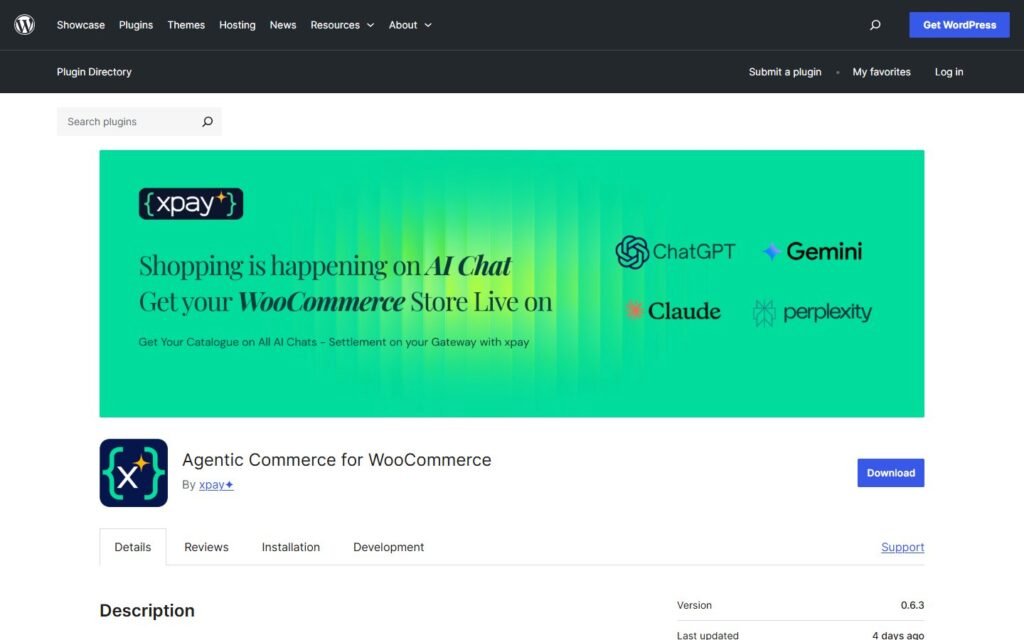
Agentic Commerce for WooCommerce by xpay belongs mainly to that third category. It is designed to publish live product information in formats that AI shopping systems can read, then route interested buyers into the store’s existing WooCommerce cart and checkout.
Niwa AI takes a broader operational approach. It is designed to help a business owner work across WordPress, WooCommerce, customer conversations, publishing, reporting, lead handling, monitoring, and conversion workflows through natural-language instructions.
This is therefore not a simple chatbot-versus-chatbot comparison. It is a comparison between an AI-commerce visibility connector and a WordPress business operator.
Quick verdict
Choose Agentic Commerce for WooCommerce if your immediate priority is making a WooCommerce catalog more legible to AI shopping agents through structured product data, discovery files, live inventory synchronization, cart deep links, and agent-attribution data.
Choose Niwa AI if you want a broader agent that can help operate the WordPress business itself: completing administrative tasks, working with WooCommerce, publishing content, reporting business signals, supporting owner workflows through Telegram or WhatsApp, capturing buyer intent, and helping move conversations toward conversion.
The simplest distinction is:
Agentic Commerce helps AI systems discover and route buyers to your WooCommerce products. Niwa AI helps the owner operate, understand, and grow the business behind the store.
For some merchants, these products may be complementary rather than mutually exclusive.
What Agentic Commerce for WooCommerce does
Agentic Commerce for WooCommerce is an open-source WordPress plugin published by xpay. Its official documentation focuses on making a WooCommerce catalog accessible to AI shopping environments without replacing the store’s existing checkout or payment gateway.
Its documented capabilities include:
- Publishing a public, agent-readable product catalog with current prices and stock.
- Adding or completing structured product data such as Product, Offer, BuyAction, AggregateOffer, and ItemList markup.
- Serving AI discovery resources such as
llms.txtand supported well-known endpoints. - Adding allow rules for recognized AI crawlers without overriding an existing robots.txt block.
- Refreshing catalog information after product and inventory changes, with a scheduled fallback sync.
- Creating cart deep links that send a buyer to the merchant’s normal WooCommerce cart with the relevant product preselected.
- Tagging agent-attributed orders so merchants can identify AI-assisted revenue in reporting.
- Publishing approved product FAQs and return-policy information for AI shoppers, with optional storefront display controls.
A major strength is architectural restraint. According to the official plugin listing, payment remains with the merchant’s existing WooCommerce gateway, while xpay says it does not process customer payment details or replace the checkout.
That makes the plugin relevant to merchants asking questions such as:
- How can my WooCommerce products appear in AI shopping answers?
- How do I prepare my store for agentic commerce?
- Can an AI assistant send a shopper directly to a prefilled WooCommerce cart?
- How can I track orders influenced by AI assistants?
What Niwa AI does
Niwa AI is built around a different problem: business owners have too many disconnected tasks, dashboards, messages, reports, and conversion opportunities.
Instead of focusing primarily on exposing a product catalog to third-party AI systems, Niwa is designed to act closer to the owner and the live WordPress business. A founder can use natural language to request work involving the site, WooCommerce, content, customer intent, research, monitoring, and reporting.
Niwa’s operating model can include:
- WordPress and WooCommerce administration.
- Product, price, stock, coupon, order, and catalog workflows where configured.
- Content research, drafting, publishing, and SEO operations.
- Owner administration through Telegram and WhatsApp.
- Business reports and summaries that explain relevant changes.
- Lead capture and qualification from website conversations.
- Competitor research and recurring monitoring.
- Conversion workflows such as product guidance, objection handling, follow-up context, and revenue-recovery actions.
The customer-facing side matters because making a catalog machine-readable is only one part of ecommerce conversion. Shoppers may still hesitate over fit, compatibility, delivery, returns, trust, product choice, or price. Niwa’s conversion approach is designed to help the business address those questions and preserve useful intent.
For a deeper explanation, see how Niwa turns website visitors into leads and the practical guide to AI lead capture for ecommerce.
Agentic Commerce for WooCommerce vs Niwa AI comparison
| Capability | Agentic Commerce for WooCommerce | Niwa AI |
|—|—|—|
| Primary purpose | Make a WooCommerce catalog readable and purchasable through AI shopping systems | Operate and support the WordPress business through natural-language workflows |
| WooCommerce catalog sync | Yes, a central documented feature | Works with WooCommerce operational data and workflows where configured |
| AI-readable product feed | Yes | Not the primary product positioning |
| Product and offer structured data | Yes, including schema gap-filling | Not the primary product positioning |
| AI crawler and discovery-file support | Yes | Not the primary product positioning |
| Prefilled WooCommerce cart links | Yes | Can support conversion workflows, but xpay’s agent-shopping deep-link layer is more specialized |
| Existing checkout remains in place | Yes | Yes; Niwa works with the existing WordPress/WooCommerce business |
| WordPress administration by conversation | Not the core documented use case | Yes |
| Product, price, stock, coupon, and order operations | Catalog data is read and synchronized; broad store administration is not its core documented role | Yes, where configured and authorized |
| Telegram owner administration | Not prominently documented | Yes |
| WhatsApp owner administration | Not prominently documented | Yes |
| Content research and publishing | Not the core documented use case | Yes |
| Business reporting | Agent-attributed order and crawl analytics are documented | Broader business reporting and operational summaries |
| Lead capture and qualification | Not the core documented use case | Yes |
| Competitor monitoring | Not prominently documented | Yes |
| Storefront conversion conversations | An AI Storefront Assistant and product FAQ features are documented | Product guidance, intent capture, objection handling, and conversion workflows |
| Best fit | Merchants prioritizing visibility and purchasing paths in external AI shopping environments | Owners wanting one agent across website operations, messaging, content, reporting, leads, and conversion work |
This comparison reflects publicly available product information reviewed on July 18, 2026. Both products can evolve, so merchants should confirm current documentation before implementation.
Where Agentic Commerce is stronger
Agentic Commerce for WooCommerce has a clear advantage when the requirement is technically specific: prepare a WooCommerce catalog for external AI shoppers.
Its product feed, structured data, discovery resources, crawler rules, live inventory synchronization, and cart-deep-link model form a specialized agentic-commerce layer. Niwa is not positioned primarily as a protocol and catalog-distribution plugin, so xpay is the more direct fit for that narrow use case.
The plugin also deserves credit for preserving the merchant’s existing checkout. Buyers are routed back to WooCommerce, and normal payment gateways remain responsible for payment. This reduces the operational disruption compared with replacing the commerce platform or moving checkout to another provider.
Another practical strength is attribution. Tagging orders influenced by agent referrals can help merchants separate AI-assisted sales from other acquisition paths, subject to the plugin’s implementation and the merchant’s analytics setup.
Where Niwa AI is broader
Agentic Commerce is specialized around discovery, product data, AI referrals, and purchase routing. Its official materials do not primarily position it as a general WordPress administrator, content publisher, competitor monitor, lead-management agent, or founder reporting system.
Niwa covers a wider operating surface.
An owner can ask Niwa to investigate a competitor, prepare a comparison article, update a WooCommerce product, summarize store activity, review a business issue, publish approved content, or act on a lead workflow. Telegram and WhatsApp administration also means the owner can request work without treating wp-admin as the only command center.
That difference becomes important after discovery. Getting a product into an AI answer may create traffic or a cart visit, but conversion can still fail. A buyer might need a recommendation, reassurance, a product comparison, a shipping answer, or a human handoff. Niwa is designed around those broader operating and conversion moments.
The strategy is explained further in AI website chat and WhatsApp for ecommerce and AI agents for ecommerce.
WooCommerce operations: catalog exposure versus store operation
Both products are relevant to WooCommerce, but they touch it differently.
Agentic Commerce reads public catalog information and publishes it in agent-friendly formats. It keeps product availability synchronized and creates paths back to the existing cart. That can expand how external AI systems understand and refer products.
Niwa works closer to the merchant’s daily operating layer. Depending on authorization and configuration, that can include product updates, pricing, stock, coupons, orders, content, reporting, and owner-requested actions.
A useful way to frame the choice is:
- Use Agentic Commerce to help AI shopping systems understand what you sell.
- Use Niwa to help operate what happens across the business before, during, and after the sale.
Telegram and WhatsApp administration
Agentic Commerce’s documented interface is centered on plugin setup, xpay connectivity, catalog readiness, and related dashboards. Telegram and WhatsApp are not prominently documented as owner administration channels.
Niwa is explicitly designed to make messaging part of the operational interface. An owner can send a request, receive a result, review a report, or continue a workflow from Telegram or WhatsApp.
This is not merely a convenience feature. It changes who can use the system and when. A founder, store manager, or operator may need to act while away from a desktop, respond to a problem quickly, or request a report without navigating several WordPress screens.
Content publishing, monitoring, and reporting
Agentic Commerce publishes machine-readable commerce information, but that is different from running a content and SEO workflow. Its public product materials do not primarily promise competitor research, editorial planning, substantial article creation, or general WordPress publishing automation.
Niwa can connect research with execution. For example, she can inspect existing content, identify a non-duplicate topic, verify current sources, prepare an SEO article, publish it, and report the outcome. She can also monitor business or competitor signals on a schedule when the workflow is configured.
Similarly, xpay documents agent-attributed commerce reporting and optional AI-bot analytics. Niwa’s reporting scope is broader: the goal is to help the owner understand site, store, lead, content, and operational signals and decide what to do next.
Lead capture and conversion workflows
Agentic Commerce’s strongest conversion mechanism is referral infrastructure: help an external AI surface a product and provide a direct path to the merchant’s cart.
Niwa’s conversion model focuses more on the conversation and the workflow around buyer intent. That can include:
- Asking useful qualification questions.
- Recommending relevant products.
- Explaining product trade-offs.
- Answering objections before checkout.
- Capturing contact details and intent.
- Sending structured context to the owner or team.
- Supporting follow-up and recovery workflows.
For stores that want to improve what happens after a shopper arrives, the guide to AI checkout assistants shows why answers about shipping, payments, returns, and product choice can protect live purchase intent.
Can you use both?
Potentially, yes.
A WooCommerce merchant could use Agentic Commerce to improve catalog visibility and purchasing paths for external AI systems, while using Niwa for owner administration, content, reports, leads, customer conversations, monitoring, and conversion operations.
The products overlap around ecommerce and AI, but their centers of gravity are different enough that a combined setup can make strategic sense. The key is to avoid duplicated storefront widgets, conflicting schema, unclear data flows, or overlapping customer experiences. Test the full journey before enabling every feature at once.
Which WordPress AI agent should you choose?
Choose Agentic Commerce for WooCommerce when your main objective is to make product data available to AI shopping systems with live stock, structured commerce data, referral attribution, and a route into your existing WooCommerce checkout.
Choose Niwa AI when you want an agent that works across the broader business: WordPress administration, WooCommerce operations, Telegram and WhatsApp access, publishing, reports, leads, monitoring, and conversion workflows.
Choose both when external AI-commerce visibility and internal business operation are separate priorities and you are prepared to configure and test the stack carefully.
If your question is not simply “Can AI find my catalog?” but also “Can AI help me run and grow this WordPress business?”, Niwa is the more complete operating model. You can book a Niwa demo to review the fit for your workflow.
Frequently asked questions
Is Agentic Commerce for WooCommerce a WordPress AI agent?
It fits the broader WordPress AI-agent market, but it is more accurately described as an agentic-commerce connector. Its central job is making WooCommerce product information readable to AI shopping systems and routing buyers back to the store’s cart and checkout.
Does Agentic Commerce replace WooCommerce checkout?
No. Its official plugin documentation says purchases continue through the merchant’s existing WooCommerce checkout and payment gateway.
Does Agentic Commerce manage WordPress through Telegram or WhatsApp?
Telegram or WhatsApp administration is not prominently documented as a core feature of Agentic Commerce for WooCommerce. Niwa is designed around owner access through those messaging channels.
Which tool is better for WooCommerce product visibility in AI chat?
Agentic Commerce is more specialized for publishing an agent-readable catalog, structured product data, live inventory, discovery files, and AI-referral purchase links.
Which tool is better for publishing and SEO operations?
Niwa is the stronger fit when the workflow includes research, duplicate-intent checks, content drafting, WordPress publishing, internal linking, and reporting. Agentic Commerce’s publishing focus is machine-readable product and commerce data rather than editorial content.
Can Niwa AI capture leads?
Yes. Niwa is designed to capture and structure buyer intent, support qualification, and connect website conversations with follow-up workflows.
Can these plugins work together?
They may be complementary because one focuses on external AI-commerce visibility while the other focuses on broader business operations and conversion workflows. Merchants should test schema, widgets, analytics, privacy settings, and the complete customer journey before deploying both widely.