Ajentrix vs Niwa AI: Which WordPress AI Agent Fits Your Business?
Compare Ajentrix and Niwa AI for WordPress, WooCommerce, voice chat, Telegram, WhatsApp, publishing, reporting, leads, and conversion workflows.
AI agents for WordPress now cover several very different jobs. Some are built primarily to talk with website visitors. Others create and distribute content across marketing channels. A smaller group is designed to help the owner operate WordPress, WooCommerce, and the commercial workflows surrounding the site.
Ajentrix and Niwa AI overlap in conversational AI, business knowledge, website chat, lead generation, WordPress, WooCommerce, Telegram, and WhatsApp. However, their center of gravity is different. Ajentrix presents a broad knowledge-trained agent platform for customer engagement and multi-platform content. Niwa AI focuses more directly on operating the WordPress business with the owner while also supporting conversion workflows on the storefront.
This comparison uses publicly available product information checked on July 19, 2026. Where a capability is not clearly documented, it is described as “not prominently documented” rather than assumed to be unavailable.
Quick verdict
Choose Ajentrix if you want a company-trained AI personality that can power voice and text chat, create branded media, and extend across a broad selection of social, messaging, and content channels.
Choose Niwa AI if you want a WordPress-centered business operator that you can direct through Telegram or WhatsApp to perform website and WooCommerce work, publish content, produce useful business reports, monitor commercial signals, and connect customer conversations with conversion actions.
The practical difference is simple:
Ajentrix is positioned as a knowledge-trained, multi-platform AI brand and engagement system. Niwa AI is positioned as an operating layer for the business running on WordPress.
What is Ajentrix?
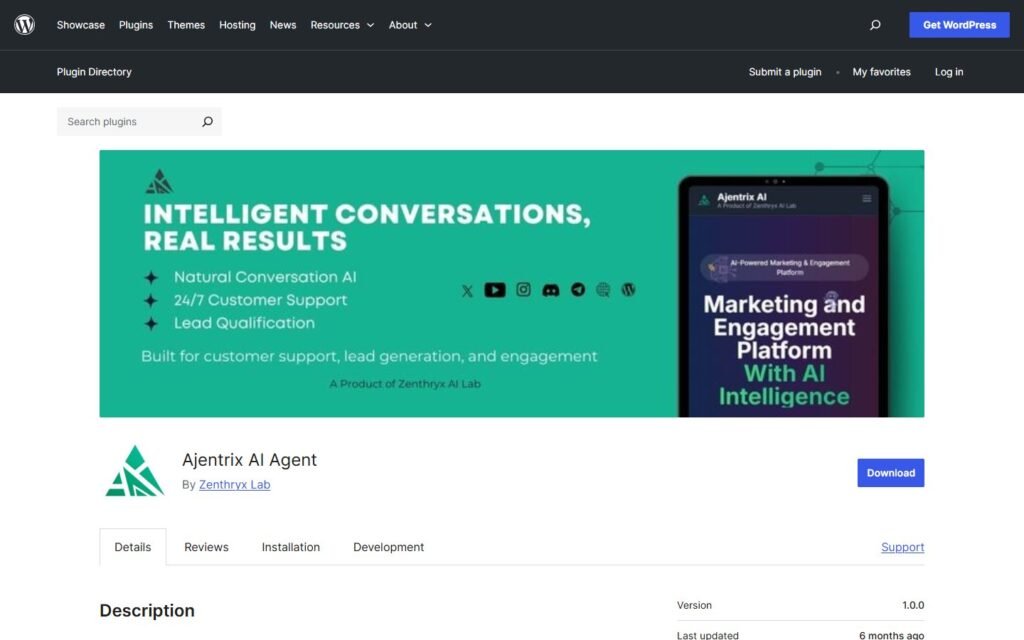
Ajentrix is an end-to-end AI agent platform from Zenthryx Lab. Its WordPress.org listing describes a plugin that adds an AI chat experience to a WordPress site through an Ajentrix account and API key.
The documented WordPress plugin features include:
- voice and text conversations;
- AI responses based on business context and agent personality;
- a customizable chat widget;
- conversation and engagement analytics;
- mobile-responsive presentation;
- session management;
- lead capture and qualification;
- customer support and troubleshooting;
- sales assistance and product discovery;
- knowledge-base answers using company data.
The wider Ajentrix platform goes beyond the plugin. Its official website says businesses can upload company profiles, brand guidelines, product catalogs, services, FAQs, and other knowledge. The agent can then use that context for content creation and engagement across channels including WordPress, WooCommerce, Telegram, WhatsApp, email, website chat, Instagram, X, Discord, and YouTube.
Ajentrix also emphasizes personality. Businesses can choose a defined voice and use it consistently across content and customer interactions. That makes the platform particularly interesting for teams that want one AI identity representing the brand in many places.
What is Niwa AI?
Niwa AI is built around the daily reality of running a WordPress or WooCommerce business. The owner can send a request from Telegram or WhatsApp instead of navigating through multiple WordPress dashboards and separate marketing tools.
Typical Niwa workflows can include updating website content, managing products and store data, preparing and publishing an article, checking business signals, researching competitors, creating reports, and handling structured conversion tasks.
Niwa also works on the customer side of the site. She can answer product questions, identify buying intent, collect useful lead context, recommend a relevant next step, and support follow-up. The goal is not only to generate more chat. It is to turn conversations into decisions, leads, demos, carts, and purchases.
That owner-plus-customer model is important. A customer-facing assistant can improve engagement, but the owner still needs to act on what the conversations reveal. Niwa is designed to connect those two layers more closely.
Ajentrix vs Niwa AI comparison table
| Capability | Ajentrix | Niwa AI |
|—|—|—|
| WordPress integration | Yes; plugin deploys an Ajentrix voice/text agent on the site | Yes; WordPress is the central operating environment |
| Customer-facing website chat | Yes | Yes |
| Voice chat | Clearly documented | Not a primary documented differentiator |
| Company knowledge training | Yes; a major platform focus | Uses website and business context for supported workflows |
| Custom agent personality | Yes; 18 personalities and custom positioning are promoted | Brand-aware behavior can be configured, but personality catalogs are not the primary focus |
| Lead capture and qualification | Yes | Yes, with intent and operational follow-up context |
| Product discovery and sales assistance | Yes | Yes |
| WooCommerce integration | Listed as available on the wider platform | Core operational and conversion focus |
| WordPress content creation | Listed on the wider platform | Yes, including owner-directed publishing workflows |
| WordPress administrative operations | Not prominently detailed in the plugin listing | A central use case |
| Telegram and WhatsApp | Listed as available platform integrations | Used as owner administration and workflow channels as well as business messaging contexts |
| Business reporting | Analytics are documented; owner-focused operating reports are less prominently detailed | A central owner workflow |
| Competitor research and monitoring | Not prominently documented as a core WordPress plugin workflow | Supported as an owner-directed business workflow |
| Conversion incentives and cart workflows | Sales assistance is documented; specific live cart incentive workflows are not prominent in public plugin details | Supported through conversion-focused WooCommerce workflows |
| Multi-platform social content | A major strength across multiple channels and media formats | Not the primary product positioning |
| WordPress.org maturity signal | Version 1.0.0, fewer than 10 active installations, and no reviews when checked | Evaluate through Niwa’s current demo and onboarding process |
Where Ajentrix is stronger
A fair comparison should recognize several clear Ajentrix strengths.
Voice and text are built into the WordPress proposition
The Ajentrix plugin explicitly promotes both voice and text conversations. For businesses where spoken interaction is important, that is a meaningful differentiator. A visitor can interact with the agent in the format that feels most convenient.
Broad brand knowledge and personality controls
Ajentrix puts company knowledge and brand identity at the center of its platform. Uploading brand books, product information, team details, service descriptions, and values can help an agent maintain a more consistent public voice.
Its personality choices are also unusually prominent. This may appeal to content-led brands, communities, and companies that want the agent itself to have a recognizable character.
Multi-platform content distribution
Ajentrix publicly describes a large range of integrations and content formats. It promotes blog posts, social posts, images, video, audio, newsletters, long-form content, and distribution across many channels.
For a marketing team that wants one company-trained system to create and repurpose branded media, Ajentrix has a strong and distinct proposition.
Straightforward customer-facing deployment
The WordPress plugin workflow is simple on paper: create an agent, obtain an API key, install the plugin, choose the agent, customize the widget, and publish it on the site. Businesses mainly seeking an AI website assistant may find that approach easy to understand.
Where Niwa AI is different
Niwa’s strongest distinction is not that she can also chat. It is what happens after the chat, or after an owner sends an instruction.
WordPress and WooCommerce operations
The Ajentrix WordPress listing concentrates on deploying a customer-facing agent. Its wider site lists WordPress blog/content management and WooCommerce integrations, but it does not publicly detail the same owner-directed WordPress administration model that defines Niwa.
Niwa is designed for requests such as changing a product, updating stock or pricing, publishing approved content, inspecting site information, and completing structured WordPress work. The owner communicates the outcome, and Niwa works through the operational steps.
This makes Niwa a closer fit when the priority is not only adding an assistant to a site, but reducing the founder’s WordPress workload.
Telegram and WhatsApp as administration channels
Both products publicly mention Telegram and WhatsApp, so it would be inaccurate to present messaging access as exclusive to Niwa.
The distinction is how the channels are positioned. Ajentrix presents them as part of broad multi-platform deployment, posting, engagement, and customer communication. Niwa uses Telegram and WhatsApp as practical owner interfaces for website administration and business work.
That means the founder can ask for an article, store change, report, check, or commercial task without first opening wp-admin. For customer journeys, Niwa can also connect website chat with follow-up, as explained in this guide to AI website chat and WhatsApp for ecommerce.
Business reporting and next actions
Ajentrix documents real-time analytics and performance tracking. Niwa’s reporting focus is more operational: explain what happened in the business, identify an issue or opportunity, and help the owner take the next action.
The difference is between viewing engagement metrics and having an operator turn signals into work. The best fit depends on whether the team primarily wants a marketing analytics layer or a closer WordPress business assistant.
Competitor monitoring
Ajentrix’s public materials emphasize company knowledge, branded content, customer engagement, and multi-platform distribution. Competitor research and ongoing monitoring are not prominently described as core WordPress plugin capabilities.
Niwa can support founder-directed competitor checks and use the findings to inform content, offers, positioning, and website actions. This is especially useful when competitor research should result in an updated page, a new comparison article, or a conversion experiment rather than remain an isolated report.
Conversion workflows beyond answering questions
Both products support customer engagement, product discovery, and lead generation. Niwa’s additional emphasis is connecting that intent to specific commercial workflows.
For example, a useful assistant should not merely collect an email address. It should understand why the visitor is interested and give the founder enough context for a relevant next step. The AI lead capture for ecommerce guide explains this help-first approach.
Niwa can also support cart and checkout tactics. A store may trigger an incentive only after a shopper reaches a meaningful cart condition rather than displaying the same generic coupon to everyone. The Niwa AI Conversion Booster guide shows how a cart-based incentive can support average order value while preserving clear rules and margin guardrails.
Which agent is better for WooCommerce?
Ajentrix may be the better choice when the store wants a company-trained, customer-facing agent with voice, text, product discovery, broad content creation, and multi-channel brand engagement.
Niwa may be the better choice when the owner wants WooCommerce administration and conversion operations in the same relationship: manage store information, publish content, receive reports, understand customer intent, monitor competitors, and act on the findings from Telegram or WhatsApp.
The important buying question is not simply, “Does it integrate with WooCommerce?” Both platforms say they do. The better question is, “What jobs can the agent reliably complete after it connects?”
Which agent is better for content publishing?
Ajentrix has the broader public content-production story. It promotes text, image, video, audio, long-form assets, and distribution across numerous platforms using company knowledge and a consistent personality.
Niwa’s advantage is tighter connection to the live WordPress operating workflow. A founder can research a topic, avoid duplicating existing site intent, prepare an SEO article, create it in WordPress, publish it after the appropriate checks, and receive confirmation.
Therefore:
- choose Ajentrix for broad branded media generation and multi-platform distribution;
- choose Niwa for WordPress-centered research, publishing, maintenance, and commercial follow-through.
Important maturity and verification considerations
The Ajentrix WordPress plugin was at version 1.0.0 when checked. WordPress.org showed fewer than 10 active installations and no submitted reviews. That does not prove the product is weak, but it means buyers have limited public WordPress-specific adoption evidence to evaluate.
Before production use, a business should test:
- answer accuracy against real company knowledge;
- lead capture and consent handling;
- how conversation data is stored and processed;
- escalation when the AI is uncertain;
- WooCommerce data access and action scope;
- Telegram and WhatsApp workflow details;
- analytics and export capabilities;
- operational permissions and rollback procedures.
The same principle applies to any AI agent with access to business systems: begin with narrow permissions, test on real scenarios, and expand only after the workflow is predictable.
Ajentrix vs Niwa AI FAQs
Is Ajentrix a WordPress AI agent or an AI chatbot?
It is both a wider AI agent platform and a WordPress plugin. The plugin’s documented role is primarily to deploy a company-aware voice and text assistant for customer support, engagement, product discovery, and lead generation. The wider platform also promotes content creation and multi-channel integrations.
Can Ajentrix work with WooCommerce?
Ajentrix lists WooCommerce as an available integration and describes ecommerce support and product discovery use cases. Businesses should confirm the exact WooCommerce data, actions, and permissions supported by their selected plan and configuration.
Does Ajentrix support Telegram and WhatsApp?
Yes. Its official website lists both among its platform integrations. Public positioning emphasizes deployment, posting, engagement, and business messaging across channels.
Can Ajentrix manage WordPress administration through Telegram or WhatsApp?
Ajentrix lists WordPress, Telegram, and WhatsApp integrations, but its public WordPress plugin page does not prominently document detailed owner-admin workflows such as remotely changing plugins, settings, products, or site configuration through those messaging apps. Ask Ajentrix for a current capability demonstration if this is a deciding requirement.
What is Niwa AI’s main advantage?
Niwa combines WordPress and WooCommerce operations with owner messaging, publishing, reporting, competitor monitoring, lead context, and conversion workflows. The focus is less on being a standalone chat widget and more on helping operate the business around the website.
Which one should a small business choose?
Choose Ajentrix if the immediate need is a branded voice/text assistant and broad multi-platform content presence. Choose Niwa if the owner wants a closer WordPress operator that can carry requests from instruction through website action and commercial follow-up.
Can I see Niwa before deciding?
Yes. Businesses can book a Niwa AI demo to review the workflows that matter for their site and WooCommerce setup.
Final verdict
Ajentrix is an ambitious platform with a distinctive combination of business knowledge, agent personality, voice and text interaction, branded media generation, and multi-platform distribution. Those strengths make it relevant for businesses that want a public-facing AI identity across many channels.
Niwa AI is the stronger conceptual fit for founders who want the agent closer to the operating core of WordPress: perform site and store work, publish content, report on the business, monitor competitors, capture intent, and connect conversations with conversion actions.
Neither choice should be reduced to a checklist. Ajentrix is broader across brand media and platform presence. Niwa goes deeper into the owner’s WordPress business workflow.
Sources checked
Product capabilities change quickly. Confirm critical integrations, permissions, and production limits directly with each provider before deployment.