

What Should I Track Before Increasing My Ad Budget?
Check tracking accuracy, qualified leads, paid customers, margin and sales capacity before scaling ads. Use mature cohorts and a defined review plan.
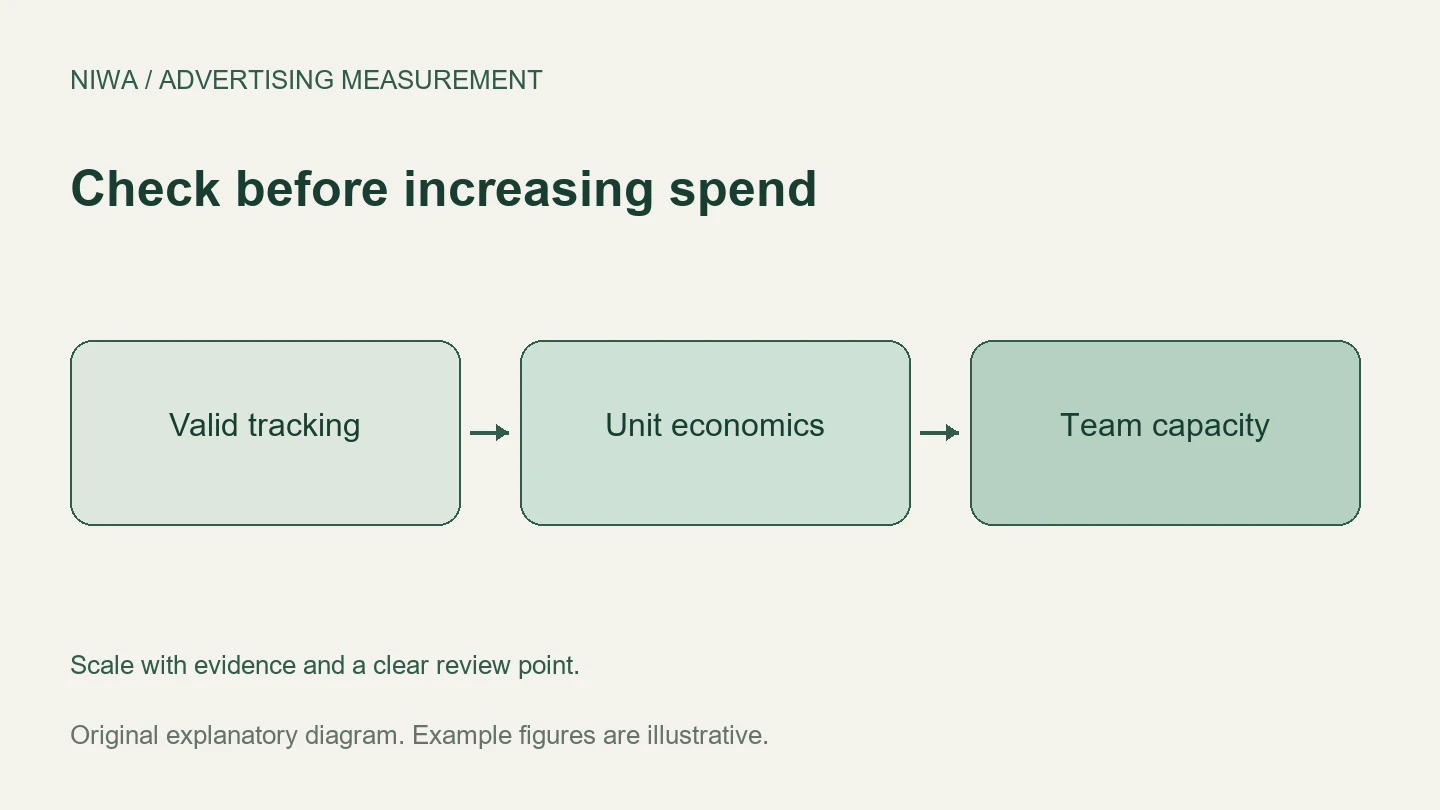
Before increasing your ad budget, track whether conversions are recorded correctly, which enquiries become paying customers, the contribution left after advertising, and whether the team can handle more demand. Compare mature lead cohorts and recent performance rather than scaling on clicks or cheap leads alone. Set a review point and a spending limit before making the change.
Niwa can help visitors understand your products and services and reach a useful next step on WordPress. Check that assisted journey before buying more traffic. How Niwa works shows the customer workflow, but its value for your campaign still needs to be measured through real enquiries, orders or completed bookings.
Verify the measurement before the economics
Run a known test visit and enquiry or order. Confirm that the source survives redirects, the intended action is saved, and the event appears once with the correct value. Try a failed form submission and a refreshed confirmation page to check that neither produces a false additional sale.
Review recent changes to the website, consent setup, checkout, booking tool and tracking integrations. A sudden improvement after a duplicate event begins firing is not evidence that more budget will work.
For WooCommerce, the native order attribution documentation describes the information captured for placed orders and its session limits. Check the data you actually have; a new feature cannot reconstruct every historical source.
Track the full lead-to-payment funnel
Keep successful submissions, genuine leads, qualified opportunities and paying customers separate. Look at the drop between stages and the time taken to progress.
If cheap enquiries rarely qualify, improving lead volume may increase workload without increasing paid business. If qualified prospects receive slow replies, the constraint may be follow-up rather than advertising reach.
For a service business, distinguish a reserved appointment, an attended appointment and a paid service. A full calendar with frequent cancellations may not justify the same budget decision as a full calendar of completed paid work.
Google’s offline conversion guidance explains supported ways to feed later outcomes into campaign measurement. Use those connections where appropriate, with confirmed data and diagnostics. Do not assume your website event already represents the final sale.
Calculate the economic limit
Know advertising cost per paying customer, net attributed revenue, refund rate and contribution margin. Include relevant fulfilment, payment and sales costs when deciding what the business can afford.
Here is an illustrative comparison:
| Measure | Campaign A | Campaign B |
|---|---|---|
| Ad spend | $500 | $500 |
| Genuine leads | 50 | 20 |
| Paying customers | 2 | 5 |
| Contribution before ads | $400 | $1,000 |
| Contribution after ads | -$100 | $500 |
Campaign A’s $10 CPL looks better than Campaign B’s $25 CPL. Yet A loses contribution under these assumptions, while B leaves $500 before any additional overhead. The useful decision depends on the commercial outcome, not the cheapest enquiry.
A high ROAS can also conceal low margin. Google’s target ROAS guidance explains conversion-value bidding, but a platform target does not establish your break-even economics or guarantee profit.
Give recent leads time to close
Review the normal delay from enquiry to payment. Compare cohorts that have had a similar opportunity to buy, and keep early indicators available for day-to-day operations.
Do not use a universal seven-day rule when your business normally closes over several weeks. Equally, do not keep funding a clearly broken form merely because some sales are delayed. Technical failures and sales-cycle maturity are different issues.
Segment new customers and repeat business when that distinction matters. A campaign drawing mostly existing customers may have attractive reported revenue without meeting a goal of acquiring new business.
Check whether more demand can be served
Review available appointment slots, stock, fulfilment time and the team’s ability to answer enquiries. Track unanswered leads, follow-up delays, cancellations and out-of-stock destinations.
Niwa uses your website’s business context to answer product and service questions, book appointments and complete sales directly in WhatsApp. Before increasing ad spend, check that services, prices, stock and appointment availability reflect what the business can deliver.
Use the Niwa setup guidance to test those next steps before asking advertising to produce more of them. Measure confirmed outcomes separately from conversation activity.
Assess the result at the next spending level
Past average performance does not guarantee the same result after expansion. Additional reach may involve different customers, placements or buying intent. Keep audience and creative changes visible so you know what changed alongside budget.
Set a controlled review plan: the intended budget, the observation period based on your sales cycle, the quality and profitability measures, and the condition that prompts investigation or adjustment. Avoid inventing a universal percentage increase for every platform and business.
Compare the additional contribution against the additional spend where the records allow it. An overall profitable campaign can still have an unprofitable latest expansion. Small samples and overlapping attribution mean that the result deserves careful interpretation rather than a claim of certainty.
Keep the decision connected to the business
Align dates, attribution settings and report scope before presenting the case for more spend. Google’s attribution settings documentation explains why reports using different scopes can credit outcomes differently.
Existing WordPress owners can install the standalone Niwa plugin to improve the supported customer journey. Niwa Business is USD 150 for a custom WordPress website or migration, hosting, maintenance and AI adaptation. Contact Niwa with your current website, lead-to-payment process and capacity constraints to discuss a journey worth measuring before you increase traffic.

