

What Is the Difference Between an AI-Built and an AI-Powered Website?
A website can be created with AI, run useful AI functions after launch, or do both. These are different capabilities to check when choosing a solution.
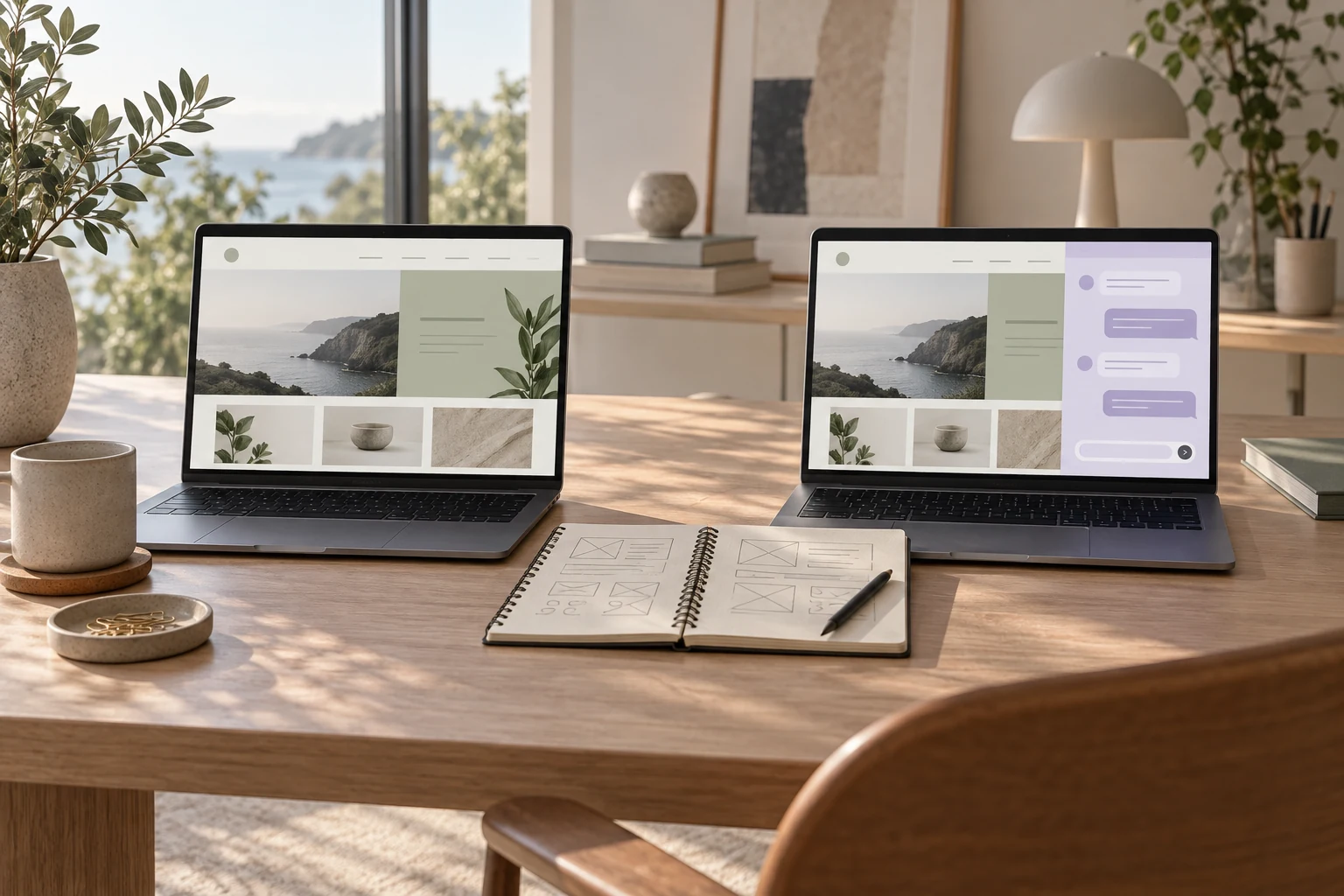
An AI-built website uses AI during creation, such as generating its layout, code or text. An AI-powered website uses AI while the published site is operating, such as answering customer questions or assisting business tasks. A website can do both, but one claim does not establish the other.
This distinction matters when comparing proposals. A generated homepage might be the deliverable you need. If you also want ongoing product assistance, website booking or owner operations, inspect those workflows separately. Niwa supplies a WordPress operating layer for that second set of tasks.
What you receive from AI-assisted construction
During construction, AI can help turn a brief into page drafts, suggest a design or produce code for review. The work still needs accurate business material, suitable images, functioning controls and a checked customer path.
Once those pages are published, their construction history does not determine how they behave. Text drafted by AI can appear on an ordinary website with no assistant. A contact form written with AI can still follow the same fixed process every time.
Wix's AI website builder is an example of AI-assisted creation. The important question for the buyer is what has been built and how it will be maintained, rather than whether every design decision was made by hand.
Ask to see the finished page, its mobile behavior and the working action that matters to your business. A generated mockup is useful design evidence, but it does not demonstrate a saved enquiry, completed order or connected schedule.
What changes when AI works after launch
An operating assistant receives a current request, interprets it and uses available business information or tools. Its next reply may depend on the conversation, the product being viewed or the detail the visitor supplies.
A shopper might compare two products and then ask about a particular size. A service customer might ask which appointment to choose. The operating layer helps with those decisions while the person is using the website.
It may also serve the owner. In Niwa, supported website editing and business operations run with the owner's access, separate from customer assistance. The owner could request a service-page revision while the visitor-facing agent explains the service. Those interfaces should not have interchangeable permissions.
For a concrete customer example, see the Niwa storefront workflow. The catalog supplies facts and supported tools determine the next action. The website needs current information even if its original design was created entirely by a person.
Can the same platform provide both?
Yes. A platform may offer AI design tools and ongoing visitor assistance. Wix documents its Smart Chat separately from its builder. Evaluate the specific feature you intend to use rather than assigning an entire supplier to one category.
The same applies to a custom WordPress site. It might be developed with AI assistance, then gain Niwa for customer conversations and owner work. Conversely, an existing site built without AI can become AI-powered through the standalone Niwa AI plugin.
Adding a feature does not make every business workflow autonomous. A connected booking flow still needs services and availability. Product assistance still needs real variants and accurate stock. The phrase AI-powered is a starting description, not a specification of all enabled actions.
Questions that separate the claims in a proposal
Before ordering, ask the supplier to show the following:
- What is delivered at launch: pages, content, integrations and access.
- What AI continues doing after launch, with a representative example.
- Which sources supply prices, service details and other changing information.
- Which actions customers can take and which require owner permissions.
- What confirms completion, such as a record or a saved website change.
- Which costs cover the website, maintenance and the selected AI connection.
Use a request with a known answer during evaluation. Then change a controlled source fact and check how the assistant receives the update. For an action, inspect its actual result. An answer that says a task is complete should be supported by the relevant record.
Recovery and data handling also belong in the proposal. The Niwa safety guide explains why provider processing and supported recovery need their own review. An automatic website check does not replace testing the feature a customer uses.
Choose the capability your business needs
If the immediate problem is an absent or outdated website, construction may be the first priority. If customers repeatedly struggle to choose a product, find a service or arrange a visit, an operating assistant may be relevant. Many businesses need both, introduced around a clear task.
Niwa Business combines a custom WordPress website or agreed migration with hosting, maintenance and an AI operating system adapted to the business for USD 150. Existing WordPress owners can add the operating tools through the standalone Niwa AI plugin plan.
Use your own supported AI subscription without additional Niwa AI usage fees or Niwa-imposed usage caps. Provider subscription terms still apply; an API connection uses separate provider billing.
Ask Niwa about the work you need after launch. State whether you need a website created, an existing site extended or a specific operating workflow. That keeps the conversation about the result you are buying.

