Botsonic vs Niwa AI: Chatbot or WordPress Business Agent?
Compare Botsonic and Niwa AI for WordPress, WooCommerce, messaging, lead capture, support, publishing, reporting, and conversion workflows.
Botsonic and Niwa AI both use conversational AI to help businesses serve customers, capture intent, and automate work. However, they approach the job from different directions.
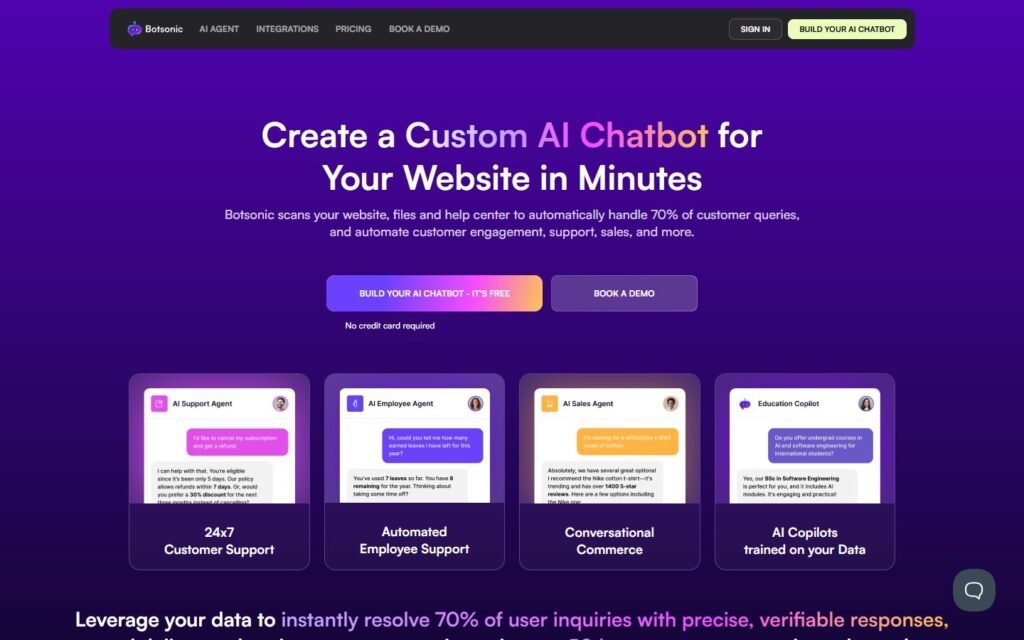
Botsonic is primarily a no-code customer-facing AI agent and chatbot platform. It can be trained on company data, embedded on WordPress, connected to channels such as WhatsApp and Telegram, integrated with support tools, and extended with workflows.
Niwa AI is designed around WordPress and WooCommerce business operations. It combines customer conversations with owner-side administration, content publishing, reporting, monitoring, and conversion workflows.
This comparison uses Botsonic’s official product pages and documentation available on July 18, 2026. It focuses on practical differences rather than declaring one tool universally better.
Quick verdict
Choose Botsonic if your priority is building a polished, multilingual customer-support or conversational-commerce agent that can be trained on your knowledge base and connected to an established support stack.
Choose Niwa AI if you want an agent that works closer to the WordPress business itself: handling site and WooCommerce tasks, publishing content, reporting to the owner, monitoring commercial signals, and connecting customer intent with operational action.
The clearest distinction is:
Botsonic is strongest as a customer-facing AI agent platform. Niwa AI is built as a WordPress business operator with customer-facing conversion capabilities.
For a broader explanation of Niwa’s operating model, see How Niwa Works.
What Botsonic does well
Botsonic, a Writesonic product, is a no-code platform for creating AI chatbots and agents trained on business data. Its official documentation shows that businesses can upload files, add website links and sitemaps, connect sources such as Google Drive, Confluence, and Notion, customize the widget, and deploy the resulting agent on a website.
WordPress support is straightforward. Botsonic provides a WordPress plugin that connects the hosted Botsonic agent to a site through a token. This is useful for businesses that want to launch an on-site assistant without developing a custom chat interface.
Botsonic’s strongest documented capabilities include:
- training an AI agent on websites, files, help centers, FAQs, and connected data sources;
- customer support in more than 50 languages;
- deployment on websites and channels including WhatsApp, Telegram, Facebook Messenger, and Slack, depending on the plan and integration;
- lead-capture forms, callback requests, email transcripts, and conversation inboxes;
- integrations with Zendesk, Freshdesk, Salesforce, HubSpot, Zapier, Calendly, and other business tools;
- live-agent handoff for questions that should not remain automated;
- workflows that can call APIs, look up information, and complete multi-step customer interactions;
- analytics for conversations, resolutions, performance, and customer-satisfaction signals;
- enterprise security controls and compliance positioning.
That makes Botsonic a credible choice for support teams, larger organizations, and businesses that already have a helpdesk or CRM ecosystem.
What Niwa AI is built to do
Niwa AI starts with a different question: what if the AI agent could help operate the WordPress business, not only answer visitors?
Niwa works across owner-side and customer-side workflows. The owner can use conversational instructions to manage WordPress and WooCommerce work, while website visitors can receive product guidance, answers, lead qualification, and conversion support.
Relevant Niwa workflows include:
- WordPress and WooCommerce administration;
- product, stock, price, coupon, order, and catalog work where configured and authorized;
- creating, updating, and publishing website content;
- owner access through Telegram and WhatsApp administration channels;
- business summaries, operational reporting, and actionable founder updates;
- lead capture with buying context rather than only contact details;
- competitor research and monitoring workflows;
- product recommendations, objection handling, follow-up, and conversion actions;
- connecting website conversations with practical next steps for the owner.
The customer-facing side is explained further in AI Lead Capture for Ecommerce, while AI Website Chat and WhatsApp for Ecommerce shows why conversation continuity matters after a visitor leaves the website.
Botsonic vs Niwa AI feature comparison
| Capability | Botsonic | Niwa AI |
|—|—|—|
| Customer-facing website chatbot | Yes | Yes |
| WordPress integration | Yes, primarily to embed the Botsonic widget | Yes, designed for WordPress operations and customer workflows |
| Knowledge-base training | Yes, with files, URLs, sitemaps, and connected sources | Yes, using relevant website, product, and business context |
| Multilingual customer support | Yes, officially positioned for 50+ languages | Yes, with multilingual conversational support |
| WhatsApp integration | Yes, as a customer-engagement channel | Yes, including customer workflows and owner administration |
| Telegram integration | Listed among Botsonic integrations | Yes, including owner-side WordPress administration |
| Lead capture | Yes, through forms, callbacks, inbox data, and integrations | Yes, with buying intent, conversation context, and follow-up workflows |
| Live-agent handoff | Yes, including documented helpdesk integrations | Yes, with human escalation and founder notifications |
| AI workflows and API actions | Yes, especially on advanced plans | Yes, focused on WordPress, WooCommerce, and business operations |
| Native WordPress content publishing | Not prominently documented as a Botsonic WordPress-plugin function | Yes |
| Native WooCommerce catalog and order administration | Not prominently documented as a Botsonic WordPress-plugin function | Yes |
| Owner commands from Telegram or WhatsApp | Not prominently documented; integrations are positioned mainly as engagement channels | Yes |
| Business performance reporting to the owner | Customer-agent analytics are documented | Yes, including business and operational reporting |
| Competitor monitoring | Not prominently documented | Yes |
| Conversion workflows | Conversational commerce, recommendations, upselling, leads, and workflows | Buyer assistance plus WordPress actions, follow-up, publishing, and operational response |
| Enterprise helpdesk ecosystem | Strong | Available integrations vary; not the primary positioning |
Public product capabilities change quickly. “Not prominently documented” means that the capability was not found in the official Botsonic product pages and documentation reviewed for this comparison; it does not claim that custom implementation is impossible.
The biggest difference: customer agent vs business operator
Botsonic’s WordPress integration places a trained customer-facing agent on the website. The agent can answer questions, collect user information, request callbacks, route complex cases, and trigger configured workflows.
Niwa’s model goes deeper into the website’s operation. A founder can ask the agent to update store information, work with WooCommerce data, publish content, prepare a report, investigate a competitor, or act on a commercial signal. The same system can also help the visitor choose a product or become a qualified lead.
This distinction matters because an answer and an operational outcome are not always the same thing.
Imagine that several visitors ask whether a product will be restocked before the weekend. A customer chatbot can explain the available policy, collect contact details, or escalate the conversation. A WordPress business operator can also help the owner inspect stock, update the product, prepare a restock notice, notify interested leads, and report the recurring demand signal.
Botsonic can support sophisticated actions through workflows and APIs, particularly on advanced plans. Niwa’s advantage is that WordPress and WooCommerce operations are central to the product rather than an external workflow project.
Where Botsonic is stronger
A fair comparison should recognize Botsonic’s clear strengths.
Mature customer-support integrations
Botsonic documents integrations with major support, CRM, and collaboration systems. Zendesk, Freshdesk, Salesforce, HubSpot, Slack, Zapier, and Calendly can be important for teams that already run structured service operations.
Broad knowledge-source options
Businesses can train Botsonic on uploaded documents, webpages, sitemaps, help-center content, and connected platforms. Advanced plans also document automatic source synchronization. This is valuable for organizations with large and frequently changing knowledge bases.
Omnichannel customer engagement
Botsonic is designed to extend customer interactions beyond the website. Its official materials describe web, WhatsApp, Telegram, Facebook Messenger, SMS, and other integrations, with availability depending on the plan.
Enterprise support and governance
Botsonic publicly emphasizes security, data controls, audit logs, compliance, advanced analytics, and enterprise deployment. Larger support organizations may value these controls more than native WordPress administration.
Configurable AI-agent workflows
Botsonic workflows can combine conversational behavior with actions such as API calls and information lookup. A team with technical resources can build customer-service automations that extend beyond simple FAQ answers.
Where Niwa AI is different
Niwa should not be presented as merely another chatbot. Its practical differentiation is the combination of WordPress operations, owner communication, and customer conversion work.
WordPress and WooCommerce administration
Botsonic’s documented WordPress plugin embeds its chatbot. Niwa is designed to work with WordPress as an operating environment. That includes tasks involving content, products, pricing, stock, coupons, orders, and other approved site actions.
For WooCommerce owners, this can reduce the distance between discovering a problem and fixing it.
Telegram and WhatsApp as owner interfaces
Both products document messaging-channel integrations. The difference is the intended user.
Botsonic positions these channels mainly as places where customers or employees can interact with an AI agent. Niwa also uses Telegram and WhatsApp as administration channels where the owner can request and review site work.
That is especially useful when the founder is away from wp-admin and still needs a task completed with a clear result.
Content publishing inside the operational workflow
Botsonic is part of the wider Writesonic ecosystem, which has strong content and SEO products. However, Botsonic itself is positioned primarily around AI agents, support, engagement, and workflows.
Niwa connects research and content publishing directly to the WordPress operating workflow. A competitor signal, repeated customer question, or product opportunity can become a drafted and published article rather than remaining only an analytics observation.
Business reporting and competitor monitoring
Botsonic documents customer-agent analytics such as conversations, resolutions, performance, and satisfaction-related metrics. These are useful for optimizing support.
Niwa’s reporting scope is broader: website and store operations, commercial activity, notable changes, and recommended next steps for the owner. Competitor research and monitoring can also feed content, pricing, positioning, and campaign decisions.
Connecting lead capture to action
Botsonic has legitimate lead-generation tools, including user forms, callback requests, conversation data, and integrations. Niwa’s distinction is not that Botsonic cannot capture leads; it clearly can.
The difference is how the lead can connect to WordPress operations and founder action. Niwa aims to retain the visitor’s question, product interest, objection, urgency, and next step so the owner receives more than an email address.
This “help first, capture second” approach is also central to Turn Website Visitors Into Leads.
Which is better for WooCommerce?
Botsonic can be useful on a WooCommerce storefront when the goal is customer support, product guidance, multilingual answers, lead capture, or a custom API-driven workflow. Its conversational-commerce positioning includes personalized recommendations, transactions, upselling, and post-purchase support.
Niwa is the better fit when the owner wants those customer conversations connected to native store operations. A question about stock can lead to an inventory check. A repeated objection can become updated product-page copy. A high-intent lead can trigger a founder notification. A commercial trend can become a report or content task.
The decision therefore depends on whether you primarily need an AI customer-service platform connected to WordPress or an AI WordPress operator that also serves customers.
Which is better for content and SEO publishing?
Botsonic can answer questions using content supplied to its knowledge base, and Writesonic offers separate content-marketing and publishing products. Botsonic’s own public documentation, however, does not prominently position the WordPress plugin as a native post-and-page publishing operator.
Niwa can connect research, drafting, internal linking, WordPress publishing, and verification in one owner-approved workflow. This is useful when content creation needs to respond directly to customer questions, competitor activity, product updates, or search demand.
If your only requirement is an AI content platform, Writesonic’s wider product suite deserves consideration. If you want content publishing to be one part of a broader WordPress business workflow, Niwa is the closer match.
Which should you choose?
Choose Botsonic when you need:
- a no-code AI chatbot or customer agent;
- strong knowledge-base training;
- multilingual customer support;
- established helpdesk, CRM, and collaboration integrations;
- configurable workflows and API actions;
- advanced enterprise support analytics and governance.
Choose Niwa AI when you need:
- WordPress and WooCommerce operations through conversation;
- owner administration through Telegram or WhatsApp;
- content creation and publishing tied to business needs;
- business reporting and actionable founder updates;
- competitor monitoring connected to content or commercial decisions;
- customer assistance, lead capture, and conversion workflows in the same operating layer.
Some businesses could use both categories of tool: Botsonic as a specialized enterprise customer-support agent and Niwa as the WordPress-side business operator. For smaller teams, choosing one should begin with the job that consumes the most founder time.
Frequently asked questions
Is Botsonic a WordPress AI agent?
Botsonic offers an official WordPress integration that embeds a trained Botsonic chatbot on a WordPress website. It is an AI agent platform for support, engagement, lead capture, and workflows, but its WordPress plugin is not publicly documented as a broad native wp-admin, publishing, and WooCommerce administration agent.
Can Botsonic work with WhatsApp and Telegram?
Yes. Botsonic’s official documentation lists WhatsApp and Telegram among its integrations, with access depending on the plan and configuration. These channels are positioned primarily for customer, employee, and conversational engagement use cases.
Does Botsonic capture leads?
Yes. Botsonic documents user forms, callback requests, conversation inboxes, transcripts, Zapier connections, and CRM integrations. It is inaccurate to describe Botsonic as lacking lead capture.
Can Botsonic publish WordPress posts?
Botsonic’s official WordPress documentation describes installing the plugin and connecting a chatbot token. Native WordPress post publishing is not prominently documented as a Botsonic plugin capability. Custom actions may be possible through workflows, APIs, or other Writesonic products.
Can Botsonic manage WooCommerce products and orders?
Botsonic is positioned for retail, conversational commerce, recommendations, transactions, upselling, and post-purchase support. However, native WooCommerce catalog and order administration through the WordPress plugin was not prominently documented in the official sources reviewed.
What is Niwa AI’s main advantage over Botsonic?
Niwa’s main advantage is the combination of customer-facing AI with owner-side WordPress and WooCommerce operations. It is designed to connect a conversation or business signal to an approved site action, report, published asset, or conversion workflow.
Is Botsonic better for enterprise support teams?
It may be. Botsonic documents a stronger enterprise helpdesk ecosystem, advanced customer-agent analytics, multiple integrations, security controls, and governance features. Teams centered on high-volume support should evaluate those strengths carefully.
Is Niwa AI better for a founder-run WooCommerce store?
Niwa is likely the closer fit when the founder wants to manage the store through conversation, receive business updates, publish content, monitor opportunities, and support customer conversion without treating each need as a separate platform.
Final verdict
Botsonic is a capable AI customer-agent platform with strong knowledge training, omnichannel engagement, lead capture, workflows, helpdesk integrations, and enterprise features. Its WordPress integration makes deploying the customer chatbot relatively simple.
Niwa AI is built for a wider WordPress operating role. It combines customer assistance with administration, WooCommerce work, content publishing, owner messaging, business reporting, competitor monitoring, and conversion workflows.
Neither product wins every category. Botsonic is stronger when the center of gravity is customer support infrastructure. Niwa is stronger when the center of gravity is operating and growing a WordPress or WooCommerce business.
To evaluate the WordPress-operator approach on your own site, book a Niwa demo.
Sources reviewed
This comparison was verified against Botsonic’s official product page and documentation for WordPress integration, integrations, plans, workflows, lead forms, callback requests, analytics-related settings, and website data synchronization. Product claims reflect public information reviewed on July 18, 2026.