TWWIM AI vs Niwa AI: Voice Commerce or WordPress Business Agent?
Compare TWWIM AI and Niwa AI for WooCommerce voice commerce, WordPress operations, messaging, publishing, reporting, leads, and conversions.
TWWIM AI and Niwa AI both bring agent-style automation to WordPress and WooCommerce, but they solve different problems.
TWWIM AI is primarily a customer-facing voice-to-action commerce assistant. It helps visitors find products, apply filters, select variations, ask catalog questions, add items to the cart, and move toward checkout using voice or text.
Niwa AI is designed as a broader WordPress business agent. In addition to customer-facing sales and support conversations, Niwa can help the owner operate WordPress and WooCommerce, publish content, review business information, monitor opportunities, and manage work through channels such as Telegram and WhatsApp.
This comparison uses TWWIM AI’s official website and current WordPress.org plugin listing as the primary sources. Features that are not clearly documented are described as “not publicly documented,” rather than assumed to be unavailable.
Quick Verdict
Choose TWWIM AI if your priority is improving storefront product discovery, especially on mobile, with voice and text commands that can change what happens on the page. Its focused WooCommerce experience is compelling for stores with large catalogs, many product attributes, or shoppers who struggle with conventional filters.
Choose Niwa AI if you want an agent that works across more of the business: WordPress and WooCommerce operations, customer conversations, publishing, reporting, lead workflows, competitor research, and owner administration through messaging apps.
The simplest distinction is:
TWWIM AI helps shoppers act inside the store. Niwa AI helps both shoppers and the owner move the business forward.
What TWWIM AI Does Well
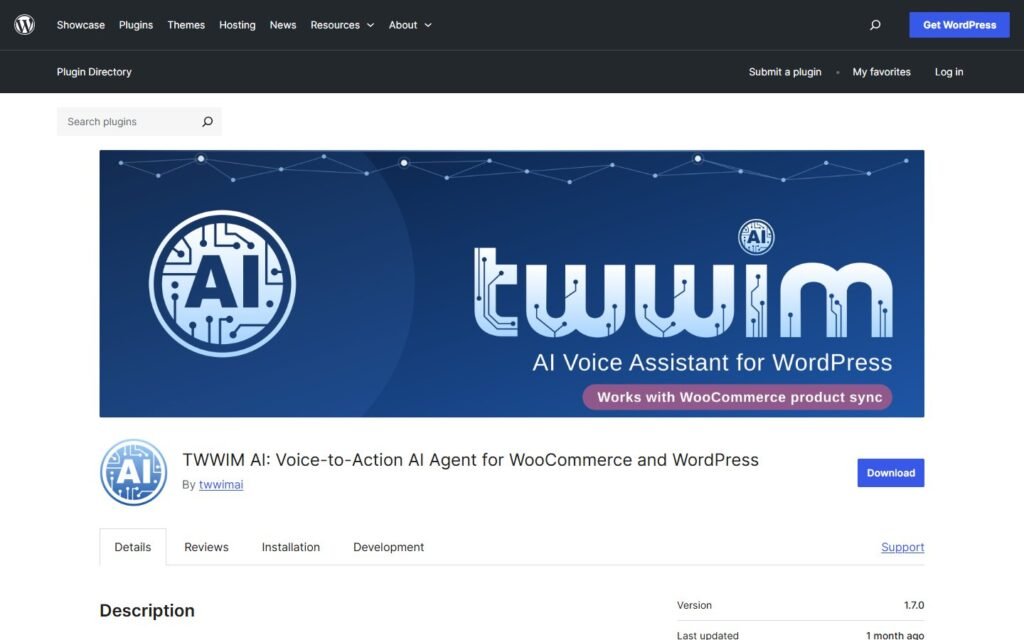
TWWIM AI describes itself as a voice-to-action AI agent for WordPress and WooCommerce. Visitors can speak or type a request, and the assistant can answer or perform a relevant storefront action.
According to the official WordPress.org plugin listing, supported customer actions include:
- navigating to a relevant category or page;
- applying WooCommerce product filters;
- answering questions from the site’s catalog and content;
- resolving product variations such as color or size;
- checking stock availability;
- adding, removing, or updating cart items;
- moving the shopper toward checkout;
- accepting voice or text input and returning text responses.
Its official WooCommerce integration page also documents automatic synchronization of products, variations, prices, stock, categories, and attributes. Product updates can flow through webhooks, helping the assistant work from current catalog information.
This is more useful than a chatbot that only produces an answer. If a shopper says, “Show me black running shoes under $100,” the intended experience is not merely a list of suggestions in a chat bubble. TWWIM AI can map that request to the store’s categories and filters and move the shopper to an appropriate result set.
That action-oriented design is TWWIM AI’s clearest strength.
What Niwa AI Does Differently
Niwa AI is built around a wider operating model. The storefront assistant is one part of the system, not the entire product.
On the customer side, Niwa can support product discovery, common questions, lead qualification, hesitation handling, and conversion-oriented next steps. This fits the connected journey described in our guide to website chat and WhatsApp for ecommerce.
On the owner side, Niwa is designed to receive instructions and complete approved work across WordPress and WooCommerce. The owner can ask for product updates, content publishing, reporting, competitor research, or other operational tasks without treating every request as a separate dashboard project.
That broader model is explained on How Niwa Works: the goal is to connect conversations, site actions, and business outcomes rather than add another isolated chatbot.
TWWIM AI vs Niwa AI Comparison Table
| Capability | TWWIM AI | Niwa AI |
|—|—|—|
| Customer-facing WordPress assistant | Yes | Yes |
| Voice input for storefront visitors | Yes, a core feature | Not the primary public positioning |
| Text-based storefront assistance | Yes | Yes |
| WooCommerce catalog synchronization | Yes | Yes, through WordPress and WooCommerce workflows |
| Product and variation discovery | Yes | Yes |
| Storefront filter navigation | Yes, a major strength | Supported through conversational product discovery rather than positioned mainly as voice filtering |
| Add or update cart items from the assistant | Yes | Supported in conversion workflows where configured |
| WordPress administration for the owner | Not prominently documented | Yes |
| WooCommerce product, stock, price, and operational management | Storefront catalog sync is documented; owner-side editing is not the primary positioning | Yes |
| Telegram administration | Not publicly documented | Yes |
| WhatsApp administration | Not publicly documented | Yes |
| Content and page publishing | Not publicly documented | Yes |
| Business reporting | Usage activity is documented; broader business reporting is not prominently documented | Yes |
| Lead capture and qualification | Customer assistance is documented; structured lead workflows are not prominently documented | Yes |
| Competitor research and monitoring | Not publicly documented | Yes |
| Conversion-focused customer workflows | Yes, especially discovery, filters, cart actions, and checkout movement | Yes, including customer guidance, lead capture, follow-up, and operational actions |
| Primary product focus | Voice-to-action storefront commerce | WordPress business operations plus customer conversion |
Public product capabilities change quickly. This table reflects the official information reviewed on July 17, 2026.
The Biggest Difference: Storefront Action vs Business Operation
TWWIM AI’s strongest workflows begin with a visitor on the website.
A shopper may not know the store’s exact category names, filter structure, SKU, or product terminology. They know the outcome they want. TWWIM AI translates that natural-language request into a page action, catalog answer, variation selection, or cart action.
This can be especially valuable on mobile. Traditional WooCommerce filters may require several taps through drawers, attributes, categories, and sorting controls. A spoken request can compress those steps into one interaction.
Niwa AI’s workflows can begin with either the shopper or the owner.
A customer might ask for a recommendation, raise an objection, or request follow-up. The owner might ask Niwa to update a product, prepare and publish content, inspect sales information, monitor a competitor, or report an issue. Niwa’s advantage is the ability to connect those activities.
For example, a customer conversation may reveal repeated uncertainty about compatibility. A storefront-only assistant can answer the immediate question. A broader business agent can also help the owner identify the pattern, update the relevant product content, publish a supporting guide, and monitor whether the objection continues.
That is the difference between completing an on-page action and participating in an operating loop.
Which Is Better for WooCommerce Product Discovery?
TWWIM AI is a strong choice when product discovery itself is the main problem.
Its official documentation emphasizes:
- automatic product and variation sync;
- category and attribute mapping;
- stock-aware responses;
- voice-driven filters;
- cart actions without leaving the page;
- mobile shopping without cumbersome filter interfaces.
For a store with hundreds or thousands of products, this specialization can be valuable. A shopper who cannot find the right category or does not understand the store’s naming system can describe the desired outcome naturally.
Niwa AI also supports conversational product discovery, but its broader value appears when discovery needs to connect with sales and operations. A shopper may need a product recommendation, a qualified human handoff, a saved lead, or a follow-up conversation. Our guide to AI product finders for ecommerce explains why the best recommendation experience should lead to a useful commercial next step, not merely another list of products.
Advantage: TWWIM AI for a highly focused voice-and-filter shopping interface.
Advantage: Niwa AI when product discovery must connect with lead management, owner workflows, reporting, and follow-up.
Which Is Better for WordPress and WooCommerce Administration?
This is where the products separate more clearly.
TWWIM AI’s official WordPress plugin documentation describes an embedded dashboard for account management, subscription settings, widget placement, page exclusions, and catalog synchronization. Its public positioning is centered on what the storefront visitor can do.
The reviewed sources do not prominently document natural-language workflows for the owner to edit products, manage stock, publish posts, create pages, run business reports, or administer the site through Telegram or WhatsApp.
Niwa AI is designed for those owner-side tasks. The aim is to reduce the operational distance between an instruction and a completed WordPress action. Instead of opening several wp-admin screens for every change, the owner can describe the required outcome through a supported messaging channel and receive a completion report.
This matters for founders who manage the business away from a desk. It also matters when a task spans several systems: reviewing a business signal, changing the website, preparing content, and reporting what happened.
Advantage: Niwa AI for owner-side WordPress and WooCommerce operation.
Telegram and WhatsApp: Two Different Uses of Conversation
TWWIM AI uses conversation primarily as the shopper interface. Voice and text help visitors navigate and act on the storefront.
Niwa AI uses conversation on both sides:
- Customer-facing conversation for sales, support, qualification, and conversion.
- Owner-facing conversation for administration, publishing, analysis, and business tasks.
Telegram and WhatsApp administration are important because the owner’s command center no longer has to be wp-admin. A founder can request a price change, ask for a report, review a draft, or trigger an approved workflow from a familiar messaging app.
TWWIM AI’s reviewed official materials do not prominently document Telegram or WhatsApp as owner administration channels. That is not a criticism of its core product; it reflects a different focus.
Content Publishing and SEO Workflows
A modern WordPress AI agent may need to do more than answer questions from existing content. It may also need to improve that content.
TWWIM AI indexes site pages and catalog information so its storefront assistant can answer questions and perform actions. This grounding is valuable because it reduces the risk of generic answers disconnected from the actual store.
However, its public feature pages do not prominently document end-to-end editorial workflows such as researching a topic, drafting a WordPress article, adding internal links, assigning SEO metadata, publishing the article, and confirming publication.
Niwa AI is designed to support those publishing workflows alongside other business tasks. The distinction is important: reading a product page to answer a shopper is different from recognizing a recurring question and helping the owner create a new page that resolves it for future visitors and search engines.
Business Reporting and Competitor Monitoring
TWWIM AI’s WordPress dashboard includes account, subscription, command-usage, activity, and synchronization information. Those are useful product-management signals.
Broader business reporting and competitor monitoring are not prominent in the reviewed TWWIM AI documentation. The product’s public promise focuses on customer communication, navigation, product discovery, and on-page action.
Niwa AI is positioned to help the owner interpret wider business signals. Depending on the connected tools and approved workflows, that can include sales summaries, product or stock observations, content opportunities, competitor research, and conversion issues.
The purpose is not to produce more dashboards. It is to identify what changed, explain why it matters, and help complete the next useful action.
Lead Capture and Conversion Workflows
TWWIM AI can reduce friction before checkout by answering catalog questions, navigating to relevant products, applying filters, checking stock, handling variations, and changing the cart. These are real conversion workflows, and TWWIM AI deserves credit for making actions, not only answers, the center of its product.
Niwa AI extends conversion work into structured lead and follow-up paths. A visitor may not be ready to buy immediately, especially for high-value products, services, wholesale requests, custom quotes, or complex implementation decisions.
In those cases, the agent should identify intent, collect the right information, preserve context, and route the opportunity correctly. See our practical guide to AI lead capture for ecommerce for how that differs from simply asking for an email address.
TWWIM AI’s reviewed materials do not prominently document structured lead qualification, CRM handoff, competitor-triggered campaigns, or owner follow-up through messaging apps. Niwa AI is the better fit when those workflows are central to the buying journey.
Where TWWIM AI Is Stronger
A fair comparison should recognize where TWWIM AI has the clearer advantage.
Voice-to-action is a real specialization
Voice is not merely an alternative way to ask a chatbot a question. TWWIM AI connects voice requests to filters, navigation, variation selection, and cart actions. That is a differentiated storefront experience.
Mobile filtering is a practical use case
Complex filter interfaces are often inconvenient on smaller screens. Letting shoppers describe several attributes in one sentence can remove meaningful friction.
Its focus is easy to understand
TWWIM AI has a sharp promise: visitors speak or type what they want, and the website responds with an answer or action. Businesses that mainly need that experience may prefer a specialized product over a broader operating platform.
Catalog data handling is clearly documented
The WordPress.org listing explains which product fields are synchronized and states that no customer or order data is sent through the WooCommerce catalog-sync process. That transparency is useful when evaluating a storefront AI tool.
Where Niwa AI Has the Broader Advantage
Niwa AI is stronger when the required job extends beyond the current visitor session.
Its broader model is a better fit when a business wants to:
- administer WordPress and WooCommerce conversationally;
- work through Telegram or WhatsApp;
- create and publish content;
- connect customer questions with site improvements;
- qualify and route leads;
- produce business-focused reports;
- research competitors and market opportunities;
- coordinate follow-up and conversion workflows.
This does not make TWWIM AI’s narrower approach inferior. It means the two products should be evaluated against different operating goals.
Which WordPress AI Agent Should You Choose?
Choose TWWIM AI when you want a focused, customer-facing voice and text assistant that can improve WooCommerce discovery, navigation, filtering, variation selection, and cart movement.
Choose Niwa AI when you want a broader business agent that can combine customer assistance with WordPress operations, WooCommerce administration, messaging-app control, content publishing, reporting, lead workflows, competitor monitoring, and conversion work.
For some stores, the decision comes down to one question:
Do you mainly need a better interface for shoppers, or do you need an agent that can also work with the owner behind the store?
TWWIM AI is compelling for the first requirement. Niwa AI is built for the second while also supporting the customer-facing conversion layer.
If you want to see how that wider model works, explore AI agents for ecommerce or request Niwa AI access.
Frequently Asked Questions
Is TWWIM AI a WordPress chatbot?
It includes a customer-facing assistant, but “chatbot” understates its main feature. TWWIM AI can perform storefront actions such as navigation, filtering, variation selection, cart updates, and checkout movement in response to voice or text requests.
Does TWWIM AI support WooCommerce?
Yes. Its official plugin documentation describes WooCommerce catalog synchronization, product-aware answers, stock awareness, variation handling, category and filter navigation, and cart actions.
Can TWWIM AI manage WordPress through Telegram or WhatsApp?
Telegram and WhatsApp owner administration are not prominently documented in the official TWWIM AI sources reviewed for this comparison. Niwa AI supports owner-facing administration through messaging channels as part of its broader operating model.
Can TWWIM AI publish WordPress posts and pages?
The reviewed public documentation focuses on indexing content and helping visitors navigate or act on the storefront. End-to-end content research, drafting, SEO configuration, publishing, and publication verification are not prominently documented.
Which is better for product discovery?
TWWIM AI has a clear advantage for voice-driven filters and direct on-page shopping actions. Niwa AI is stronger when product discovery must connect with lead qualification, follow-up, business reporting, or owner operations.
Which is better for WooCommerce administration?
Niwa AI is the better fit for conversational owner-side administration, including operational product and store workflows. TWWIM AI’s documented WooCommerce strength is primarily customer-facing catalog discovery and storefront action.
Are TWWIM AI and Niwa AI direct substitutes?
Not completely. They overlap in customer-facing WordPress and WooCommerce assistance, but their centers of gravity differ. TWWIM AI is a specialized voice-to-action commerce interface. Niwa AI is a broader WordPress business agent designed to work with both the customer and the owner.
Final Takeaway
TWWIM AI is one of the more interesting WordPress AI plugins for stores that want visitors to do more with natural language. Its voice-to-action approach is specific, understandable, and commercially relevant.
Niwa AI takes a wider view. The website assistant should not only help a visitor find a product. It should also help the owner understand demand, improve the site, operate WooCommerce, publish useful content, capture opportunities, and complete the next business action.
That makes the choice less about which tool has “more AI” and more about where you want the agent to work: inside the storefront experience alone, or across the business that the storefront supports.