

What Is Local SEO?
Understand local SEO for businesses serving a real place: Google Business Profile, local service pages, genuine reviews and a usable enquiry or booking route.
Local SEO is the work of helping a business appear in relevant searches connected to a place or service area. It includes the business's website, accurate local information and, for eligible businesses, its Google Business Profile. The goal is to help nearby customers find a suitable service and understand how to contact or visit the business.
A local result can involve Google Maps or ordinary website results. These are related parts of a customer's search journey, but they are not identical reports or ranking systems.
For the website part, Niwa's maintenance assistant can help an owner update approved service, location and contact details on WordPress. A useful local page should describe where the business actually operates and how a customer can proceed.
A local search has a place attached to the need
Someone searching for a locksmith usually needs a business that can serve their location. Someone reading about how a lock works may need an explanation regardless of where the author operates.
That difference affects the information the customer needs. A fictional locksmith's local service page should explain its genuine service area, opening arrangements, services offered and contact process. It should not claim round-the-clock coverage if the team cannot provide it.
Local intent does not always include an explicit town name. Google can use location information when presenting local results. Test and interpret visibility in the places your customers use, rather than treating a search from the owner's desk as a universal view.
Google Business Profile has eligibility rules
A Business Profile can help an eligible business represent itself on Search and Maps. Eligibility and representation depend on Google's rules, including how the business interacts with customers. An online-only company cannot assume it qualifies simply because it has an address.
Google's Business Profile guidelines describe how to represent a business, including storefront and service-area arrangements. Use the real business name and appropriate information. A service area is not permission to invent premises in every town.
Keep control of the account that represents your business. If a specialist helps manage it, establish appropriate access rather than losing ownership of the profile. Profile changes and website changes are separate tasks, so confirm what a service provider will actually handle.
What shapes local ranking?
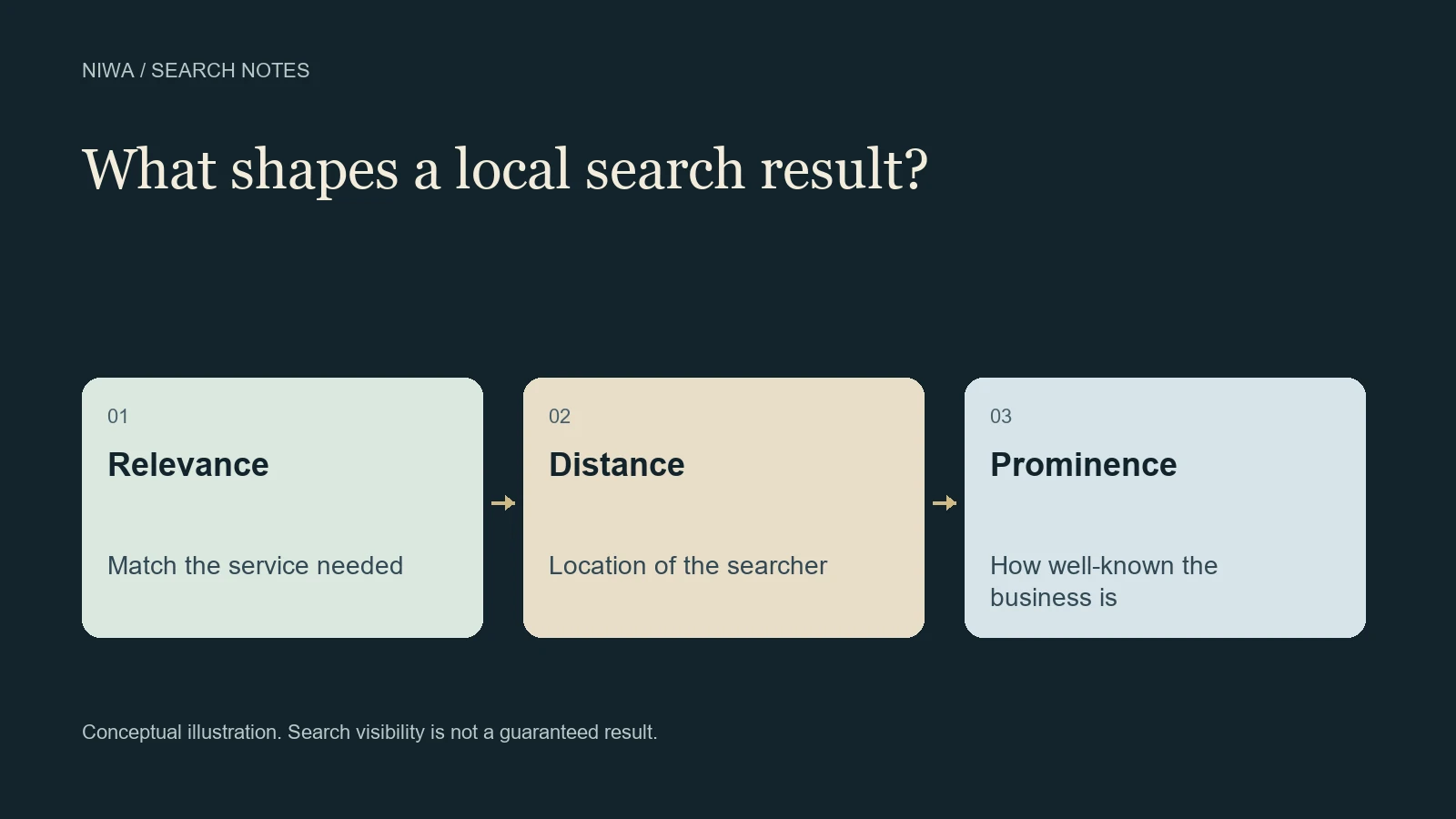
Google identifies relevance, distance and prominence as the main factors in its local ranking guidance. Relevance concerns how the business matches the search. Distance concerns location. Prominence concerns how well known the business is.
Complete, accurate information helps Google understand the business. Genuine reviews and relevant references can contribute to its wider presence. Distance also means the same business can appear differently for searchers in different places.
No profile field lets an owner purchase a preferred organic local position. A promise that every customer across a large region will see the business first ignores the query and location involved.
What belongs on the local website?
A customer should be able to check practical facts without assembling them from several inconsistent pages:
- The service the business actually provides.
- A genuine location or accurate service area.
- Current hours and the way enquiries are handled.
- Contact information and any relevant visiting arrangements.
- A working next step, such as an enquiry or website booking flow.
Keep those details consistent with the business's real operation. Different hours on the website and profile create a customer problem even before anyone discusses rankings.
A location page is useful when it represents something real and distinct. Copying the same generic page across many town names does not prove local relevance. Explain genuine differences in availability, travel arrangements or facilities when those differences exist.
Reviews need to reflect real experiences
Make it straightforward for customers to leave genuine feedback under the platform's rules. Google prohibits fake engagement and incentives for reviews in its contribution policy. Do not offer a discount in exchange for a favorable review or selectively solicit only praise.
Respond thoughtfully and protect customer information. A reply can acknowledge a concern without revealing private service details. Treat a complaint as evidence about the experience to investigate, rather than something to conceal from future customers.
More reviews do not fix inaccurate opening hours or a broken booking form. Local SEO depends on the information and experience fitting together.
A concrete WordPress task with Niwa
Suppose the fictional locksmith changes its weekend hours. The owner should update the relevant public website pages and separately maintain the Business Profile. Providing one precise instruction and the approved hours makes the website change reviewable.
Use the Niwa setup guide to configure the plugin and authorized owner access. Identify each affected page, provide the current details and review the saved output. Check the phone layout and contact link afterward. This does not assume that a website edit automatically changes an external Business Profile.
For a service business using Niwa's customer assistance, Niwa can use the website's service details and business context to answer WhatsApp questions, show availability and complete a booking in the conversation. Describe that option accurately on the service page.
Measure the local customer's next step
Review profile performance where available and use Search Console for the website's pages and queries. Track relevant enquiries or completed bookings with the measurement setup your business actually uses. A click on a contact button and a completed booking are different events.
Keep location context when assessing visibility. A search result in one postcode does not establish the same position throughout your service area, and a spike in visitors does not prove they became customers.
If local service information is scattered across your WordPress site, contact Niwa with the pages and current operating details. Start by making the business easy to understand and contact in the places it genuinely serves.

