

What Is Off-Page SEO?
Learn how off-page SEO relates to independent links, business reputation and referrals, and how to assess opportunities without buying ranking promises.
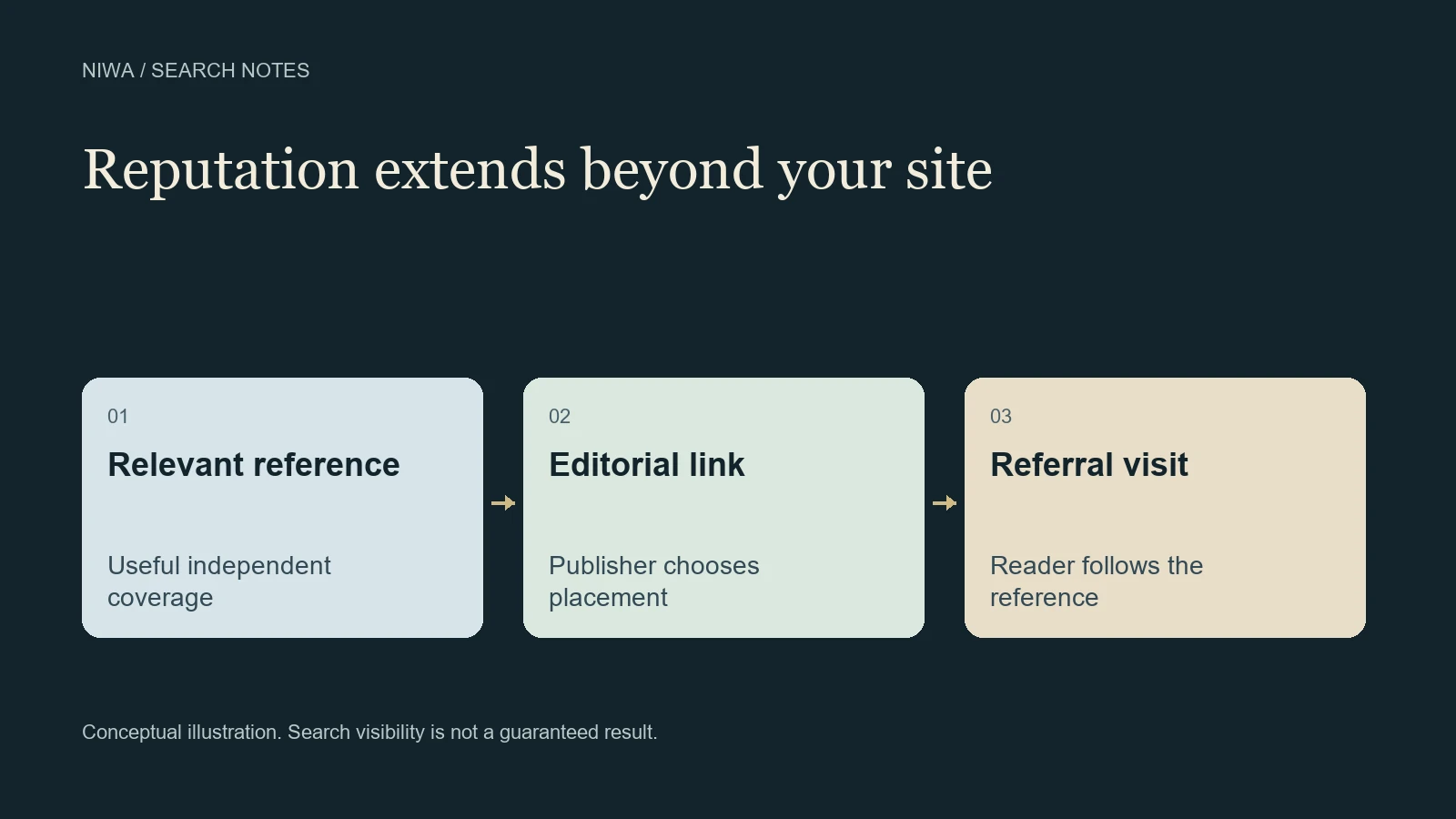
Off-page SEO is work outside your own website that helps people and search engines understand its reputation and relevance. It often involves independent links, relevant business listings and genuine references to your work. For local businesses, customer reviews and an accurate business profile are also important parts of the wider presence.
You can improve your own page directly. You cannot unilaterally decide that an independent publisher will recommend it, link to it or give it a favorable review. A useful off-page plan respects that difference.
Niwa can help an owner prepare and maintain the WordPress content a reference should lead to. Its business operating workflow also describes research and work on backlink opportunities. The result still needs evidence: a discovered opportunity is not a published link.
Why links receive attention
A link can help a reader reach a page and help a search engine discover it. Google also describes references from prominent sites as one factor in understanding content quality in its explanation of ranking results.
This does not make every link equally useful. A relevant reference in an article customers actually read has a different role from a paid bundle of unrelated links. Placement, context and the destination all matter to the reader.
Imagine a fictional bicycle repair workshop publishing a detailed guide to maintaining commuter bikes. A local cycling club might find it useful and choose to include it in a resources page. The workshop can make the guide accurate and explain why it may help members. The club decides whether it belongs on its site.
Do not mistake the example for a required tactic or a prediction. The practical idea is to create something worth referring to and look for audiences for whom it is genuinely relevant.
Reputation is broader than a link count
A business may be discovered through professional associations, local organizations, press coverage, customer recommendations and directories people actually use. These references can produce direct visits or help a customer confirm that the business exists.
An unlinked mention can still be commercially useful. It is not automatically equivalent to a crawlable backlink or proof of a direct ranking benefit. Keep those claims separate when evaluating a report.
For an eligible local business, Google says local results mainly consider relevance, distance and prominence. Its local ranking guidance includes links and reviews among the information relevant to prominence. That does not mean a business can pay Google to occupy a preferred local position.
What should an owner avoid?
Google's spam policies describe link practices intended to manipulate rankings. The guidance covers paid ranking links, excessive exchanges and other arrangements created primarily for that purpose.
Advertising and sponsorship can be legitimate, but their links need appropriate qualification. A sponsored placement should not be presented to a client as an independent editorial endorsement. Likewise, a directory entry should not be described as press coverage.
Be cautious with a vendor promising a certain number of links without explaining where they will appear, why they are relevant or what control you retain. A large count is not evidence that the work helps your customers or complies with search policies.
No vendor can guarantee that an independent editor will accept a contribution. If a report lists pitches sent, treat that as outreach activity. A live reference should have a source URL, a destination, a checked date and a description of the actual placement.
A practical way to assess an opportunity
Start with the audience and the reason a reference would be useful. For the bicycle workshop, a local cycling club may fit better than a general website with no connection to cycling or the service area.
Ask whether a real person uses the site and whether the page context makes sense. Inspect the existing material, the expected contribution and the destination on your own website. Do not provide an irrelevant guest article just to force in a link.
Your landing page must also fulfill the reference. A guide linked for maintenance advice should contain useful advice. A business listing should lead to accurate contact and service information. Broken links or a confusing destination waste the visit even when the external reference is legitimate.
Keep an opportunity list distinct from a results list. An editor considering your guide, a submitted listing and a published reference represent different states.
Where Niwa can help
Use Niwa to prepare supported content changes on the destination page: correct service details, revise an outdated explanation or organize approved material into a useful guide. The Niwa setup guide covers the plugin configuration and access needed for owner work.
For research or content preparation, define the audience, scope and acceptable evidence. Review suggestions before acting on them. External outreach needs its own approved recipients and message; drafting a pitch does not authorize sending it or make its claims true.
The owner should keep actual placement evidence and assess relevant referral visits or enquiries where measurement is available. A ranking change can have multiple causes, so a newly acquired link is not proof that it alone caused an increase.
If your business receives external references but the destination page is outdated, contact Niwa with that page and the correction needed. Accurate content gives the visitor something useful after the click. Off-page work begins to make business sense when the reference and the page serve the same customer need.

