

AI Subscription Assistant for Ecommerce: Reduce Churn Before Renewal
See how an AI subscription assistant answers renewal questions, fixes plan confusion, and hands off high-risk subscribers before churn happens.
Subscription ecommerce is supposed to feel predictable: the customer chooses a plan, receives the product on schedule, and keeps paying because the experience stays easy. In reality, many subscription stores lose revenue in the quiet moments between checkout and renewal. A shopper is unsure which plan fits. A subscriber wants to skip one delivery but cannot find the option. A card fails. A cancellation request arrives because nobody answered the small question in time.
An AI subscription assistant helps ecommerce teams protect recurring revenue without forcing every question into a human support queue. It answers plan, renewal, delivery, payment, and cancellation questions in the chat flow, then hands off the right conversations when a human should step in.
What an AI subscription assistant actually does
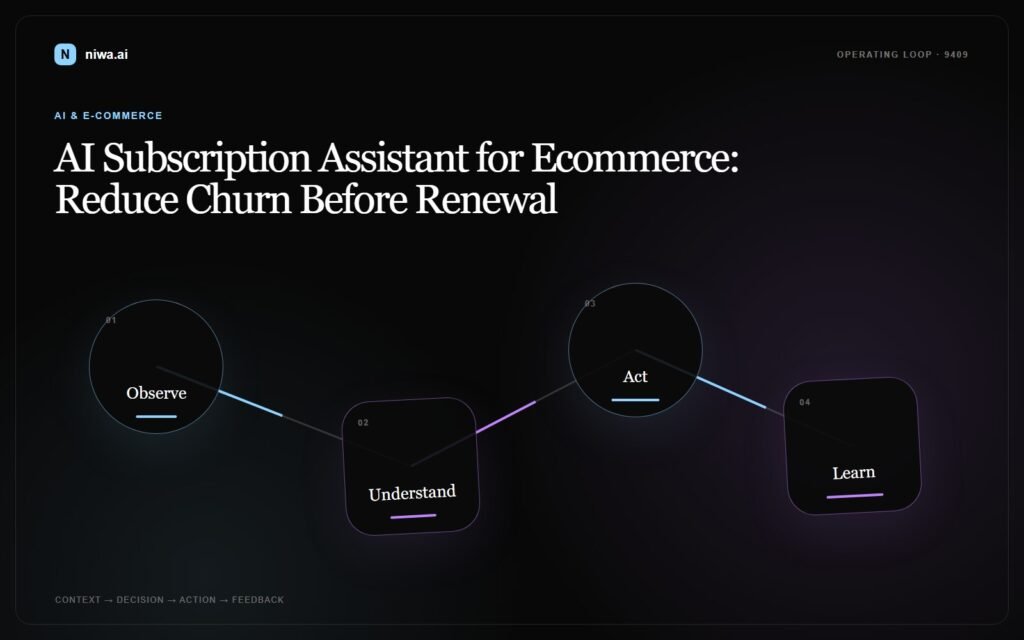
A useful subscription assistant is not just a generic FAQ bot with the word “subscription” added to the script. It understands the commercial moments that matter for recurring revenue:
- Before checkout: it explains plan differences, delivery cadence, minimum commitments, and what happens after the first order.
- After purchase: it helps customers find order status, next shipment dates, refill timing, and account settings.
- Before renewal: it answers “Can I skip?”, “Can I change the frequency?”, “Can I swap products?”, and “When will I be charged?”
- When risk appears: it detects cancellation language, failed payment concerns, complaints, and downgrade intent.
- When the account matters: it sends a clean summary to support, sales, or CRM instead of making the customer repeat the story.
That last part matters. A subscription business does not only need more chats answered. It needs better retention signals captured while the buyer is still willing to talk.
Where subscription revenue usually leaks
Most teams notice churn after the cancellation. The better move is to catch the friction earlier. In subscription ecommerce, friction often appears in five places.
1. The first checkout feels more risky than a normal order
A one-time purchase asks for one decision. A subscription asks for trust: future charges, future deliveries, future product fit, and an easy way to pause or cancel. Even normal ecommerce checkout is fragile. Baymard’s 2026 cart abandonment benchmark reports a 70.22% average documented online shopping cart abandonment rate. A subscription checkout adds extra questions on top of that baseline.
The assistant should answer the trust questions before they become exits: “How often do I receive it?”, “Can I skip a month?”, “Is there a commitment?”, “What happens if I choose the wrong size/flavor/plan?”
2. Plan confusion creates silent non-buyers
Subscription pages often show three plans because the business wants a clean pricing table. Customers do not think in pricing-table logic. They think in use cases: “I need enough for two people,” “I only want this during the season,” or “I am buying for my team.”
An AI assistant can ask two or three qualifying questions and recommend the practical starting plan. This is similar to an AI product finder for ecommerce, but tuned for recurring commitments instead of one-off product choice.
3. Renewal anxiety turns into cancellation
A subscriber may be happy with the product and still cancel because the account controls are unclear. If the only obvious options are “keep paying” or “cancel,” customers who only wanted to pause will choose cancellation.
The assistant should make safe alternatives visible: skip one delivery, change the delivery date, reduce frequency, update the product mix, or talk to support. This is not about hiding cancellation. It is about helping the customer choose the action they actually intended.
4. Payment problems are treated like support tickets instead of revenue events
Failed cards, expired payment methods, unclear invoices, and “Why was I charged?” messages can become churn triggers. The assistant should explain the next step clearly and route sensitive billing issues to the right place. If the store already uses an AI payment assistant for ecommerce, subscription logic should connect to the same handoff path.
5. Support learns about churn, but marketing and sales never see the pattern
One cancellation may be a normal account decision. Fifty similar cancellation chats are product, offer, or onboarding data. The assistant should tag reasons such as price concern, too much product, not enough product, delivery timing, missing feature, wrong plan, or payment issue.
Those tags should move into the systems the team actually uses. HubSpot describes CRM software as a centralized platform for managing customer relationships, leads, and customer activity. For a subscription store, that centralized history is what turns chat conversations into retention work instead of isolated support notes.
High-value chat triggers for subscription stores
The best subscription assistant is proactive in the right moments and quiet when the shopper is already moving. Start with these triggers:
- Plan page hesitation: if the visitor compares plans for more than a set time, offer to recommend a plan based on usage.
- Checkout hesitation: if the visitor pauses near billing or commitment details, answer cancellation, skip, and renewal questions directly.
- Account page visits: if the subscriber opens subscription settings, offer help with pause, frequency, address, or product changes.
- Cancellation intent: if the subscriber types “cancel,” “pause,” “too expensive,” or “not using it,” ask one respectful reason and present the best next step.
- VIP or high-LTV account: if the subscriber has high order value or a long subscription history, summarize the issue for a human before the relationship is lost.
This is where subscription support overlaps with loyalty. A good AI loyalty assistant for ecommerce does not only reward the happy customer. It also notices when a valuable customer is about to leave.
What the assistant should say during cancellation intent
Cancellation flows become toxic when they feel manipulative. The assistant should never trap the customer or bury the cancel option. A better script sounds like this:
“I can help with that. Before you cancel, do you want to stop future deliveries completely, pause for one cycle, change the delivery frequency, or switch products? If you still want to cancel, I’ll show you the direct next step.”
That response gives control back to the customer. It also separates real churn from solvable friction.
Data the AI should hand off to your team
For subscription revenue, the handoff summary is often more valuable than the chat transcript. Niwa AI should capture fields such as:
- Subscriber status: prospect, active subscriber, paused, payment failed, cancellation intent, or win-back.
- Plan and cadence: current plan, desired frequency, product preference, and next renewal date if available.
- Risk reason: price, product fit, too much stock at home, delivery timing, billing confusion, missing feature, or support issue.
- Recommended next step: self-serve account action, support follow-up, retention offer, CRM task, or human review.
- Commercial priority: first-time subscriber, high-LTV customer, wholesale/subscription hybrid buyer, or low-fit account.
If your sales or support workflow already uses structured follow-up, connect this with an AI CRM handoff for ecommerce so the next person sees the account context immediately.
A practical rollout plan
You do not need to automate every subscription scenario on day one. Start with the revenue moments that already create tickets or cancellations.
- Map the top 20 subscription questions: plan fit, skip/pause, renewal date, billing, product swaps, delivery changes, cancellation, and refunds.
- Define safe actions: what the assistant can answer, what it can link to, and what must go to a human.
- Add retention tags: create a short reason list instead of letting every chat become free-form notes.
- Build escalation rules: high-value subscribers, angry language, billing disputes, and repeated failed payments should get faster human attention.
- Review weekly: look for repeated objections and update the subscription page, onboarding emails, and account settings.
The goal is not to replace your retention strategy with a chatbot. The goal is to make sure subscription friction is answered, categorized, and routed before it becomes churn.
When a subscription assistant is worth it
An AI subscription assistant is especially useful when your store has recurring orders, replenishment products, memberships, product boxes, consumables, B2B repeat orders, or any offer where the second and third purchase matter more than the first. It is also useful when support spends too much time answering the same account questions instead of saving the conversations that need human judgment.
If you want Niwa AI to answer subscription questions, detect cancellation risk, and hand off the right conversations before revenue is lost, Book a Niwa AI demo.

