AI Loyalty Assistant for Ecommerce: Turn Support Chats Into Repeat Purchases
An AI loyalty assistant turns ecommerce support chats, reorder questions, reviews, and CRM handoffs into repeat purchases without creepy automation.
Repeat purchases do not happen because a store has a loyalty program. They happen because the customer remembers the brand, trusts the next recommendation, and can get help without repeating the same story again.
That is where an AI loyalty assistant becomes useful. Instead of treating loyalty as a coupon popup after checkout, it uses the conversations shoppers already have with your store: product questions, delivery concerns, return requests, sizing doubts, reorder reminders, and post-purchase follow-ups.
For ecommerce teams, the goal is simple: turn ordinary support and sales chats into cleaner customer data, better next-best actions, and more repeat orders.
What is an AI loyalty assistant?
An AI loyalty assistant is a customer-facing chat agent that helps shoppers before and after the first order, then uses that context to guide the next purchase.
It can answer routine questions, recommend relevant products, explain loyalty benefits, collect preferences, route sensitive issues to a human, and pass structured notes into your CRM or support workflow.
The important part is not the word “loyalty.” The important part is memory. If a customer previously asked about vegan skincare, bought a winter jacket, returned the wrong shoe size, or requested business invoicing, the next conversation should not start from zero.
Why loyalty breaks when chat, support, and CRM are disconnected
Many stores already have the pieces: a live chat widget, a support inbox, email marketing, a review tool, and a CRM. The problem is that these tools often behave like separate islands.
A typical failure looks like this:
- A shopper asks a sizing question in chat before buying.
- The support team answers, but the size concern is not saved as a useful customer note.
- The customer buys, receives the product, and later asks about an exchange.
- A different agent asks the same questions again.
- The next campaign sends a generic discount instead of a better-fit product recommendation.
Zendesk’s CX Trends 2026 page says that 74% of consumers now expect customer service to be available 24/7, and 88% expect faster response times than they did a year ago. That expectation makes disconnected support feel even worse: shoppers do not only want an answer; they want continuity.
HubSpot describes one CRM use case as the ability to centralize commerce in your CRM. For an AI loyalty assistant, that is the operational point. Chat should not only close the current ticket. It should create a usable customer record for the next sale.
Where an AI loyalty assistant creates repeat revenue
A loyalty assistant is strongest when it sits at moments where the customer is already engaged. These moments often matter more than a generic “10% off your next order” email.
1. Reorder reminders based on actual buying context
If a customer buys consumable products, supplements, pet food, cosmetics, filters, printer supplies, or accessories, the assistant can ask whether they want a reminder before they run out.
Good example:
Customer: “How long does this pack usually last?”
AI loyalty assistant: “For most customers it lasts around 30 days. If you want, I can remind you before you run out and suggest the same product or a larger bundle next time.”
This is not aggressive upselling. It is helpful continuity. It also connects naturally with your AI reorder assistant workflow.
2. Better recommendations after support conversations
Support conversations reveal intent. A shopper who asks about sensitive skin, quiet office equipment, wide-fit shoes, or compatibility with an older device is giving you preference data.
A loyalty assistant can turn those details into safer recommendations:
- Preference: “Customer prefers fragrance-free products.”
- Risk: “Customer returned size M because it was too tight.”
- Next action: “Recommend size L or stretch-fit alternatives.”
- Human note: “Do not push bundles until sizing issue is resolved.”
That kind of context makes the next offer feel personal without pretending the AI knows more than it actually knows.
3. Review and feedback loops that lead somewhere
Asking for a review is useful, but the bigger opportunity is learning what should happen next.
If the review is positive, the assistant can recommend a complementary product, invite the customer to a loyalty benefit, or ask whether they want help choosing the next item. If the review is negative, it can collect the issue, route it to a human, and prevent a generic sales follow-up from going out at the wrong moment.
This connects directly with the logic behind an AI review assistant: feedback should become either trust-building proof, product insight, or a recovery task.
4. Post-purchase support that protects the next order
Many stores only think about conversion before checkout. But the next purchase is shaped after checkout: delivery clarity, order tracking, returns, warranty questions, setup instructions, and product usage tips.
Baymard’s cart abandonment benchmark reports a 70.22% average documented online shopping cart abandonment rate. That number is a reminder that stores already lose many first-order opportunities. Once someone does buy, the post-purchase experience should not be treated as a low-value support cost.
A good post-purchase AI assistant keeps the customer informed, reduces anxiety, and gives the store a better chance of earning the second order.
What the assistant should remember
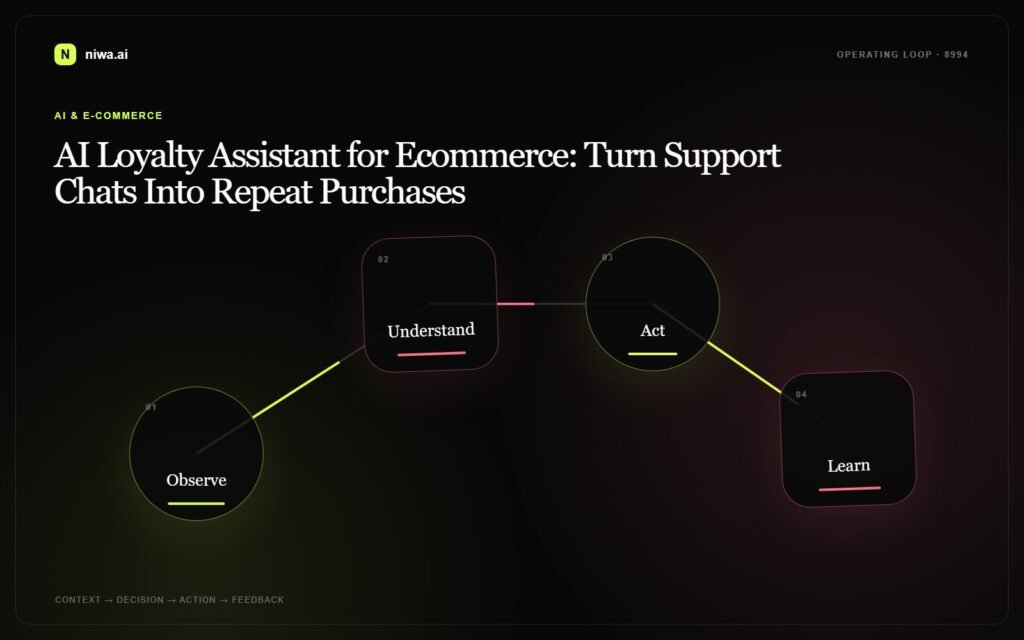
More memory is not automatically better. A loyalty assistant should remember useful commercial context, not collect random personal details.
Useful fields include:
- Product preferences: sizes, colors, materials, dietary needs, skin type, device compatibility, style preferences.
- Purchase cycle: how often the product is used, when the customer might need a refill, upgrade, replacement, or accessory.
- Support history: delivery issues, returns, warranty concerns, complaints, unresolved tickets.
- Buying role: personal shopper, gift buyer, business buyer, reseller, parent, office manager, procurement contact.
- Consent and channel preference: whether the customer wants reminders by email, chat, WhatsApp, or not at all.
The assistant should also know when not to act. If a customer is angry about a missing order, the next step is not a loyalty discount. The next step is resolution.
How to avoid making loyalty feel creepy
AI loyalty fails when it behaves like surveillance. The assistant should be transparent, specific, and easy to correct.
Use language like:
- “I can remember this size preference for next time if you want.”
- “Based on your last order, this refill may be useful. Want me to show alternatives?”
- “I’ll pass this issue to the team before recommending anything else.”
- “You can ignore this reminder or ask me to stop sending it.”
Avoid language like:
- “We know what you need.”
- “Customers like you always buy this.”
- “Your behavior suggests you are ready to purchase.”
The difference is small but important. Helpful loyalty gives the customer control. Creepy loyalty assumes too much.
Simple playbook: first 30 days with an AI loyalty assistant
You do not need to automate every retention workflow on day one. Start with a narrow playbook that can be measured.
Week 1: Identify the top repeat-purchase moments
Pick three product groups where repeat orders, accessories, refills, or upgrades are already common. Write down what customers usually ask before buying again.
Week 2: Add memory fields to chat outcomes
For each relevant chat, save a small structured note: preference, issue, next action, and whether a human should follow up. This is where an AI CRM handoff becomes important.
Week 3: Create safe follow-up triggers
Start with helpful triggers: refill reminder, accessory recommendation, delivery issue follow-up, warranty check, or product education. Avoid broad discount blasts.
Week 4: Review quality before scaling
Check whether the assistant is improving the customer journey or just producing more messages. Look at repeat order rate, support reopen rate, unsubscribe rate, human escalation quality, and customer replies.
Metrics that matter
Do not judge an AI loyalty assistant only by chat volume. More conversations are not automatically better.
Track metrics that connect to revenue and trust:
- Repeat purchase rate: Are more first-time buyers coming back?
- Time to second order: Does the assistant shorten the gap between purchase one and purchase two?
- Support-to-sale conversion: Do resolved support chats lead to relevant next purchases?
- Escalation quality: Do human agents receive useful context instead of messy transcripts?
- Refund and return signals: Are recommendations reducing wrong-fit orders?
- Opt-out rate: Are reminders useful or annoying?
If these numbers improve, loyalty automation is doing its job. If only message volume increases, the assistant is probably adding noise.
Where Niwa AI fits
Niwa AI is built for ecommerce conversations where sales, support, and conversion are connected. A loyalty assistant is a natural extension of that: it helps shoppers get answers now while giving the store cleaner context for the next interaction.
Instead of forcing every customer into the same email flow, Niwa can help your store identify what the shopper needs, recommend the next useful product, collect the right details, and hand off sensitive or high-value conversations to your team.
Want to see how this works on your store? Book a Niwa AI demo and we’ll walk through the loyalty, support, and repeat-purchase moments where an AI assistant can create measurable value.