miniOrange AI Agent vs Niwa AI: Which WordPress Agent Wins?
Compare miniOrange AI Agent and Niwa AI for WordPress administration, WooCommerce, MCP automation, messaging, reporting, leads, and conversion workflows.
The phrase “WordPress AI agent” now covers several very different products. Some are primarily chat assistants inside wp-admin. Others are automation builders that connect WordPress to external systems. A smaller group aims to become an operating layer for the website and the business behind it.
miniOrange AI Agent and Niwa AI both belong in this conversation, but they approach the job from different directions. miniOrange emphasizes MCP connectivity, configurable workflows, enterprise integrations, and WordPress/WooCommerce actions. Niwa emphasizes a founder-friendly operator that can be reached through familiar messaging channels, perform website and store tasks, report on the business, and support conversion workflows.
This comparison uses publicly documented capabilities available on July 16, 2026. It does not assume that an undocumented feature is impossible; it distinguishes between capabilities that are clearly documented, capabilities available through configurable integrations, and product areas that are central to each tool’s positioning.
Quick verdict
Choose miniOrange AI Agent if your priority is building configurable, cross-system automations around WordPress, WooCommerce, CRMs, business applications, MCP servers, schedules, events, and webhooks. It is especially relevant to technical teams that want to design reusable workflows and govern what each agent can do.
Choose Niwa AI if you want a more direct WordPress business operator: ask for work through WhatsApp or Telegram, manage day-to-day WordPress and WooCommerce tasks, publish content, receive business reports, research competitors, and connect owner-side operations with customer-facing conversion activity.
The simplest distinction is:
miniOrange is strongest as an extensible AI workflow and integration layer. Niwa is designed as a conversational operator for the owner and the business.
That distinction matters more than the number of individual features because it determines how much setup is required, where the owner interacts with the agent, and whether the system is centered on infrastructure or outcomes.
What is miniOrange AI Agent?
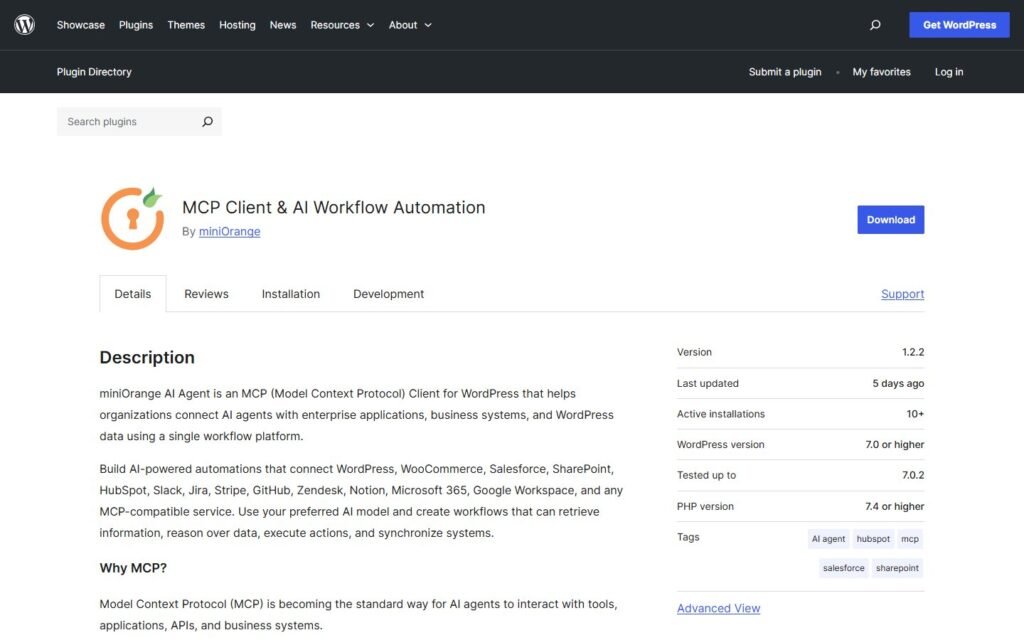
The current WordPress.org listing describes miniOrange AI Agent as an MCP client and AI workflow automation platform for WordPress. It can connect WordPress and WooCommerce with MCP-compatible services and enterprise applications, use a preferred LLM provider, and run event-driven or scheduled workflows.
Its official WordPress plugin listing documents capabilities including:
- creating and updating WordPress posts and pages;
- managing custom post types, taxonomies, users, and media;
- creating and updating WooCommerce products;
- managing WooCommerce orders;
- triggering workflows from orders, registrations, product updates, publishing events, schedules, and other business events;
- connecting systems such as Salesforce, HubSpot, Slack, Stripe, GitHub, Zendesk, Notion, Microsoft 365, and Google Workspace;
- analyzing WooCommerce orders and generating reports through its chatbot;
- using administrative or customer-facing chatbot experiences.
miniOrange also documents MCP connections and reusable AI pipelines through its AI Studio product page. This architecture is important. Rather than limiting the agent to a fixed set of isolated WordPress commands, miniOrange is designed to chain WordPress abilities, AI steps, external applications, and MCP tools into workflows.
That makes it a credible option for teams asking questions such as:
- Can an AI agent synchronize WooCommerce and Salesforce?
- Can a publishing event trigger an external workflow?
- Can WordPress data be used inside an AI-driven business process?
- Can different roles receive different action permissions?
- Can scheduled automations run across several connected systems?
What is Niwa AI?
Niwa AI is positioned as a WordPress AI operator rather than only an automation builder or dashboard chatbot. The owner can communicate with Niwa through WhatsApp or Telegram and ask for practical outcomes: update products, change prices or stock, create coupons, publish content, inspect a problem, prepare a report, research competitors, or perform other approved WordPress and WooCommerce work.
The broader product idea is explained on How Niwa Works: website administration is only one layer. Niwa is intended to connect owner instructions, website operations, customer questions, lead context, and commercial signals.
Niwa therefore works across two sides of the business:
- Owner-side operations: WordPress administration, WooCommerce management, content publishing, reporting, research, monitoring, and recurring work.
- Customer-side conversion: answering questions, guiding visitors, capturing intent, recommending next steps, and supporting follow-up or escalation.
This is why messaging access is not merely a notification feature. For Niwa, WhatsApp or Telegram can become the owner’s command interface rather than another destination at the end of a workflow.
miniOrange AI Agent vs Niwa AI comparison table
| Capability | miniOrange AI Agent | Niwa AI |
|---|---|---|
| Natural-language WordPress management | Yes, through its chatbot and WordPress tools | Yes, through Niwa’s operator interface |
| WordPress content creation and updates | Clearly documented | Yes |
| WooCommerce product management | Create and update products is documented | Yes, including practical catalog, price, and stock workflows |
| WooCommerce order operations | Order management and analysis are documented | Yes, within approved operational workflows |
| Scheduled and event-driven automation | A core documented strength | Supported through recurring and scheduled operator tasks |
| External business-system integrations | Broad MCP and enterprise integration focus | Available through Niwa’s connected operator tools and workflows |
| WhatsApp and Telegram | Documented as connectable external MCP applications; implementation depends on the workflow and connected service | Core owner communication channels |
| Content publishing | Documented for posts, pages, publishing events, and scheduled workflows | Core operational use case, including researched SEO publishing |
| Business reporting | Report generation and scheduled business reporting are documented | Core owner-facing reporting use case |
| Lead capture and CRM workflows | CRM lead creation and management can be configured through integrations | Lead capture and intent context are part of the customer-facing product direction |
| Customer-facing chatbot | Documented as an available experience | Yes, connected to conversion and operational context |
| Competitor monitoring | Could potentially be assembled with connected tools, but a packaged capability is not clearly established in the reviewed primary documentation | A stated Niwa owner-side use case |
| Conversion workflows | Can be built through WooCommerce, CRM, chatbot, and external workflow components | Productized around visitor assistance, lead capture, buyer hesitation, and commerce actions |
| Best fit | Technical teams building flexible cross-system automation | Owners wanting an accessible WordPress and business operator |
The table intentionally avoids treating “not prominently documented” as “technically impossible.” miniOrange’s MCP architecture is extensible, so a capable team may be able to build workflows beyond the examples in its public materials. The relevant purchasing question is whether a capability is ready as a product behavior or must be designed as an integration project.
Where miniOrange AI Agent is stronger
1. MCP and enterprise integration architecture
miniOrange’s clearest advantage is its explicit focus on MCP-compatible systems and enterprise applications. Its public materials name CRM, collaboration, storage, development, payment, and productivity platforms. For a business that wants WordPress to participate in a larger automation architecture, that breadth is meaningful.
A team could, for example, use a WooCommerce order event to create or update CRM records, send a summary to a collaboration tool, and synchronize information elsewhere. The value is not one AI response; it is the reusable workflow joining several systems.
2. Configurable workflow orchestration
miniOrange documents event-driven triggers, scheduled automation, prompt-based sequencing, external application events, and connected MCP tools. This gives technical operators a framework for creating repeatable processes rather than relying only on conversational one-off requests.
That is attractive when the process is stable, the integration requirements are known, and a team is prepared to configure and maintain the workflow.
3. Governance for teams
The official AI Studio page highlights action-level permissions. miniOrange also positions its broader MCP products around governed access, approvals, and visibility. For organizations with multiple roles, compliance requirements, or formal automation ownership, granular control can be a decisive advantage.
4. Broad CRM and business application scenarios
The plugin listing gives concrete examples involving Salesforce, HubSpot, SharePoint, customer lifecycle updates, lead management, product synchronization, and business reporting. Niwa can work across business tools, but miniOrange makes configurable enterprise integration a central part of the proposition.
Where Niwa AI is stronger
1. A simpler owner experience
A workflow platform gives a business flexibility, but flexibility often creates setup work. Someone must choose triggers, configure connections, map data, define permissions, test edge cases, and maintain the automation.
Niwa’s core experience is more direct: the owner asks for the outcome in a normal conversation. That can be especially valuable for a founder who does not want to design an automation diagram every time the business needs a new task.
The difference is similar to hiring an integration specialist versus working with an operator. The specialist gives you infrastructure. The operator receives context and completes the job.
2. WhatsApp and Telegram as the command center
miniOrange documentation supports Telegram and WhatsApp as external applications that can participate in MCP workflows. That is useful, but it is not identical to a product designed around the owner managing WordPress from those channels.
Niwa’s homepage explicitly positions WhatsApp and Telegram as primary ways to communicate with the operator. An owner can request a price change, content update, competitor check, supplier action, or report without opening wp-admin or a workflow builder.
This is an important difference for mobile operations, small teams, warehouses, stores, and founders who make decisions away from a desktop.
For a customer-side view of connected messaging, see AI Website Chat and WhatsApp for Ecommerce.
3. Competitor research connected to action
Niwa explicitly includes competitor analysis and current web research in the owner workflow. The useful part is not merely producing a list of competitor pages. It is connecting research to a decision: update an offer, identify an SEO opportunity, prepare a comparison article, adjust a product page, or create a monitoring task.
miniOrange’s architecture may support a custom research workflow when suitable MCP or web tools are connected. However, the primary documentation reviewed for this comparison does not establish competitor monitoring as a packaged, central use case. That is a product-positioning difference, not a claim that the architecture could never support it.
4. Conversion workflows as a first-class goal
miniOrange can connect customer-facing chat, WooCommerce, CRM, and automation components. That provides building blocks for conversion workflows.
Niwa makes conversion a core outcome: understand the visitor’s question, reduce uncertainty, capture intent, recommend a product or next step, escalate useful context, and connect the signal back to the owner.
The distinction is visible in Niwa’s approach to AI lead capture for ecommerce. A lead is not only a contact record. It includes the product, problem, urgency, objection, and reason for follow-up.
Niwa also supports productized commerce ideas such as the Niwa AI Conversion Booster, where cart context can trigger a relevant checkout incentive. miniOrange could potentially orchestrate comparable components, but Niwa presents conversion behavior as part of the operating model rather than only an automation assembled from integrations.
Which is better for WordPress administration?
Both products support meaningful WordPress administration, but they serve different administrative styles.
miniOrange is a strong fit when:
- administrators want a chatbot inside WordPress;
- WordPress actions must connect to external systems;
- workflows should run from events, schedules, or webhooks;
- the team needs role-based controls and reusable pipelines;
- technical staff will configure and govern the automation.
Niwa is a strong fit when:
- the owner wants to delegate through a familiar message;
- routine administration should not require opening wp-admin;
- one request may combine research, content, WooCommerce, reporting, and follow-up;
- the business wants an operator that explains the result, not only a workflow execution log;
- customer and owner workflows should share commercial context.
If your main question is “How can we connect WordPress to our enterprise stack?”, miniOrange has a persuasive answer. If your main question is “How can I tell my WordPress site what the business needs next?”, Niwa is closer to that job.
Which is better for WooCommerce?
miniOrange publicly documents WooCommerce product creation and updates, order management, order analysis, event triggers, CRM synchronization, and scheduled reporting. These are substantial WooCommerce automation capabilities.
Niwa’s WooCommerce proposition is broader at the owner-experience level. The owner can ask for catalog changes, stock or price work, coupons, content, reports, research, and conversion actions through conversation. On the storefront side, Niwa can support shoppers before and after purchase.
Therefore:
- Choose miniOrange for structured WooCommerce-to-enterprise workflows and configurable integration architecture.
- Choose Niwa for conversational store operations combined with customer guidance, owner reporting, and conversion-oriented workflows.
The right choice depends on whether the store primarily needs an automation platform or an accessible operating partner.
Which is better for content publishing and SEO automation?
miniOrange documents post and page creation, content publishing events, scheduled publishing, and document-to-WordPress scenarios. It can be a capable foundation for content automation, particularly when content originates in another business system or must pass through a defined pipeline.
Niwa can research a current topic, inspect the existing site to avoid duplication, prepare conversion-focused SEO content, create the post, publish it, and report the result to the owner. That end-to-end editorial workflow is closer to a delegated content operation than a single content-generation action.
Businesses evaluating this area should ask:
- Does the system inspect existing content before writing?
- Can it verify current facts with reliable sources?
- Does it create internal links and conversion paths?
- Can it publish and then verify the final WordPress status?
- Can the owner request the whole workflow from a phone?
Content generation is common. Reliable publishing operations are less common.
Which one should you choose?
Choose miniOrange AI Agent when your organization wants a flexible MCP client, workflow builder, enterprise connector, and governed automation layer inside WordPress. It is particularly compelling when technical staff already think in events, integrations, data mappings, and reusable pipelines.
Choose Niwa AI when you want WordPress and WooCommerce to feel less like software you administer and more like a business system you can delegate to. Niwa is designed for founders and operators who want to send a request through WhatsApp or Telegram, receive a useful result, and connect website work with reporting, research, leads, and conversion.
Neither approach makes the other irrelevant. In fact, they represent two important directions for WordPress AI:
- infrastructure-first agents that connect and orchestrate systems;
- outcome-first operators that receive business instructions and carry them through.
For many technical organizations, miniOrange’s extensibility may be the deciding factor. For owner-led businesses, Niwa’s directness and commercial focus may matter more.
You can also compare this architecture-first distinction with SiteGround AI Agent vs Niwa AI, where the contrast is more focused on dashboard administration versus a broader business operator.
Frequently asked questions
Is miniOrange AI Agent a WordPress plugin?
Yes. miniOrange publishes its AI Agent through the WordPress plugin directory. The current listing positions it as an MCP client and AI workflow automation tool for WordPress, WooCommerce, enterprise applications, and connected MCP services.
Can miniOrange AI Agent manage WooCommerce?
Its official listing documents creating and updating WooCommerce products, managing orders, analyzing order data, triggering workflows from WooCommerce events, synchronizing data with external systems, and generating reports.
Does miniOrange support Telegram and WhatsApp?
miniOrange documentation lists Telegram and WhatsApp among external MCP-enabled applications that can be connected to workflows. The precise experience depends on the connected service and workflow configuration. This should not automatically be interpreted as the same turnkey owner-administration experience that Niwa provides through its messaging channels.
Can Niwa manage WordPress from Telegram or WhatsApp?
Yes. Niwa is explicitly positioned around communicating with the WordPress operator through WhatsApp or Telegram for approved website, WooCommerce, reporting, research, and operational tasks.
Which product is better for lead capture?
miniOrange can create lead and CRM workflows through connected systems such as Salesforce or HubSpot, and it supports customer-facing chatbot scenarios. Niwa focuses more directly on capturing visitor intent and connecting the conversation to the owner’s conversion workflow. The better choice depends on whether you want a configurable CRM automation or a productized website-to-owner conversion flow.
Which product is easier for a non-technical store owner?
Niwa is likely the more direct fit because the owner can request outcomes through a normal messaging conversation. miniOrange offers greater workflow configurability, but teams should expect to define and maintain connections, triggers, permissions, and sequences.
Can miniOrange monitor competitors?
Its extensible MCP architecture may allow a team to assemble research and monitoring workflows with suitable connected services. However, the primary product pages reviewed for this article do not present competitor monitoring as a clearly packaged core feature. Niwa explicitly positions competitor research and monitoring as an owner-side use case.
Is Niwa only a chatbot?
No. Niwa combines owner-side WordPress and WooCommerce operations with customer-side assistance, lead context, reporting, research, content publishing, and conversion workflows. The chatbot interface is one way to communicate with the operator, not the whole product.
Final verdict
miniOrange AI Agent is one of the more ambitious WordPress automation plugins because it treats WordPress as part of a connected business stack. Its MCP client architecture, enterprise integrations, scheduled workflows, event triggers, WooCommerce tools, and permissions deserve serious consideration.
Niwa AI makes a different promise. Instead of asking the owner to become the architect of every workflow, Niwa aims to become the operator who receives the instruction, uses the right tools, completes the task, and explains the business result.
miniOrange is the stronger choice for configurable cross-system orchestration. Niwa is the stronger choice for founder-friendly WordPress operations and conversion-focused delegation.
If the second model fits your business, book a Niwa demo and test the workflow with a real WordPress or WooCommerce task.