StoreAgent vs Niwa AI: Which WooCommerce AI Agent Fits Your Store?
Compare StoreAgent and Niwa AI for WooCommerce AI, product content, shopper chat, WordPress administration, messaging, reporting, leads, and conversions.
AI tools for WooCommerce now cover several very different jobs. Some improve product copy. Some answer shopper questions. Others help an owner operate WordPress, publish content, review business signals, and take action through conversation.
That distinction matters when comparing StoreAgent and Niwa AI. StoreAgent is a focused suite of WooCommerce AI agents for catalog content, product discovery, customer questions, review summaries, and store merchandising. Niwa AI is designed as a broader WordPress business operator that connects site administration, WooCommerce work, publishing, owner messaging, reporting, customer intent, and conversion workflows.
This comparison is based on StoreAgent’s official website, WordPress.org listing, knowledge base, and public product documentation reviewed on July 16, 2026. When a feature is not clearly documented, this article says so rather than treating missing documentation as proof that the feature is impossible.
Quick Verdict
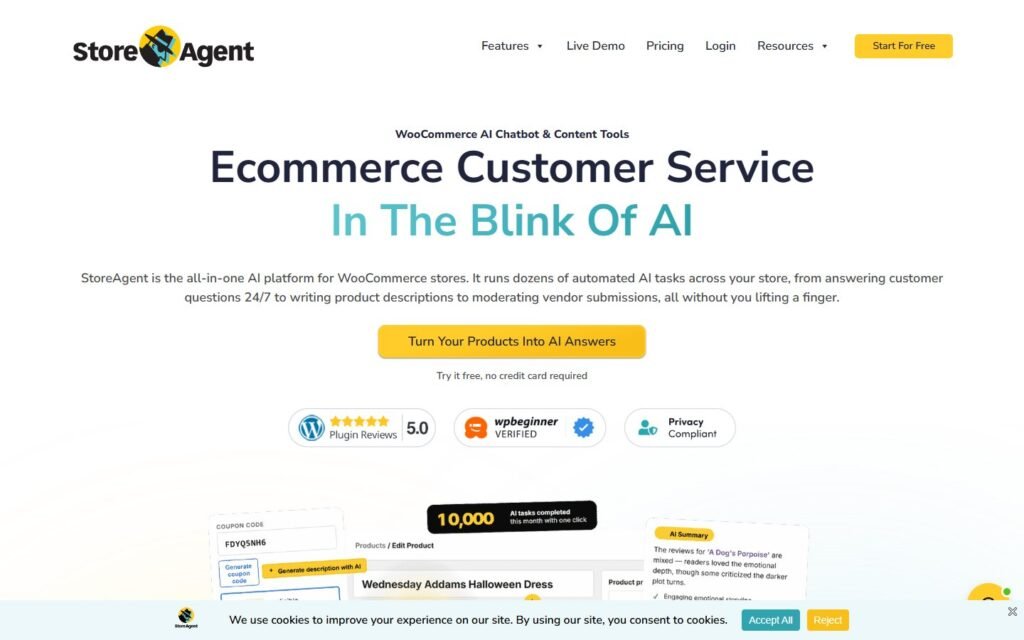
Choose StoreAgent if your main goal is to improve a WooCommerce catalog and storefront with specialized AI tools. Its strongest documented use cases include generating product content, creating tags, producing image alt text, summarizing reviews, powering product-aware chat, making product recommendations, and providing listing insights.
Choose Niwa AI if you want a broader operating relationship around the WordPress business: issue instructions through Telegram or WhatsApp, manage WordPress and WooCommerce tasks, research and publish content, receive business-oriented reports, monitor competitors, preserve lead context, and connect website conversations with approved conversion actions.
The shortest fair summary is:
StoreAgent is a specialized WooCommerce AI merchandising and shopper-assistance suite. Niwa AI is designed as a wider WordPress operating and conversion agent.
These products overlap, but they are not identical substitutes.
What Is StoreAgent?
StoreAgent is a WordPress plugin built specifically for WooCommerce. Its official materials describe a collection of AI agents that can be enabled individually, allowing a merchant to add the tools relevant to the store without activating every feature.
Its publicly documented agents and capabilities include:
- Product description generation
- Product short-description generation
- Product tag generation
- Product image alt-text generation
- Product review summaries
- Product listing and content insights
- A customer-facing product assistant
- Product recommendations
- Store chat connected to WooCommerce information
- Order-status assistance for shoppers
- Coupon and promotional actions within supported chat workflows
- Bulk processing for selected catalog-content tasks
- Multiple model-provider options in current product materials
This is a sensible product shape for merchants whose immediate problem is catalog scale. A store with hundreds or thousands of products may need consistent descriptions, cleaner tags, better accessibility text, summarized reviews, and a conversational route to product discovery. StoreAgent puts those jobs in one WooCommerce-focused suite.
What Is Niwa AI?
Niwa AI starts from a broader operating question: what if a WordPress owner could message an AI agent like a capable team member and delegate an outcome rather than opening several dashboards?
Niwa’s approved workflows can cover areas such as:
- WordPress content creation, updating, and publishing
- WooCommerce product, price, stock, coupon, and order work
- Telegram and WhatsApp administration for the owner
- Website investigation and maintenance workflows
- SEO research and end-to-end article publishing
- Business and performance reporting
- Competitor research and monitoring
- Customer-facing product and purchase guidance
- Lead and buyer-intent capture
- Conversion follow-up and commercial workflow execution
The product direction is explained further on How Niwa Works. The important difference is scope: Niwa is intended to connect an owner’s instruction to the relevant site, store, research, reporting, publishing, or customer workflow.
StoreAgent vs Niwa AI: Feature Comparison
| Capability | StoreAgent | Niwa AI |
|—|—|—|
| Core positioning | Specialized WooCommerce AI-agent suite | WordPress business operator and conversion agent |
| WooCommerce focus | Strong and central | Strong, combined with wider WordPress operations |
| Product descriptions | Yes | Yes, through content and catalog workflows |
| Product tags and image alt text | Yes, dedicated documented agents | Can be handled through approved content workflows |
| Review summaries | Yes, dedicated documented agent | Can analyze customer and store information when connected and authorized |
| Customer-facing product chat | Yes | Yes |
| Product recommendations | Yes | Yes, with buyer-intent and conversion context |
| Order-status assistance | Yes, documented for customer chat | Yes, depending on connected store tools and permissions |
| WordPress-wide administration | Official positioning is primarily WooCommerce and storefront focused | Yes, a core operating use case |
| Blog and page publishing | Product-content generation is documented; general editorial publishing is not a central public claim | Yes, including research, structure, metadata, internal links, and publication |
| Telegram administration | Not documented as a native owner interface in the official sources reviewed | Yes |
| WhatsApp administration | Not documented as a native owner interface in the official sources reviewed | Yes |
| Business reporting | Product listing insights are documented | Broader owner-facing business and performance reporting |
| Lead capture | Customer conversations can reveal intent; a packaged lead-management workflow was not clearly documented in the reviewed sources | Yes, with conversational context and follow-up workflows |
| Competitor monitoring | Not presented as a core public workflow in the reviewed sources | Yes |
| Conversion workflows | Recommendations, product assistance, coupons, and merchandising support | Customer intent, guidance, lead context, follow-up, store actions, and reporting |
| Best fit | WooCommerce merchants prioritizing catalog quality and shopper assistance | Owners wanting one conversational operator across WordPress, WooCommerce, messaging, publishing, and growth |
Feature availability can depend on plan, configuration, connected AI provider, site data, permissions, and product updates. “Not documented” means only that the capability was not clearly presented in the official sources reviewed for this article.
Where StoreAgent Does Well
A useful comparison should begin with StoreAgent’s real strengths rather than treating every narrower product as incomplete.
Purpose-built WooCommerce agents
StoreAgent is not a generic writing plugin with a WooCommerce label added later. Its public product design is organized around recognizable store jobs: product descriptions, review summaries, recommendations, catalog tagging, image accessibility text, listing analysis, and customer questions.
That specialization can make adoption easier. A merchant can identify a catalog problem and enable the corresponding agent without first designing a broad automation architecture.
Catalog content at scale
Product content is repetitive, commercially important, and difficult to maintain across a large inventory. StoreAgent documents bulk-oriented workflows for selected content tasks, which is valuable when a store needs to improve many listings rather than edit one product at a time.
This is an area where StoreAgent may be the more direct choice. Niwa can support catalog and publishing work, but StoreAgent exposes several catalog jobs as dedicated productized agents.
Review summarization
Review volume creates a useful but messy data set. StoreAgent’s review-summary agent is designed to turn customer reviews into a concise overview that can help shoppers understand recurring sentiment without reading every entry.
That is a focused storefront feature and a meaningful conversion aid. It complements the wider role described in our guide to an AI product page assistant: reducing uncertainty while the visitor is still evaluating the product.
Product discovery and recommendations
StoreAgent documents a product-aware assistant and recommendation agent that can use WooCommerce catalog information to help shoppers find suitable items. This is well aligned with stores that have complex inventories, similar products, or visitors who do not know the exact product name they need.
Its current documentation also describes merchandising actions such as presenting relevant coupons through supported chat scenarios. That means it should not be described as only a content generator; StoreAgent also participates in customer-facing conversion work.
A focused merchant experience
Some businesses do not want a broad AI operator. They want a contained WooCommerce tool with a clearly defined job. StoreAgent’s narrower surface can be an advantage for teams prioritizing catalog and storefront assistance over WordPress-wide delegation.
Where Niwa AI Is Different
Niwa’s differentiation is not based on claiming StoreAgent cannot assist shoppers or influence conversion. StoreAgent clearly documents those capabilities. The difference is the breadth and continuity of the operating workflow.
WordPress and WooCommerce administration beyond merchandising
StoreAgent’s official positioning centers on WooCommerce content, insights, recommendations, and customer assistance. Niwa is designed to work across the larger WordPress operation.
An owner can ask for a product update, a new page, an SEO article, a site investigation, a coupon change, an order check, or another authorized administrative outcome. The conversation is connected to the required tools rather than limited to a predefined catalog agent.
This makes Niwa more relevant when the business wants to delegate work spanning both the storefront and the systems behind it.
Telegram and WhatsApp as owner interfaces
StoreAgent’s documented chat experience is customer-facing and website-centered. The official StoreAgent materials reviewed for this comparison did not present Telegram or WhatsApp as native administration channels for the store owner.
Niwa treats owner messaging as a primary interface. The founder can send an instruction from Telegram or WhatsApp, answer a necessary safety question, and receive the result without navigating wp-admin for every routine task.
That is not merely another chatbot channel. It changes where administration happens and can be particularly useful for owners working from a phone, warehouse, meeting, or shop floor.
Delegated editorial publishing
StoreAgent has strong product-content tools. Its official sources document descriptions, short descriptions, tags, review summaries, and image alt text. Those are valuable publishing-adjacent capabilities inside the catalog.
Niwa extends the workflow to general WordPress publishing. A request can begin with search-intent and competitor research, continue through drafting and fact checking, and end with categories, tags, internal links, SEO metadata, publication, and verification.
For a hands-on catalog team, StoreAgent’s dedicated generators may be ideal. For an owner asking, “Research this topic and publish the finished article,” Niwa is designed around the complete delegated outcome.
Business reporting and operational context
StoreAgent documents product-listing insights, including analysis intended to improve WooCommerce content and conversion performance. That is a legitimate form of store intelligence.
Niwa’s reporting proposition is broader. It can connect sales activity, operational changes, content work, customer signals, exceptions, and external research into an owner-facing report. The aim is to explain what deserves attention and, where authorized, take the next action.
The distinction is therefore listing insight versus wider business-operating context, not “insights versus no insights.”
Competitor monitoring and research-to-action workflows
Competitor monitoring is not presented as a central StoreAgent capability in the official sources reviewed. Niwa can research a competitor or search market, compare positioning and content, identify an opportunity, and turn the result into a report, page, article, or other approved website action.
This closes the distance between learning and execution. The owner does not have to move findings manually from a research tool into a content brief and then into WordPress.
Lead context and conversion follow-through
StoreAgent’s customer chat, recommendations, order assistance, and coupon tools can support conversion. It would be inaccurate to imply otherwise.
Niwa’s additional emphasis is carrying the conversation into a broader workflow. A buyer question can become a recommendation, a qualified lead, a human handoff, a follow-up task, or an insight for the owner. This is the same reason AI lead capture for ecommerce should preserve purchase intent rather than collect only an email address.
Niwa can also connect pre-purchase questions with checkout support. Our guide to the AI checkout assistant explains how shipping, payment, returns, compatibility, and product-choice uncertainty can be addressed before it becomes abandonment.
Which Is Better for WooCommerce?
StoreAgent is the stronger fit when the primary requirement is a ready-made collection of specialized WooCommerce AI tools. It has clear agents for product descriptions, tags, alt text, review summaries, recommendations, product questions, and listing insights. Merchants focused on catalog enrichment and storefront assistance should take it seriously.
Niwa is the stronger fit when WooCommerce is one part of a larger operating system. The owner may want to manage catalog data, publish content, review orders, receive reports, research competitors, handle instructions through messaging apps, and connect customer intent to follow-up.
A store can therefore prefer StoreAgent without rejecting the broader agent category. The decision depends on whether the immediate need is specialized store tooling or cross-business delegation.
Which Is Better for WordPress Administration?
Niwa has the clearer advantage for WordPress-wide administration because that is part of its central product model. StoreAgent’s public materials focus mainly on WooCommerce agents and customer-facing store improvements.
That does not prove StoreAgent can never be extended or integrated with other automation. It simply means buyers should not assume that a WooCommerce merchandising suite automatically provides the same owner-administration scope as a WordPress operating agent.
If administration is the main search intent, readers may also want the SiteGround AI Agent vs Niwa AI comparison, which examines a product more directly centered on conversational site management.
Which Is Better for Content Teams?
For teams producing large volumes of WooCommerce catalog content, StoreAgent’s dedicated generators are attractive. The interface is organized around recurring product-data tasks, and selected workflows can be applied in bulk.
For teams delegating broader editorial outcomes, Niwa is a better conceptual fit. It can connect topic selection, live research, comparison checks, drafting, internal linking, SEO preparation, WordPress creation, publication, and verification.
The practical question is whether “content” means catalog enrichment or end-to-end website publishing.
Can StoreAgent Replace Niwa AI?
StoreAgent can overlap with Niwa in several areas: product content, customer questions, recommendations, order assistance, merchandising insights, and conversion support. A WooCommerce merchant whose needs stay within that scope may not need a broader operating agent for those jobs.
However, StoreAgent’s documented product scope does not match Niwa’s wider combination of WordPress administration, Telegram and WhatsApp owner control, general content publishing, business reporting, competitor workflows, and cross-system execution.
The reverse is also true: a business may value StoreAgent’s dedicated review-summary, listing-insight, alt-text, and catalog-content agents even if it also uses a broader operator. Specialized and general agents can be complementary when responsibilities are clearly separated.
Final Recommendation
Choose StoreAgent when you want a focused WooCommerce AI suite for improving product information, helping shoppers discover items, summarizing reviews, answering store questions, and strengthening catalog-level conversion experiences.
Choose Niwa AI when you want to delegate work across the WordPress business: administer the site and store, operate through Telegram or WhatsApp, publish researched content, receive business reports, monitor competitors, capture customer intent, and connect findings to action.
The fairest decision rule is:
Choose StoreAgent to add specialized AI workers to the WooCommerce storefront. Choose Niwa AI when you want an AI operator working with the owner across the wider WordPress business.
Frequently Asked Questions
Is StoreAgent a WordPress AI agent?
Yes. StoreAgent is a WordPress plugin offering multiple AI agents designed for WooCommerce tasks such as catalog content, product assistance, recommendations, review summaries, and listing insights.
Is StoreAgent only a product-description generator?
No. Product content is an important part of the suite, but StoreAgent also documents product recommendations, customer chat, review summaries, listing insights, order-status assistance, and supported promotional actions.
Does StoreAgent work with WooCommerce?
Yes. WooCommerce is StoreAgent’s central product focus. Its agents use store and product information for catalog and customer-facing workflows.
Does StoreAgent support Telegram or WhatsApp administration?
Telegram and WhatsApp were not documented as native owner-administration interfaces in the official StoreAgent sources reviewed on July 16, 2026. That statement does not rule out custom integrations. Niwa AI treats Telegram and WhatsApp owner administration as core workflows.
Can StoreAgent publish WordPress blog posts and pages?
StoreAgent officially documents several product-content tools, including descriptions, short descriptions, tags, review summaries, and alt text. General end-to-end blog and page publishing was not a central documented product claim in the reviewed sources. Niwa is designed to handle delegated research and WordPress publishing workflows.
Can StoreAgent capture leads?
StoreAgent’s customer conversations can reveal purchase intent, and its chat and recommendation capabilities can support conversion. The reviewed official sources did not clearly present a packaged lead-management workflow comparable to Niwa’s intent capture and follow-through. Buyers should verify current plan and integration details for their exact use case.
Which option is better for product recommendations?
Both are relevant. StoreAgent provides a dedicated product-recommendation agent for WooCommerce. Niwa connects product guidance with wider buyer context, owner reporting, lead handling, and approved conversion workflows.
Which option is better for competitor monitoring?
Niwa AI is the better fit when competitor monitoring needs to become an ongoing owner workflow connected to reports, content, and website actions. Competitor monitoring was not presented as a core StoreAgent feature in the official materials reviewed.
Can StoreAgent and Niwa AI be used together?
Potentially, yes. StoreAgent can handle specialized catalog or storefront jobs while Niwa manages broader owner operations. Any combined deployment should be tested carefully so customer chat, AI-provider usage, permissions, and overlapping automations do not conflict.