ZipWP vs Niwa AI: AI Website Builder or Business Operator?
Compare ZipWP and Niwa AI for AI site building, WordPress operations, WooCommerce, messaging, publishing, reporting, leads, and conversions.
ZipWP and Niwa AI both make WordPress easier to control through natural language, but they solve different problems.
ZipWP is strongest at creating and deploying WordPress sites quickly. Its AI builder can generate a multi-page website with relevant copy, images, a theme, and a page-building setup. Its newer Model Context Protocol (MCP) connection also lets supported AI clients list sites, create AI or blank sites, deploy blueprints, clone sites, track build progress, and delete sites with permission.
Niwa AI is designed for the work that continues after a website exists. It combines WordPress and WooCommerce operations with owner access through Telegram or WhatsApp, content publishing, business reporting, lead capture, competitor monitoring, and conversion workflows.
This is therefore not a simple contest between two interchangeable WordPress AI plugins. It is a comparison between an AI-first website creation platform and a WordPress business operator.
Quick verdict: Choose ZipWP when the priority is generating, cloning, and deploying WordPress websites quickly. Choose Niwa AI when the priority is operating an existing WordPress or WooCommerce business, communicating with the owner, publishing content, monitoring commercial signals, and improving conversion workflows.
What Is ZipWP?
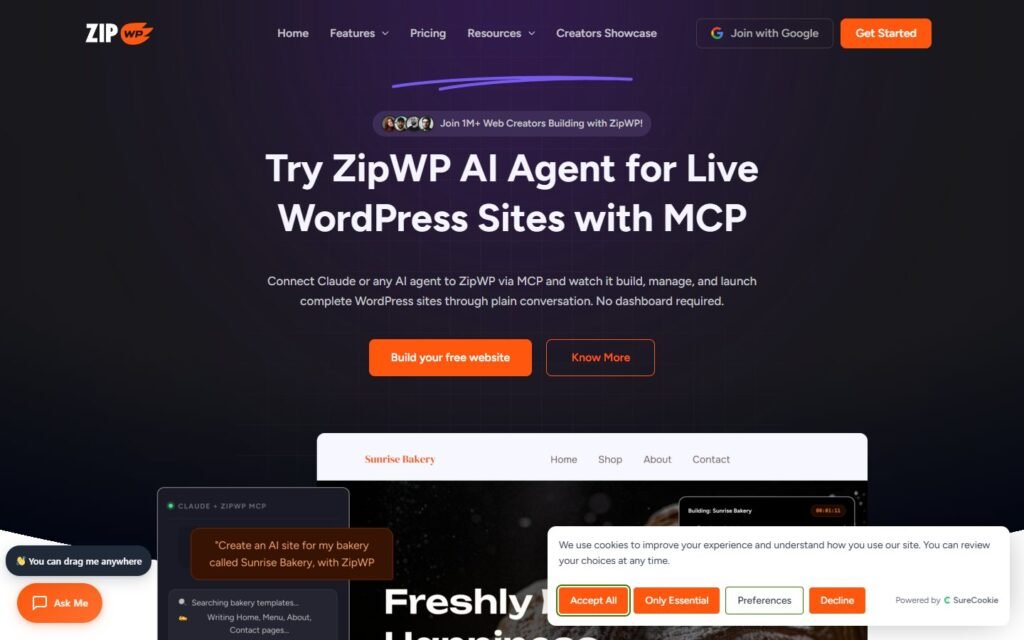
ZipWP is an AI-powered WordPress website builder and hosting platform. Its core workflow starts with a business description and produces a ready-to-edit WordPress draft rather than an empty installation.
According to ZipWP’s current official documentation, a generated site can include multiple pages, AI-written copy, selected images, contact information, social links, and an appropriate structure for the business. ZipWP commonly sets up the Astra theme and Spectra block editor, while its ecosystem also supports Starter Templates and AI-assisted content refinement.
ZipWP has also expanded into conversational site deployment through MCP. Its officially documented MCP tools currently cover:
- listing and searching sites;
- browsing templates and saved blueprints;
- creating blank WordPress installations;
- generating AI sites from business information;
- deploying sites from blueprints;
- cloning existing sites;
- monitoring build progress;
- deleting sites when the optional permission is enabled and the user confirms the action.
That is a meaningful feature set for agencies, freelancers, developers, and hosts that repeatedly need new WordPress installations, staging environments, client drafts, or standardized site foundations.
What Does ZipWP Do Well?
It removes the blank-site problem
A traditional WordPress installation gives you a dashboard, a default theme, and a large amount of setup work. ZipWP instead creates a usable first draft with pages, content, images, and design foundations already in place.
That can dramatically shorten the distance between an idea and something a client or internal team can review.
It is well suited to repeatable agency delivery
Blueprints and site cloning are practical features for agencies. A team can preserve a proven setup and reuse it for another client rather than manually recreating themes, plugins, layouts, and baseline configuration.
The MCP layer makes this workflow more accessible from tools such as Claude, Cursor, Windsurf, and other compatible clients. The user can describe the desired site in chat while ZipWP handles the deployment actions exposed by its MCP server.
It produces standard WordPress sites
ZipWP’s official positioning emphasizes that the result is WordPress rather than a closed proprietary CMS. That matters to businesses that want normal WordPress access, plugin freedom, migration options, and the ability to continue customizing the site after generation.
It has sensible permission boundaries
ZipWP separates MCP access into read, write, and delete scopes. Delete access is optional, and site deletion requires explicit confirmation. This is a thoughtful safety model for a platform capable of creating and removing sites.
What Is Niwa AI?
Niwa AI is built around a different center of gravity. The main unit of work is not a new website draft; it is an instruction from the business owner and the operational result that follows.
An owner can communicate with Niwa through Telegram or WhatsApp and ask for work across WordPress and WooCommerce. Depending on the connected tools and approved workflow, that can include updating products, prices, stock, coupons, posts, pages, SEO content, reports, and other site data.
Niwa is also designed to connect website administration with commercial context. The goal is not only to complete an isolated WordPress action, but to help answer questions such as:
- What changed in the business today?
- Which products or pages need attention?
- What are visitors asking before they buy?
- Which competitor or content opportunity should be monitored?
- Which lead, cart, or customer conversation needs follow-up?
- What should the owner do next?
That broader role is why Niwa is better described as a WordPress business operator than as an AI website builder.
ZipWP vs Niwa AI: Feature Comparison
| Capability | ZipWP | Niwa AI |
|—|—|—|
| Generate a complete new WordPress site from a prompt | Yes; a core strength | Not the primary positioning |
| Generate initial pages, copy, images, and structure | Yes | Can create and publish content, but is not primarily a one-prompt site generator |
| Create blank sites and staging environments | Yes | Not the primary positioning |
| Clone sites and deploy reusable blueprints | Yes | Not a core advertised workflow |
| Connect through MCP-compatible AI clients | Yes | Uses its own agent and connected tool workflows |
| Manage the owner relationship through Telegram | Not documented as a native owner channel | Yes |
| Manage the owner relationship through WhatsApp | Not documented as a native owner channel | Yes |
| Ongoing WordPress post and page publishing | AI-assisted creation is supported; MCP documentation focuses on site lifecycle tools | Yes; central operational workflow |
| WooCommerce-ready site creation or hosting | Yes | Yes |
| Ongoing WooCommerce product, stock, pricing, coupon, and order operations | Not listed in ZipWP’s current nine documented MCP site-lifecycle tools | Yes |
| Customer-facing lead capture | Not documented as a core ZipWP capability | Yes |
| Business performance reporting for the owner | Not documented as a core ZipWP capability | Yes |
| Competitor research and monitoring | Not documented as a core ZipWP capability | Yes |
| Conversion-focused shopper workflows | Not documented as a core ZipWP capability | Yes |
| Abandoned-cart or lead follow-up workflows | Not documented as a core ZipWP capability | Yes, where configured with the relevant data and messaging permissions |
This comparison reflects publicly documented product capabilities reviewed on July 16, 2026. Product features can change, so buyers should confirm any critical requirement before choosing a platform.
The Biggest Difference: Site Lifecycle vs Business Lifecycle
ZipWP’s current MCP tools cover the site lifecycle particularly well: find a template, create a site, check its build, clone it, redeploy a blueprint, or delete an unwanted environment.
Niwa is focused on the business lifecycle running through the site: publish an article, change a product, review sales, summarize customer questions, capture a lead, research a competitor, identify a conversion issue, and report the result to the owner.
A simple example shows why the distinction matters.
An agency may ask ZipWP to create three client sites from a saved blueprint. That is exactly the kind of repeatable deployment workflow ZipWP is designed to accelerate.
A WooCommerce owner may ask Niwa to review low-stock products, update selected prices, publish a buying guide, summarize yesterday’s performance, and flag buyer questions that suggest missing product information. Those tasks happen after the website foundation is already present and require operational context across several business functions.
For a broader explanation of that second category, see AI agents for ecommerce, which explores how stores can use agents for support, catalog work, and repeatable operational processes.
WordPress and WooCommerce Operations
ZipWP can generate websites suitable for ecommerce and its managed hosting supports WooCommerce. It can also include themes and plugins when creating blank sites or new AI sites. Those are valuable setup capabilities.
However, it would be inaccurate to treat “WooCommerce-ready site creation” as identical to “ongoing WooCommerce operations.”
ZipWP’s officially listed MCP tools are presently centered on sites, templates, blueprints, cloning, creation, progress, and deletion. They do not list tools for editing individual WooCommerce products, changing stock, creating coupons, reviewing orders, or producing store reports.
Niwa’s operating model is intended for those ongoing tasks. The owner does not need to translate every commercial request into a sequence of dashboard clicks. The instruction can begin with the desired outcome: update the product, prepare the promotion, publish the supporting content, or explain what changed.
That makes the products potentially complementary. ZipWP can accelerate the creation of a new WordPress foundation, while Niwa can become the conversational operating layer for the business that runs on it.
Telegram and WhatsApp Administration
ZipWP’s conversational interface is based on MCP-compatible AI clients. That is useful for developers and teams already working in Claude, Cursor, Windsurf, or similar tools.
Niwa’s channel strategy is different. Telegram and WhatsApp are intended to act as practical owner command centers. This is especially useful for founders who do not spend their day inside a development environment or WordPress dashboard.
The distinction is not merely about where chat appears. It changes who the product naturally serves:
- ZipWP’s MCP workflow fits creators, agencies, and technical users deploying sites from AI tools.
- Niwa’s messaging workflow fits owners who want to run site and business tasks from the apps they already check throughout the day.
Content Publishing and SEO Workflows
ZipWP is strong at generating initial website copy and refining text while building pages. It can help turn a business description into headings, service copy, calls to action, and a multi-page first draft.
Niwa is better aligned with continuous publishing after launch. That includes researching a topic, checking existing posts to avoid search-intent duplication, drafting a substantial article, adding internal links, creating the WordPress post, and publishing it with the appropriate metadata and taxonomy.
The difference is initial content generation versus an ongoing editorial operation.
For businesses publishing regularly, the latter also connects content with commercial insight. Visitor questions can reveal missing articles, comparison opportunities, unclear product information, or objections that deserve a new landing page.
Reporting and Competitor Monitoring
ZipWP’s official materials focus on website generation, hosting, templates, blueprints, and site deployment. They do not currently present recurring business reporting or competitor monitoring as core product capabilities.
Niwa is designed to bring those signals into the owner conversation. A report can combine WordPress activity, WooCommerce performance, lead information, content progress, and recommended next actions. Competitor research can inform new content, pricing reviews, positioning, or campaign ideas rather than remaining an isolated browser task.
The important advantage is not simply collecting more data. It is turning the data into a concise operating brief that helps the owner decide what deserves attention.
Lead Capture and Conversion Workflows
ZipWP can generate conversion-oriented pages and launch the website infrastructure needed for forms, ecommerce, and other marketing plugins. That does not automatically make the platform a customer-facing lead or conversion agent.
Niwa’s broader model includes the visitor side of the site: answering questions, understanding buying intent, capturing useful contact context, recommending an appropriate next step, and handing important conversations to the owner.
As explained in our guide to AI lead capture for ecommerce, a valuable lead is more than an email address. The business should understand what the visitor wants, what is blocking the purchase, and why follow-up matters.
Conversion workflows can also continue after a visitor leaves. An AI abandoned-cart recovery workflow can use product and customer context to make follow-up more relevant, provided the store has the necessary consent, channels, and integrations.
These are not capabilities ZipWP currently documents as part of its core site-building or MCP toolset.
Where ZipWP Is the Better Choice
Choose ZipWP when you need to:
- create a new WordPress website from a short business brief;
- generate a multi-page first draft with copy and images;
- avoid starting from an empty WordPress installation;
- create blank sites for testing or development;
- clone an existing site;
- deploy standardized agency blueprints repeatedly;
- manage several ZipWP sites from an MCP-compatible AI client;
- use ZipWP hosting and its Astra/Spectra-oriented ecosystem.
For agencies and freelancers, those advantages can remove hours of repetitive setup. Niwa does not need to imitate them to be useful; they represent a genuinely different and valuable specialization.
Where Niwa AI Is the Better Choice
Choose Niwa AI when you need to:
- operate an existing WordPress or WooCommerce business conversationally;
- send owner instructions through Telegram or WhatsApp;
- update products, inventory, pricing, coupons, posts, and pages;
- create and publish ongoing SEO content;
- receive business-focused summaries and reports;
- monitor competitors and turn findings into action;
- capture visitor intent and qualified leads;
- support customer conversations and conversion workflows;
- connect multiple tasks into one owner-approved business process.
The strongest Niwa use case is not “build me a website in 90 seconds.” It is “help me run this website and the business behind it every day.”
Can ZipWP and Niwa AI Work Together?
Yes. Their strengths are different enough that a combined workflow can make sense.
ZipWP can create the first WordPress installation, generate the design foundation, configure an initial theme and plugins, and produce a client-ready draft. After launch, Niwa can support publishing, WooCommerce administration, reporting, lead capture, competitor monitoring, and owner communication.
This is similar to the distinction in our SiteGround AI Agent vs Niwa AI comparison: the right choice depends on whether the business mainly needs infrastructure and website administration or a broader operational and conversion layer.
Final Verdict
ZipWP is a strong AI WordPress website builder. Its speed, standard WordPress output, reusable blueprints, site cloning, permission model, and MCP tools make it particularly attractive for agencies, developers, hosts, and businesses launching new sites.
Niwa AI is the better fit when the website is already part of a living business and the owner needs more than deployment. Its value is in connecting WordPress and WooCommerce actions with messaging administration, content publishing, reporting, leads, competitor intelligence, and conversion work.
The fairest conclusion is therefore not that one product replaces the other.
ZipWP helps you get to a working WordPress site faster. Niwa AI helps the working WordPress site become easier to operate, understand, and grow.
Frequently Asked Questions
Is ZipWP a WordPress AI agent?
ZipWP now uses that positioning for its MCP-enabled website builder. Its documented agent tools can list, create, clone, monitor, deploy, and delete sites through compatible AI clients. The current toolset is primarily focused on website creation and site lifecycle management.
Is ZipWP a WordPress plugin?
ZipWP is broader than a single plugin. It is an AI website-building and hosting platform connected with WordPress products such as Astra, Spectra, and Starter Templates. Generated sites remain standard WordPress installations.
Can ZipWP create a WooCommerce store?
ZipWP supports ecommerce-oriented websites and WooCommerce-capable hosting. However, buyers should distinguish site creation from ongoing store operations. Its current official MCP tool list does not document product-level, stock, coupon, or order-management commands.
Does ZipWP support Telegram or WhatsApp administration?
ZipWP’s official conversational workflow is documented around MCP-compatible AI clients. Native Telegram or WhatsApp owner administration is not currently presented as a core ZipWP capability. Niwa AI is designed around those messaging channels.
Which is better for agencies, ZipWP or Niwa AI?
ZipWP is likely the stronger choice for rapidly creating, cloning, and standardizing many client websites. Niwa is the stronger fit when the agency or client needs ongoing WordPress operations, publishing, reporting, lead workflows, and business communication after launch.
Which is better for an established WooCommerce business?
Niwa AI is the more relevant choice when the store needs ongoing product administration, owner reporting, content publishing, lead capture, and conversion workflows. ZipWP remains useful when the immediate need is a new store foundation, staging environment, clone, or deployment blueprint.
Is Niwa AI an AI website builder?
Niwa can create and publish WordPress content and perform connected site work, but one-prompt full-site generation is not its primary positioning. Niwa is designed as an operational agent for the website and business after the initial build.
Are the feature differences permanent?
No. WordPress AI products are evolving quickly. This comparison is based on publicly documented capabilities reviewed on July 16, 2026. Always verify any mission-critical integration or action before purchasing.