Tukify vs Niwa AI: Shopping Assistant or WordPress Business Agent?
Compare Tukify and Niwa AI for WooCommerce shopping, visual search, WordPress operations, messaging, reporting, leads, and conversion workflows.
Tukify and Niwa AI both bring conversational AI to WooCommerce, but they are designed around different centers of gravity.
Tukify is primarily a customer-facing shopping assistant. It helps shoppers search a catalog in natural language, compare products, upload images, get policy answers, add products to the cart, check order status, and complete parts of the buying journey inside chat.
Niwa AI is designed as a broader WordPress business agent. It can support the storefront conversion journey, but it also works with the owner on WordPress and WooCommerce operations, content publishing, reporting, competitor research, lead workflows, and administration through Telegram or WhatsApp.
This is not a comparison between a good tool and a bad tool. It is a comparison between a focused WooCommerce shopping experience and a wider operating layer for the business behind the website.
Quick verdict
Choose Tukify if your main goal is to add a feature-rich AI shopping interface to a WooCommerce storefront, especially if visual search, semantic catalog discovery, product comparisons, in-chat cart actions, order lookup, and bring-your-own-model flexibility are priorities.
Choose Niwa AI if you want the AI to work with both customers and the business owner: handling WordPress and WooCommerce tasks, publishing content, providing business reports, capturing and routing leads, monitoring competitors, and receiving operational instructions through Telegram or WhatsApp.
The simplest distinction is:
Tukify helps customers shop inside WooCommerce. Niwa AI helps the owner operate and grow the WordPress business while also supporting customer conversion.
What is Tukify?
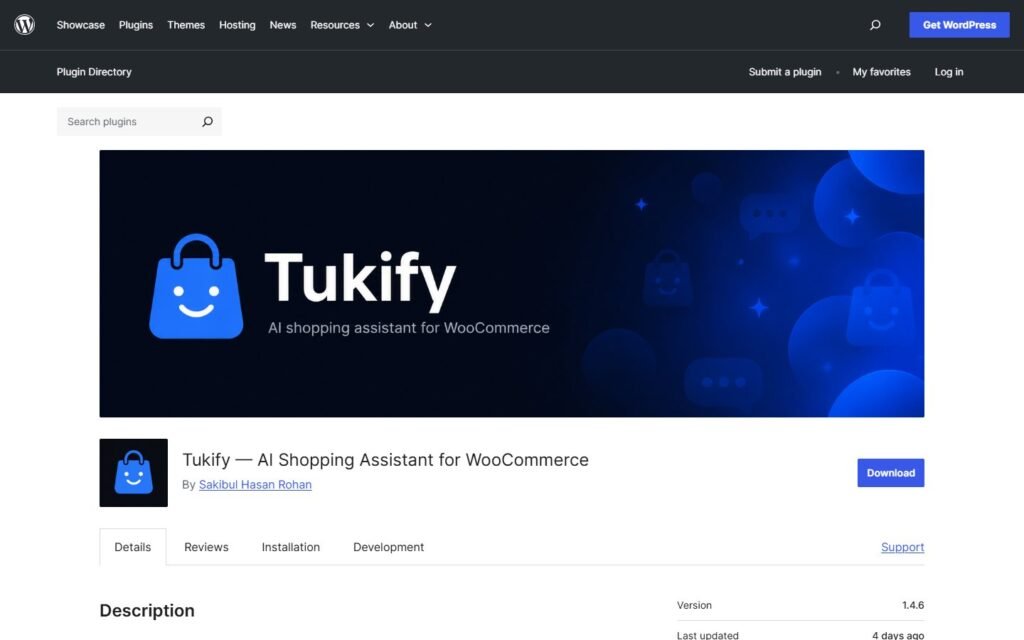
Tukify is an open-source WooCommerce plugin positioned as an AI chatbot and shopping assistant. According to its official WordPress.org listing, shoppers can describe what they want in plain language or upload an image, and the assistant can find relevant products from the store catalog.
Its documented storefront capabilities are unusually broad for a young plugin:
- Semantic product search based on meaning rather than exact keywords.
- Conversational RAG grounded in real products and store content.
- Natural-language filters for price, size, color, brand, category, stock, and sorting.
- Clarifying questions when a shopper request is too vague.
- Side-by-side product comparison.
- Shipping, returns, warranty, and FAQ answers from selected site content.
- Cart-aware complementary product suggestions.
- Visual search from an uploaded image.
- Exit-intent re-engagement.
- Back-in-stock email notifications with consent and unsubscribe controls.
- Secure order-status lookup.
- Optional in-chat checkout.
- Analytics for searches, zero-result demand, clicks, and chat-to-sale activity.
Tukify also lets the merchant choose supported AI providers. Its public listing documents Google Gemini, OpenAI, Anthropic Claude, and xAI Grok, with separate chat and embedding provider choices where required. AI requests are sent server-side, while product embeddings are stored in the site’s own WordPress database.
As of July 17, 2026, the WordPress.org listing showed version 1.4.6, fewer than 10 active installations, and one review. That means the feature set is ambitious, but stores should still evaluate it as a relatively new plugin and test it carefully against their catalog, theme, privacy requirements, and checkout setup.
What is Niwa AI?
Niwa AI approaches WordPress AI from the owner’s side as well as the shopper’s side.
The customer-facing layer can answer questions, guide product discovery, capture buying intent, qualify leads, reduce hesitation, and support conversion workflows. The owner-facing layer can receive instructions, perform WordPress and WooCommerce work, publish content, report on business activity, research competitors, and coordinate follow-up.
The core idea behind how Niwa works is that the assistant should not stop after generating an answer. It should help turn the request into an operational or commercial result.
For a store owner, that can mean tasks such as:
- Update a WooCommerce product, price, stock level, or coupon.
- Create or publish a WordPress article or landing page.
- Review sales, site activity, leads, or operational signals.
- Research a competitor and prepare an actionable summary.
- Receive and act on instructions through Telegram or WhatsApp.
- Capture a shopper’s intent and route a useful lead instead of saving an unstructured transcript.
- Connect customer questions with conversion actions such as product guidance, incentives, follow-up, or human handoff.
Niwa is therefore less accurately described as only a chatbot. Its intended role is closer to a WordPress business operator that can participate in website administration, ecommerce operations, customer conversations, and growth workflows.
Tukify vs Niwa AI feature comparison
| Capability | Tukify | Niwa AI |
|—|—|—|
| Customer-facing WooCommerce chat | Yes | Yes |
| Semantic product discovery | Yes | Yes, through conversational product guidance |
| Visual product search from an uploaded image | Yes | Not a primary documented capability |
| Natural-language catalog filters | Yes | Supports product discovery and WooCommerce workflows |
| Product comparison | Yes | Yes, through guided product conversations |
| Cart-aware recommendations | Yes | Yes |
| Exit-intent re-engagement | Yes | Supports conversion and abandonment workflows |
| In-chat cart and checkout experience | Yes, documented | Conversion support is broader; exact flow depends on deployment |
| Secure order-status lookup | Yes | WooCommerce operational support is available |
| Back-in-stock email collection | Yes | Lead capture and follow-up workflows are broader |
| WordPress post and page publishing | Not prominently documented as an owner workflow | Yes |
| General WordPress administration | Not the primary product focus | Yes |
| WooCommerce product and business operations | Shopper and catalog focused | Yes, owner and customer focused |
| Owner administration through Telegram | Not publicly documented | Yes |
| Owner administration through WhatsApp | Not publicly documented | Yes |
| Business reporting | Storefront search and conversion analytics | Broader business and operational reporting |
| Competitor research and monitoring | Not publicly documented | Yes |
| Lead qualification and routing | Limited documented opt-in workflows | Yes |
| AI provider choice | Strong multi-provider BYOK model | Depends on Niwa deployment and configuration |
| Primary use case | AI shopping assistant | WordPress business agent |
Public product capabilities change quickly. The Tukify column reflects its official WordPress.org listing available on July 17, 2026. “Not publicly documented” does not mean a feature can never be added; it means it was not clearly presented as part of the current public product scope.
Where Tukify is stronger
Visual and semantic shopping are central, not secondary
Tukify’s strongest advantage is focus. It is built around helping a customer find and evaluate products inside a WooCommerce store.
The combination of semantic search, natural-language filters, comparison mode, and image upload can be valuable for catalogs where customers struggle to express what they want with ordinary search terms. Fashion, furniture, gifts, accessories, home décor, and visually distinctive products are obvious examples.
A shopper can describe an outcome instead of guessing the merchant’s product taxonomy. That directly addresses a common ecommerce problem: the customer knows the need but not the exact product name.
The in-chat buying journey is unusually complete
Tukify publicly documents product cards, quantity controls, cart actions, a persistent checkout button, opt-in in-chat checkout, and order-status lookup. For stores seeking a tightly integrated conversational shopping experience, that is a compelling package.
It also includes back-in-stock subscriptions and cart-aware upsells, giving the assistant useful actions before and after the initial product search.
Merchants get meaningful AI provider flexibility
Tukify’s bring-your-own-key model supports several major AI providers. Merchants can choose chat and embedding providers, keep API keys server-side, and store embeddings in their own WordPress database.
That flexibility can appeal to technically comfortable store owners who want more control over model choice, usage cost, and infrastructure.
Where Niwa AI is broader
Niwa can operate WordPress, not only assist shoppers
Tukify’s public positioning is storefront-first. Its documented actions are mainly tied to product discovery, shopping, policies, carts, orders, and storefront analytics.
Niwa’s scope extends into the work behind the storefront. The owner can ask for a product update, a new article, a landing page, a report, a competitor check, or another website operation. This reduces the gap between identifying an opportunity and executing the response.
For businesses that publish regularly, this matters. Niwa can connect research, writing, WordPress publishing, and review into one workflow rather than acting only as a customer chat layer.
Telegram and WhatsApp become an owner command center
Tukify runs primarily as a WooCommerce storefront and WordPress-admin plugin. Its public documentation does not currently position Telegram or WhatsApp as channels from which the owner can administer the business.
Niwa is designed so the owner can send instructions from messaging apps already used throughout the day. That changes the practical role of the AI. Instead of opening wp-admin for every task, the owner can request an update, ask for a report, approve content, or investigate an issue conversationally.
This is particularly useful for founders who manage a store while moving between sales, inventory, suppliers, customer questions, and marketing.
Reporting can lead to action
Tukify documents useful analytics, including top searches, zero-result searches, click-through activity, chat-to-sale signals, usage, estimated AI cost, and unmet demand insights. Those are meaningful storefront metrics.
Niwa’s reporting role is broader. The goal is not only to show what shoppers searched for, but to connect business signals with suggested or completed actions: update content, change a product, follow up with a lead, investigate a conversion problem, or research what a competitor is doing differently.
Competitor monitoring and content operations are separate advantages
Tukify is not publicly positioned as a competitor-monitoring or publishing system. Niwa can research competing offers, identify content opportunities, prepare an SEO article, and publish through WordPress when approved.
That distinction matters for growth teams. Product discovery improves the experience of existing traffic. Competitor and content workflows can also help the business attract and convert future traffic.
Which is better for WooCommerce?
The answer depends on whether you define WooCommerce AI narrowly or broadly.
If WooCommerce AI means a sophisticated shopping assistant embedded in the storefront, Tukify is a strong and focused option. Its visual search, semantic retrieval, comparisons, cart actions, checkout, order status, and model flexibility deserve serious consideration.
If WooCommerce AI means an agent that works across the operating business, Niwa is the better fit. It combines store operations with owner messaging, publishing, reporting, lead handling, competitor monitoring, and conversion workflows.
The two products may even be evaluated for different layers of the same business. Tukify’s public feature set is optimized for the shopper interface. Niwa is positioned as the operating relationship between the owner, the website, and the commercial result.
Lead capture and conversion workflows
Tukify includes practical conversion mechanisms: clarifying questions, comparison, cart-aware upsells, exit prompts, back-in-stock signup, chat-to-sale analytics, and checkout support. These features can reduce dead ends and help shoppers move toward a purchase.
Niwa places those moments inside a wider lead and follow-up system. The purpose of turning website visitors into leads is not simply to collect an email address. The useful outcome is a structured record of what the visitor wants, what prevented the purchase, and what the business should do next.
Niwa can also connect conversational intent with practical conversion tactics. The Niwa AI Conversion Booster demonstrates how cart behavior can trigger a timely incentive rather than displaying the same generic coupon to every visitor.
For stores focused on qualification and handoff, the guide to AI lead capture for ecommerce explains why intent and context matter more than a bare contact field.
Which WordPress AI agent should you choose?
Choose Tukify when:
- Your immediate priority is customer-facing WooCommerce product discovery.
- You want visual search and natural-language catalog filters.
- You want product comparisons, cart actions, and checkout inside chat.
- You prefer a bring-your-own-key setup with several model providers.
- You are comfortable testing a new plugin with a small current installation base.
Choose Niwa AI when:
- You want an AI agent that works with the owner as well as the shopper.
- You need WordPress and WooCommerce administration from Telegram or WhatsApp.
- You want content research, creation, and publishing workflows.
- You need broader reporting, competitor monitoring, and operational summaries.
- You want lead capture connected to qualification, follow-up, and conversion action.
- You prefer one agent relationship across website operations and growth workflows.
Final verdict
Tukify is one of the more feature-dense WooCommerce shopping assistants in the WordPress plugin directory. Its visual search, semantic product discovery, grounded catalog answers, in-chat commerce, order lookup, analytics, and model flexibility make it a credible option for merchants who want to improve the storefront shopping conversation.
Niwa AI solves a wider problem. It is intended to help run the business behind the website: administer WordPress and WooCommerce, publish content, report on activity, monitor competitors, work through messaging apps, capture useful leads, and connect customer intent with conversion workflows.
For a focused AI shopping interface, Tukify may be the more direct choice. For a broader WordPress business agent, Niwa is the more complete fit.
To see the wider operating model, review how Niwa works or book a Niwa demo.
Frequently asked questions
Is Tukify a WordPress AI agent?
Tukify is best described as a WooCommerce AI shopping assistant. It performs meaningful customer-facing actions inside the store, but its public positioning is not centered on general WordPress administration, business operations, or owner messaging workflows.
Does Tukify support visual product search?
Yes. Its official WordPress.org listing says shoppers can upload an image and use a vision-capable AI provider to identify the product type before matching similar products in the WooCommerce catalog.
Can Tukify complete checkout inside chat?
Tukify documents an opt-in in-chat checkout, cart controls, shipping details, and a checkout button when the cart contains items. Merchants should test the flow with their payment, shipping, tax, and checkout extensions before using it in production.
Does Tukify work with OpenAI, Gemini, Claude, and Grok?
Its current public listing documents all four as chat options. Gemini and OpenAI can also provide embeddings, while Claude and Grok require Gemini or OpenAI for the embedding layer.
Can Tukify manage WordPress through Telegram or WhatsApp?
That capability is not documented on Tukify’s current public plugin listing. Niwa AI is designed for owner administration and communication through Telegram or WhatsApp.
Which tool is better for lead capture?
Tukify documents back-in-stock email subscriptions and storefront analytics. Niwa is designed for broader lead capture, qualification, routing, and follow-up workflows that preserve the visitor’s intent and commercial context.
Which tool is better for content publishing and competitor monitoring?
Niwa AI is the clearer fit. Tukify’s public scope focuses on the shopping journey, while Niwa includes content operations and competitor research as part of the owner’s workflow.
Can I use Tukify and Niwa AI for the same store?
Potentially, because their primary roles differ. However, two customer-facing assistants can create a confusing experience, duplicate scripts, or affect performance. A store should define which system owns the storefront conversation and test compatibility before running both.