Agent Builder vs Niwa AI: Build Agents or Run Your WordPress Business?
Compare Agent Builder and Niwa AI for WordPress agents, WooCommerce, WhatsApp, Telegram, publishing, reporting, leads, monitoring, and conversions.
Agent Builder and Niwa AI both belong to the new generation of WordPress AI agents: tools that can do more than generate a paragraph inside the editor. Both can connect natural-language instructions to real WordPress actions, but they are designed around different starting points.
Agent Builder is primarily a platform for creating, training, deploying, and extending specialized AI assistants inside WordPress. Niwa AI is designed as a ready-to-operate business agent for owners who want WordPress, WooCommerce, messaging administration, customer conversion, and reporting connected in one workflow.
This comparison looks at what each product currently documents, where each one is stronger, and which approach fits different WordPress and WooCommerce teams. Product capabilities change quickly, so the comparison reflects publicly available information reviewed on July 17, 2026.
Quick verdict
Choose Agent Builder if you want a flexible WordPress-native framework for building multiple specialized assistants, assigning tools and skills, running scheduled tasks, reacting to WordPress events, and extending agents through channels, MCP, WP-CLI, or a marketplace.
Choose Niwa AI if you want an operational agent that is already centered on the owner’s daily work: managing WordPress and WooCommerce, publishing content, receiving instructions through Telegram or WhatsApp, reviewing business signals, monitoring competitors, capturing buyer intent, and supporting conversion workflows.
The simplest distinction is:
Agent Builder gives you a workshop for assembling AI assistants. Niwa AI gives you a business operator designed to start working across the website, store, messaging channels, and customer journey.
Neither approach is automatically better. The right choice depends on whether you want to build an agent system or deploy a more opinionated operating system for the business behind the site.
What Agent Builder does well
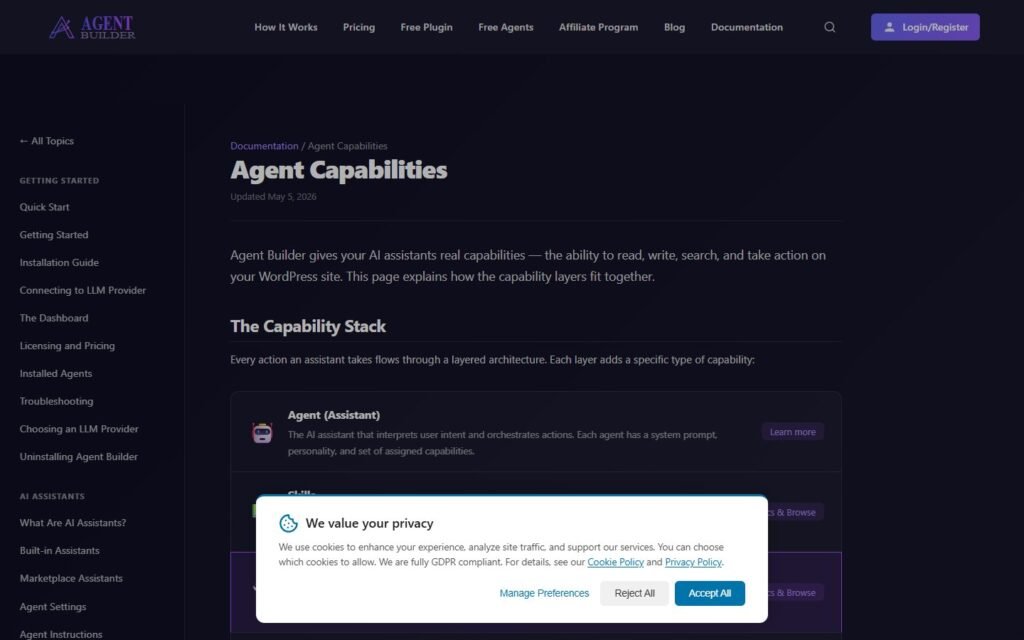
Agent Builder by Agentic Tech is a WordPress plugin and agent framework. Its official documentation describes a layered architecture built around assistants, skills, executable tools, communication channels, the WordPress Abilities API, and Model Context Protocol integration.
That structure is one of its clearest strengths. A developer or advanced site owner can create separate agents for separate jobs rather than expecting one assistant to handle everything.
Its documented built-in and marketplace use cases include:
- creating, editing, and publishing posts and pages;
- auditing titles, meta descriptions, headings, keywords, and links;
- checking site health, broken links, database bloat, plugins, logins, and modified files;
- monitoring visibility to AI search engines;
- building custom assistants from plain-language job descriptions;
- running assistants on schedules or in response to WordPress events;
- deploying assistants through admin chat, shortcodes, Gutenberg blocks, channels, WP-CLI, and MCP;
- adding a marketplace WooCommerce Assistant for products, orders, customers, coupons, inventory, and sales analytics.
Agent Builder also documents granular permissions, approvals, audit trails, and backups. Those controls matter because an assistant that can publish content, query the database, or change a store needs clearer boundaries than a simple chatbot.
For agencies, developers, and teams that want to assemble their own agent stack, this modularity is compelling. The official Agent Builder capability documentation makes it clear that the product is intended to be extensible rather than limited to a single predefined assistant.
What Niwa AI does well
Niwa AI starts from a different product question: What does a WordPress or WooCommerce owner need handled today?
Instead of making the owner first design a collection of agents, assign tools, and define each workflow, Niwa is built around practical operating requests. An owner can ask for a product update, price change, stock check, new article, sales summary, competitor review, website fix, lead follow-up, or conversion task in conversational language.
The owner-facing experience is a central part of how Niwa works. Niwa is designed to connect website administration with commercial context, rather than treating every WordPress action as an isolated technical command.
That means working across two sides of the business:
- Owner operations: WordPress and WooCommerce administration, content publishing, research, reports, monitoring, and recurring workflows.
- Customer conversion: answering buying questions, understanding hesitation, capturing useful lead context, recommending the next step, and supporting follow-up.
This distinction matters. Publishing a product page is a website task. Noticing that visitors repeatedly ask about compatibility, improving that page, capturing a high-intent lead, and reporting the pattern to the founder is a connected business workflow.
Agent Builder vs Niwa AI feature comparison
| Capability | Agent Builder | Niwa AI |
|—|—|—|
| Natural-language WordPress actions | Yes | Yes |
| Content creation and publishing | Yes; Content Writer and custom agents | Yes; integrated into owner workflows |
| SEO auditing and content optimization | Yes; dedicated assistants documented | Yes; research, content, metadata, and publishing workflows |
| Build multiple custom agents | Major product strength | Possible through Niwa’s skills and operating workflows, but not the primary positioning |
| Scheduled and event-driven tasks | Yes; prominently documented | Yes; recurring research, reports, publishing, and admin workflows |
| WooCommerce administration | Available through tools and a marketplace WooCommerce Assistant | Core operational focus |
| Products, orders, coupons, inventory | Documented for the WooCommerce Assistant | Supported as owner-operated WooCommerce workflows |
| Sales analytics and reporting | Documented for the WooCommerce Assistant | Business reporting is part of the broader owner experience |
| WhatsApp access | Yes; documented as a premium channel | Yes |
| Telegram administration | Not listed among the currently documented official channels | Yes |
| Email or Slack channels | Yes; premium channels documented | Email workflows supported; product focus is owner administration rather than Slack deployment |
| Storefront customer assistant | Agents can be deployed on the frontend | Built around customer questions, buying intent, and conversion support |
| Lead capture and qualification | Can be built with agents, tools, forms, or custom workflows | A defined conversion use case |
| Abandoned-cart and conversion workflows | Possible through custom or commerce agents; not presented as the core bundled promise | A central product direction, including proactive conversion workflows |
| Competitor monitoring | Could be created as a custom scheduled agent | A defined owner research and monitoring workflow |
| Marketplace for third-party agents | Yes | No equivalent marketplace is the current primary model |
| MCP and developer extensibility | Strong, prominently documented | Supports tool-based and MCP-oriented operations, with the emphasis on completed business outcomes |
| Approval, permissions, audit, backup controls | Strong, explicitly documented | High-impact changes use controlled admin workflows and verification |
The biggest difference: platform architecture vs operating context
Agent Builder’s strongest idea is specialization. You can activate a Content Writer, SEO Assistant, Security Assistant, Site Doctor, AI Radar, WordPress Assistant, or Assistant Trainer. You can then add tools, skills, channels, scheduled tasks, and event listeners.
That is attractive when a team wants explicit separation of responsibility. A security agent can have different permissions from a content agent. A frontend support assistant can use different instructions from an internal administrative agent. Developers can inspect and extend the capability stack.
Niwa’s strongest idea is continuity of context. The same owner conversation can move from a business question to a WordPress action, then to verification and reporting. The emphasis is less on choosing the correct specialist interface and more on delegating an outcome.
For example, a founder might ask:
Find which products are losing momentum, compare a competitor’s current offer, prepare a promotional angle, update the relevant landing page, and tell me what changed.
In Agent Builder, that could be implemented by combining or creating agents with the necessary tools. In Niwa, this type of connected owner request is closer to the product’s core operating model.
WordPress and content publishing
Agent Builder is strong for structured editorial systems. Its Content Writer can create, edit, and publish posts and pages, while its SEO tools can audit metadata, headings, links, and keyword use. Scheduled tasks can support recurring content production, and event listeners can trigger work after a post is published or another WordPress event occurs.
Niwa also handles research, drafting, internal linking, SEO metadata, WordPress creation, publication, and post-publication verification. The difference is that content can be connected to wider business signals: customer questions, competitor movements, product priorities, lead patterns, or conversion problems.
If your goal is to assemble a team of distinct editorial agents, Agent Builder offers a clearer agent-building framework. If your goal is to tell one operator why the article matters, have it created, publish it, and connect it to the rest of the business, Niwa is the more opinionated fit.
WooCommerce operations and reporting
Agent Builder should not be dismissed as a content-only system. Its marketplace lists a WooCommerce Assistant that can manage products, orders, customers, coupons, inventory, and sales analytics through natural conversation. Its general tool and custom-agent architecture can also support specialized store workflows.
However, that commerce capability is presented as an assistant that users add to the broader platform. The quality and breadth of a final setup will depend on the selected assistants, tools, permissions, channels, licensing, and any custom training.
Niwa is positioned more directly around the daily needs of ecommerce owners. WooCommerce operations, reporting, customer questions, lead context, and conversion actions are meant to work together. A report is not only a list of totals; the useful outcome is understanding what changed, why it matters, and what action should follow.
This is also why Niwa’s Conversion Booster workflow is relevant. The product is designed not only to administer the catalog but also to respond to live buying behavior with appropriate conversion actions.
Telegram and WhatsApp administration
Agent Builder deserves credit for its channel strategy. Its official documentation lists WhatsApp, email, and Slack as communication bridges for agents, with channels available as premium capabilities. This means an Agent Builder assistant does not have to remain trapped inside wp-admin.
Niwa also supports WhatsApp, but Telegram is an important practical difference. Agent Builder’s current official channel documentation does not list Telegram, while Niwa uses Telegram and WhatsApp as owner-facing command centers.
For founders who already operate from Telegram, that can reduce friction substantially. The owner can delegate work, receive reports, review results, and continue the conversation without treating WordPress administration as a separate desktop activity.
Agent Builder may be the better fit when Slack, email, developer clients, or a custom channel architecture matters more. Niwa is the better fit when the founder wants a ready operational relationship through Telegram or WhatsApp.
Lead capture and conversion workflows
Agent Builder can deploy assistants on the frontend through shortcodes and Gutenberg blocks. Its architecture can support forms, specialized customer agents, and custom conversion logic. A capable team could build a product adviser, support bot, lead qualifier, or commerce assistant on top of the platform.
The difference is what comes predefined as product intent.
Niwa treats the storefront conversation as part of the operating system. The goal is not only to answer questions but to recognize why a visitor is hesitating, capture useful context, route serious opportunities, and help the owner improve the pages causing friction. The Niwa lead-capture approach emphasizes helping first and collecting contact details when a real follow-up reason exists.
So the fair comparison is not “Agent Builder cannot do lead capture.” Its framework may support it. The more accurate distinction is that Niwa makes lead capture and conversion continuity a central ready-to-use business case, while Agent Builder provides components from which teams can construct their own version.
Competitor monitoring and commercial research
Agent Builder’s custom assistants and scheduled tasks could be configured for recurring research. Its Assistant Trainer is specifically designed to create new agents from plain-language job descriptions, so a competitor-monitoring assistant is a plausible extension.
But competitor monitoring is not listed among the main bundled assistants in the current official documentation. Building a reliable monitor would require the appropriate research tools, sources, schedule, instructions, and reporting rules.
Niwa includes competitor research and monitoring within the owner workflow. That is useful for founders who do not want to architect the monitoring agent first. They want to ask what changed, receive evidence, and turn the finding into a product, pricing, content, or conversion decision.
Agent Builder offers more freedom to design the research system. Niwa offers a shorter path from commercial question to action.
Safety and control
Agent Builder is especially strong in how clearly it documents safety architecture. Official materials describe granular permissions, human approval for important actions, audit logs, rate limits, role controls, and filesystem backups. Developers and agencies evaluating an extensible agent platform should take those controls seriously.
Niwa also uses controlled execution, verification, and role-aware administration for impactful actions. The practical goal is that the founder can delegate confidently while still receiving a clear record of what happened.
For a team that wants to tune permissions separately across many custom assistants, Agent Builder’s architecture is a major advantage. For an owner who wants the safety system to support a unified operating relationship without managing an agent roster, Niwa’s model is simpler.
Where Agent Builder is stronger
Agent Builder is the stronger choice when you need:
- a framework for building many specialized assistants;
- a marketplace model for installing or selling third-party agents;
- explicit skills, tools, channels, WordPress Abilities, and MCP layers;
- Slack and email channels as part of the official premium architecture;
- WP-CLI and developer-oriented deployment;
- fine-grained configuration for separate agent roles;
- a customizable platform that an agency can adapt for different clients.
It is a serious option for developers, agencies, and technically confident WordPress teams that want to shape their own agent ecosystem.
Where Niwa AI is stronger
Niwa is the stronger choice when you need:
- a single business operator rather than a collection of assistants to configure;
- WordPress and WooCommerce tasks connected to founder context;
- Telegram as an owner administration channel;
- WhatsApp administration without changing the product’s core operating model;
- customer-facing lead capture and buying-intent workflows;
- conversion actions connected to live website behavior;
- competitor monitoring linked to content, pricing, and commercial decisions;
- reporting that leads naturally into the next action;
- a shorter route from “please handle this” to verified execution.
Niwa’s advantage is not that every underlying capability is impossible to build elsewhere. It is that these capabilities are designed to work together around the owner and the commercial result.
Which WordPress AI agent should you choose?
Choose Agent Builder if your priority is flexibility, extensibility, custom agent creation, marketplace assistants, developer interfaces, and clearly separated specialist roles. It is particularly attractive when you have the technical capacity to design and govern the system you want.
Choose Niwa AI if your priority is delegating real business work across WordPress, WooCommerce, messaging, publishing, reporting, leads, competitor intelligence, and conversion. It is a better fit when you want the agent system to arrive with a stronger opinion about how an owner actually runs the business.
Both products reflect an important shift in WordPress: the future is not another dashboard full of recommendations. It is software that can understand an instruction, use the right tools, complete the work safely, and report the result.
Agent Builder approaches that future as an extensible agent platform. Niwa approaches it as an operating partner.
Frequently asked questions
Is Agent Builder a chatbot or a real WordPress AI agent?
Agent Builder is more than a simple chatbot. Its official documentation describes executable tools, skills, scheduled tasks, event listeners, channels, approvals, WordPress Abilities, and MCP connections. The exact actions available depend on the assistant, tools, plan, permissions, and configuration.
Can Agent Builder manage WooCommerce?
Yes. Agent Builder’s marketplace lists a WooCommerce Assistant for products, orders, customers, coupons, inventory, and sales analytics. Teams can also create custom commerce agents, although availability and setup may depend on licensing and installed assistants.
Does Agent Builder support WhatsApp?
Yes. WhatsApp is documented as a premium Agent Builder channel. Its current official channel list also includes email and Slack.
Does Agent Builder support Telegram?
Telegram is not listed among Agent Builder’s currently documented official channels reviewed for this comparison on July 17, 2026. Niwa AI supports Telegram as an owner administration channel.
Can both tools publish WordPress content?
Yes. Agent Builder documents content creation, editing, SEO optimization, and publishing. Niwa also researches, creates, optimizes, publishes, and verifies content as part of broader owner workflows.
Which is better for a WooCommerce owner who is not a developer?
Niwa is likely the more direct fit when the owner wants a ready business operator spanning store administration, messaging, customer conversion, and reporting. Agent Builder may be preferable if the owner or agency wants to assemble a customized team of specialist agents.
Which is better for agencies and developers?
Agent Builder has a strong case for agencies and developers because of its custom-agent framework, marketplace, WordPress Abilities integration, MCP, WP-CLI, channels, and granular agent configuration. Niwa is a stronger fit when the agency wants a business-operations layer centered on verified execution and owner communication.
Can I see Niwa AI before choosing?
Yes. You can book a Niwa AI demo to review how owner administration, WooCommerce workflows, publishing, reporting, lead capture, and conversion support fit together.