AI Address Correction for Ecommerce: Stop Delivery Failures
Use AI to resolve checkout and post-purchase address errors, protect completed orders, and route risky delivery changes to the right person.
A completed ecommerce order can still become an expensive support problem if the delivery address is wrong. A misspelled street, missing apartment number, outdated saved address, or mismatched postal code may lead to a delayed shipment, a failed delivery, a return to sender, or a customer asking for an urgent correction after fulfillment has started.
Address validation software can flag many technical errors. An AI address correction assistant adds the conversational layer: it explains the issue in plain language, asks for the missing detail, confirms what the customer meant, and routes time-sensitive changes to the right person before the parcel leaves the warehouse.
The goal is not to let a chatbot rewrite addresses freely. The goal is to combine verified address data, clear customer confirmation, and a controlled operational handoff.
What is an AI address correction assistant?
An AI address correction assistant helps customers resolve delivery-address problems during checkout or shortly after an order is placed. It works alongside an address validator, ecommerce platform, order management system, and customer support workflow.
Depending on the store’s rules and integrations, it can:
- explain why an address was flagged;
- ask for a missing apartment, unit, building, or floor number;
- show the customer’s entry beside a validated suggestion;
- confirm the intended recipient, postal code, city, or region;
- collect a correction request after purchase;
- check whether fulfillment has started;
- route risky or late changes to a human with the order context;
- send a clear confirmation of what happens next.
The assistant should never claim that an address has been changed unless the commerce or order system confirms the update.
Why address mistakes deserve a conversion workflow
Address entry looks like a simple form task, but small mistakes can survive checkout. Baymard’s address-validator research reports that 47% of benchmarked sites did not provide an address validator. In one checkout-testing round, 9% of more than 150 placed orders contained a typo or misspelling in the shipping address.
Baymard also documents the customer consequences: missed or delayed delivery, extra contact with the store or carrier, canceled orders, and lost sales. Validation is therefore not only a logistics feature. It protects the revenue already won at checkout and the trust needed for the next purchase.
A raw error such as “invalid address” often creates more work than it removes. The shopper may not know which field is wrong or whether the suggested version changes the destination. A short conversation can turn that error into a precise decision.
The assistant should support the validator, not replace it
There are two different jobs:
- Address validation: compares the entered address with trusted postal, carrier, or geocoding data.
- Conversational resolution: helps the customer understand the result, provide missing context, and confirm the final choice.
An AI model should not guess house numbers, apartment numbers, postal codes, or recipient details. It should receive structured validator results and present them safely.
For example, the validator may return “secondary unit missing.” The assistant can then ask, “Does this delivery address include an apartment or unit number?” If the validator suggests a standardized street name, the assistant can show both versions and ask the customer to choose. The final address should be written only after explicit confirmation and a successful system update.
Three moments when address assistance matters
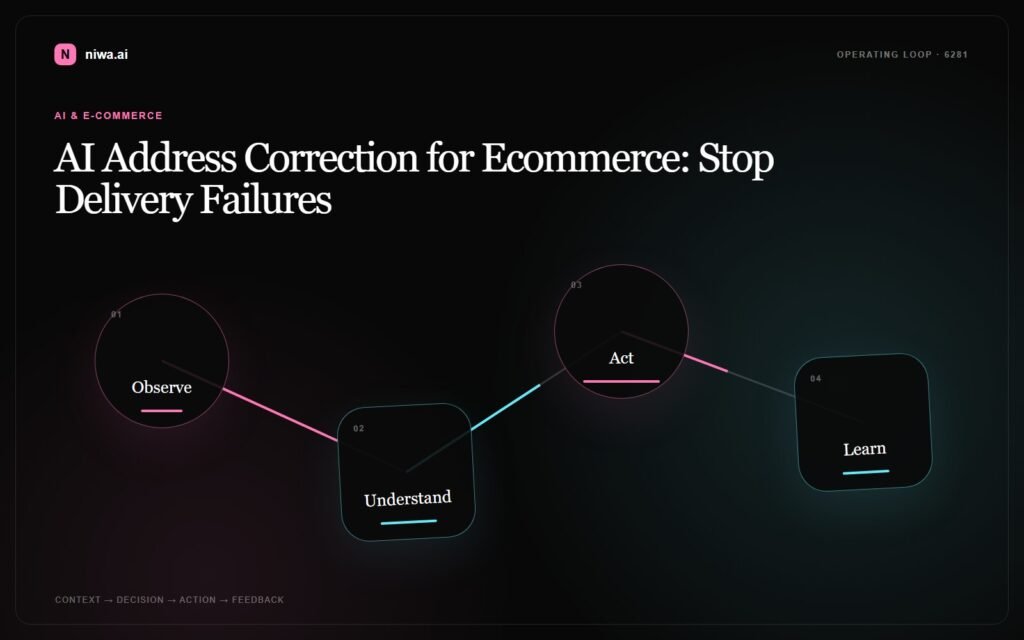
1. During checkout
This is the safest time to resolve an address problem because the parcel has not entered fulfillment. The assistant can appear after the validator flags a meaningful issue, not while the shopper is still typing every character.
A useful flow is:
- Receive the original address and the validator response.
- Explain the specific mismatch in one sentence.
- Show the original entry and verified suggestion.
- Ask the shopper to confirm one option or add the missing detail.
- Revalidate the completed address.
- Return the shopper to checkout without losing cart data.
Do not turn a harmless formatting difference into a blocking conversation. Escalate only issues that may affect delivery.
2. Immediately after purchase
Customers often notice a wrong address on the confirmation page or email. A generic support form creates uncertainty: Did anyone see the request? Has the order already shipped? Should the customer contact the carrier?
An assistant can collect the order number, verify the customer through an approved method, capture the requested correction, and check the fulfillment state. If the order is still editable, the system can apply the change according to policy. If it is not, the assistant should create an urgent human task and explain that the change is not guaranteed.
3. Before fulfillment or label creation
Some address issues appear in operational review rather than during checkout. The assistant can send a controlled request asking the customer to confirm a missing detail before a deadline. The conversation should identify the order without exposing sensitive information and should stop once the address is confirmed or the case is assigned to an agent.
A practical conversation example
Assistant: The delivery service could not verify the apartment information for this address. Is there an apartment or unit number?
Customer: Yes, apartment 14.
Assistant: Thank you. Please confirm: 25 King Street, Apartment 14, Manchester, M2 6AQ.
Customer: Correct.
Assistant: Your address has been revalidated. The order system has confirmed the update, and your order has not entered fulfillment yet.
Notice the final sentence. The assistant reports a successful change only after receiving confirmation from the order system. If the system does not confirm it, the correct response is: “I have sent an urgent correction request to the support team. The address change is not confirmed yet.”
What information should be included in a human handoff?
Address changes become risky when the order is valuable, fulfillment has started, fraud controls are triggered, or the customer wants to change the destination country or recipient. The handoff should include:
- order ID and current fulfillment status;
- verified customer identity status;
- original address and requested correction;
- validator response and any remaining warning;
- shipping method and carrier status;
- time of the request;
- conversation summary;
- the exact commitment already made to the customer.
This information should land in the team’s existing support or customer-data workflow. HubSpot’s CRM overview emphasizes organizing customer data and unifying teams and data on one platform. For an address case, that means support and fulfillment should work from one traceable request rather than separate chat transcripts and inbox messages.
See How Niwa Works for the broader model of turning a website conversation into a structured next action.
Security and fraud guardrails
Changing a shipping address can redirect physical goods, so convenience cannot override security. Build explicit rules:
- Verify identity: use an approved login, order-token, one-time code, or human verification flow.
- Limit exposed data: do not reveal a full saved address before the customer is verified.
- Restrict high-risk changes: route country, recipient, or materially different destination changes to review.
- Respect fulfillment locks: do not promise edits after label creation, picking, or carrier collection.
- Keep an audit trail: record the original value, requested value, confirmation, actor, and timestamp.
- Avoid model invention: every suggested address must come from validated data or customer input.
- Provide a human path: customers need a clear escalation option when automation cannot safely complete the request.
How to measure business impact
Chat volume is not the main success metric. Track whether the workflow prevents avoidable delivery and support costs:
- address warnings resolved before order placement;
- missing unit numbers recovered;
- post-purchase corrections completed before fulfillment;
- average time from correction request to resolution;
- failed deliveries and returns to sender caused by address issues;
- support contacts per address problem;
- orders canceled because an address could not be corrected;
- repeat-purchase rate after a successfully resolved delivery issue.
Segment results by device, country, carrier, and error type. Mobile typo patterns may require better form controls, while repeated unit-number problems may call for a clearer field. The assistant handles the individual case; the aggregated conversation data shows where the checkout itself should improve.
Start with a narrow, safe workflow
Begin with one low-risk scenario, such as a validator-detected missing apartment number before checkout completion. Connect the validator response, define the exact customer question, require explicit confirmation, and verify the final write in the order system.
Then add post-purchase correction requests with identity checks and fulfillment-state rules. Keep high-risk changes in a human review queue. This approach improves the customer experience without letting conversational flexibility bypass operational controls.
Niwa AI can help turn checkout and post-purchase questions into structured, sales-protecting actions while preserving the human handoff for changes that need judgment.
Book a Niwa AI demo to map an address correction flow around your ecommerce platform, validation service, fulfillment rules, and support process.