

AI Appointment Booking Assistant for Ecommerce: Turn Qualified Chats Into Sales Calls
Learn how an AI appointment booking assistant qualifies ecommerce buyers, protects sales time, and turns serious chat intent into booked calls.
Most ecommerce conversations do not need a longer chatbot script. They need a clear next step.
A shopper asks whether a product will fit their use case. A buyer wants to confirm delivery timing before paying. A B2B customer needs a custom quote, payment terms, or approval from a manager. If the answer is simple, an AI assistant can solve it in the chat. If the purchase needs a human conversation, the assistant should not leave the buyer with a vague “someone will contact you soon.” It should qualify the request and help the right customer book the right call.
That is the job of an AI appointment booking assistant: turn qualified chat intent into scheduled sales conversations without making your team chase every weak inquiry manually.
Why booking is a conversion problem, not just a calendar problem
Booking tools are useful, but a naked calendar link is rarely enough. If you show it too early, the sales team receives unqualified calls. If you hide it too late, motivated buyers leave before speaking to anyone.
The problem usually appears in one of these places:
- High-ticket products: the buyer wants confidence before committing to a premium order.
- Custom ecommerce: the product depends on dimensions, volume, implementation, delivery constraints, or configuration.
- B2B ecommerce: the shopper is not the final decision-maker and needs a quote, invoice, or procurement-friendly process.
- Complex support-to-sales moments: a support question reveals that the customer is ready for an upgrade, bundle, subscription, or replacement order.
In these moments, the assistant should not behave like a generic FAQ bot. It should understand buying intent, collect the details your sales team needs, and offer a booking path only when the conversation is qualified.
Where appointment booking fits in the AI sales flow
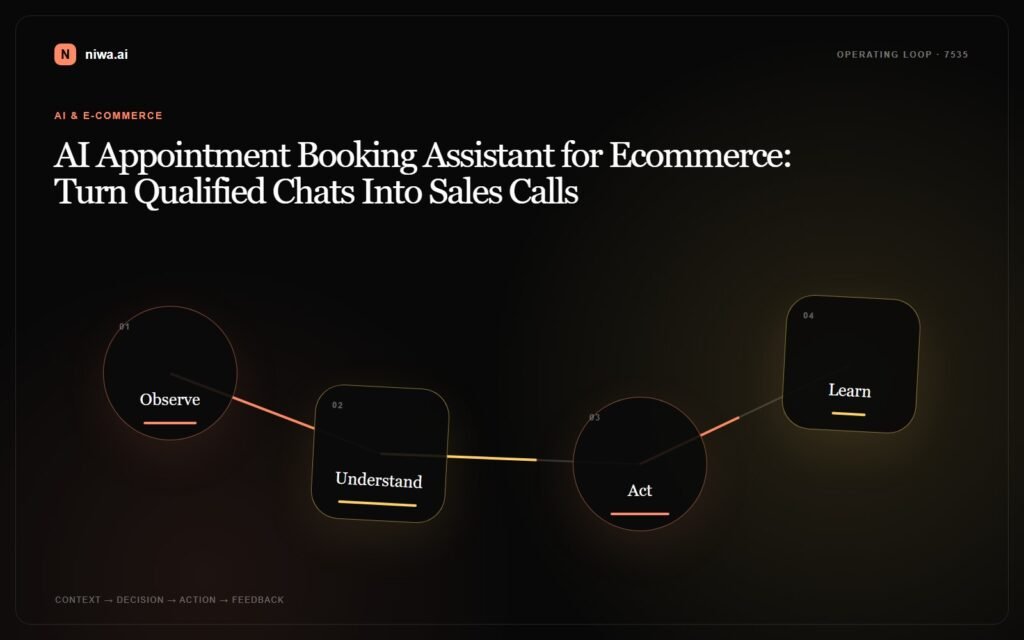
A strong AI booking flow has four steps.
- Answer the immediate question: The assistant first removes the blocker: price range, compatibility, delivery, return policy, minimum order quantity, warranty, or product availability.
- Check sales fit: It asks for practical qualification details such as product category, order size, budget range, timeline, country, company type, or preferred communication channel.
- Route the buyer: A simple question can stay in self-service. A complex order can move to a sales specialist, implementation call, wholesale request, or post-purchase support path.
- Book or hand off cleanly: If a call is the right next step, the assistant should present available booking options and pass the conversation context to the team.
This is why appointment booking belongs inside the AI sales conversation, not only on a separate “Contact us” page. By the time a qualified buyer sees the booking CTA, the store already knows why the call matters.
What the assistant should ask before offering a call
The mistake is asking for too much too early. A good booking assistant uses short, buyer-friendly questions that improve the call without slowing the buyer down.
For a premium ecommerce product, it might ask:
- Use case: “What are you trying to solve or buy for?”
- Product context: “Which product, size, model, service, or package are you considering?”
- Timing: “When do you need this delivered or implemented?”
- Budget or order value: “Is this a single order, repeat purchase, or bulk request?”
- Decision path: “Are you buying for yourself, your company, or a client?”
- Contact preference: “Would you prefer a short call, email follow-up, WhatsApp, or a scheduled demo?”
The point is not to interrogate the shopper. The point is to protect the buyer’s time and the team’s time. A qualified call should start with context, not with “so, how can we help?”
When the assistant should not book a call
Some stores accidentally train customers to use the sales team for everything. That creates calendar noise.
An AI assistant should avoid booking a human call when the conversation is clearly about:
- basic shipping information already available in the store policy;
- simple stock availability that can be answered from the catalog;
- order tracking that belongs in post-purchase support;
- refund or warranty status that should go to the support workflow;
- low-intent browsing with no product, quantity, timeline, or budget signal.
Instead, the assistant can answer directly, offer a relevant product page, suggest a help article, or invite the visitor to continue only if the answer does not solve the problem.
This matters because fast responses are now expected. Zendesk CX Trends 2026 reports that 74% of consumers now expect customer service to be available 24/7, and 88% expect faster response times than they did a year ago. The solution is not to put every buyer on a sales calendar. The solution is to resolve simple needs instantly and reserve human time for conversations where human judgment can close revenue.
Practical ecommerce examples
1. Custom furniture or home goods
A visitor asks whether a product can be made in a different size. The assistant explains available customization rules, asks for room dimensions and delivery city, then offers a design consultation if the request is realistic.
Bad handoff: “Please contact us for more information.”
Better handoff: “Based on your dimensions and delivery location, this needs a quick customization check. Would you like to book a 15-minute consultation? I will send the size, product, and timeline to the team before the call.”
2. B2B wholesale inquiry
A buyer asks about bulk pricing. The assistant asks for quantity range, country, expected reorder frequency, and whether the buyer needs an invoice or reseller terms. If the request fits your wholesale criteria, it offers a sales call or quote request.
This prevents the team from treating every “price?” message as equal. A buyer asking for 500 units next month is not the same lead as a visitor asking for a one-time discount code.
3. Product setup or implementation
A customer wants to know whether a product integrates with their existing setup. The assistant can answer known compatibility questions, then book a technical sales call when the answer depends on configuration.
For stores selling software, devices, equipment, professional tools, or subscription products, this can be the difference between a lost visitor and a sales-ready conversation.
How to connect booking with CRM and sales follow-up
A booking is only useful if the team receives the context. The assistant should pass structured details into the CRM or sales workflow:
- conversation summary;
- product or service discussed;
- qualification answers;
- buyer contact details;
- preferred time or channel;
- urgency and expected order value;
- next step owner.
HubSpot describes its CRM as a system that unifies customer data and helps teams personalize engagement across marketing, sales, and service with connected tools and AI. That is the right mindset for AI booking: the chat should not disappear after the calendar event is created. It should become sales context.
If your team already uses a scheduling tool, the assistant can still improve the flow. Calendly’s sales scheduling page positions scheduling software around helping revenue teams book meetings and manage sales scheduling. The missing layer is not the calendar itself; it is the qualification and conversation context before the calendar link appears.
Why this also protects checkout revenue
Appointment booking is not only for classic lead generation. It can also reduce hesitation near checkout when the order is complex enough to justify a human touch.
Baymard’s 2026 cart abandonment benchmark reports an average documented online shopping cart abandonment rate of 70.22%. Not every abandoned cart should become a call, but some checkout exits are not caused by lack of interest. They are caused by unanswered risk:
- “Will this work for my situation?”
- “Can you deliver by this date?”
- “Can I get a formal quote?”
- “Can someone confirm the right package before I pay?”
For those cases, the assistant can offer a clean choice: finish checkout now, get the answer in chat, or book a short consultation with the right context attached.
What to measure after launching an AI booking assistant
Do not judge the flow only by number of booked calls. More calls can be a bad result if quality drops.
Track:
- Qualified booking rate: how many booked calls match your sales criteria;
- Show-up rate: whether AI-qualified buyers attend the call;
- Call-to-offer rate: how many calls become quotes, proposals, carts, or demos;
- Offer-to-order rate: how many qualified conversations turn into revenue;
- Self-service resolution rate: how many simple questions are solved without a call;
- Sales notes quality: whether the team receives enough context to start the call productively.
The best outcome is not “AI booked more meetings.” The best outcome is “AI booked the right meetings and handled the rest without creating manual work.”
How Niwa AI fits this flow
Niwa AI is built for ecommerce and business sites where chat should do more than answer generic questions. It can guide shoppers, qualify intent, support product discovery, and move serious buyers toward the correct next step.
If you are planning an AI booking flow, start with these pages:
- How Niwa Works — understand the assistant flow and how it supports customers.
- Turn Website Visitors Into Leads — see how Niwa turns visitor intent into usable sales opportunities.
- Book a Niwa Demo — talk through your store’s qualification and booking use case.
Final takeaway
An AI appointment booking assistant should not be a calendar link with a chatbot wrapper. It should be a sales filter, support shortcut, and context collector in one flow.
Use it to answer simple questions instantly, qualify complex buyers, protect your team from low-intent calls, and make every scheduled conversation start with the right context.
Book a Niwa AI demo: If your ecommerce store receives serious questions that should turn into consultations, quotes, or demos, book a Niwa AI demo and we will map where AI should answer, qualify, and schedule the next step.

