DBM Sonia vs Niwa AI: WooCommerce Shop Assistant or Business Operator?
Compare DBM Sonia and Niwa AI for WooCommerce product discovery, forms, WordPress operations, messaging, reporting, leads, and conversions.
The search for a WordPress AI agent often mixes together two very different product categories. One category serves website visitors: it answers product questions, recommends items, and helps people complete forms. The other works for the site owner: it updates WordPress and WooCommerce, publishes content, reviews business data, monitors competitors, and carries approved tasks through to completion.
DBM Sonia and Niwa AI sit on different sides of that divide. Sonia is primarily a customer-facing AI shop assistant and form helper for WooCommerce. Niwa AI is designed as a broader WordPress business operator, combining owner-side administration with customer-side conversion workflows.
This comparison is based on public product information reviewed on July 17, 2026, including the official WordPress.org plugin listing and DBM-AI product demonstrations. Where a Sonia capability is not established in those sources, this article says “not documented” rather than claiming it is technically impossible.
Quick verdict
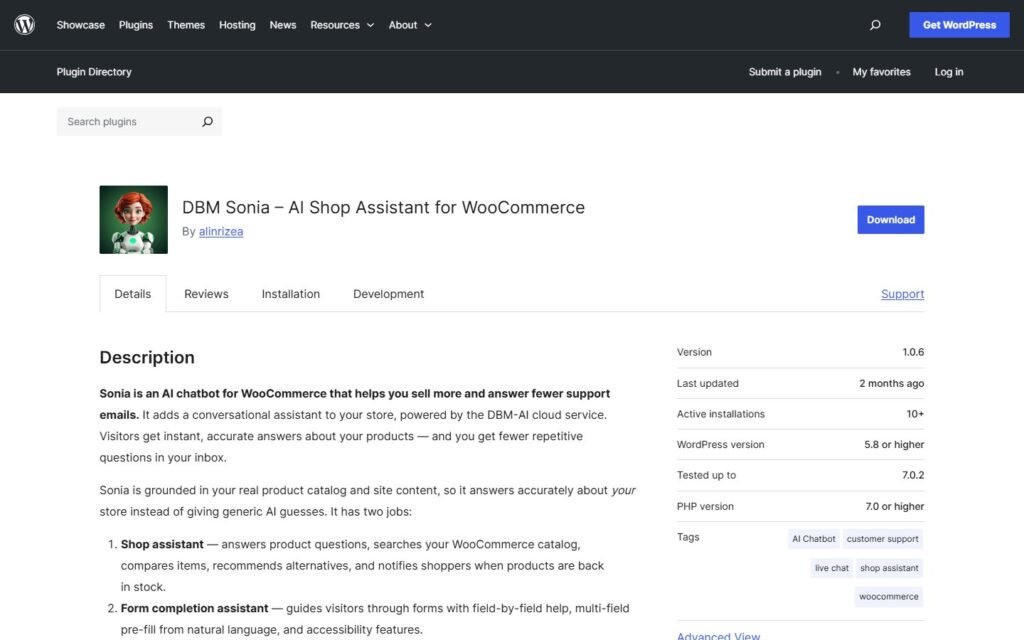
Choose DBM Sonia if your main goal is to add a visitor-facing WooCommerce assistant that can search the catalog, compare products, recommend alternatives, answer store questions, support voice interaction, send restock notifications, and help visitors complete forms.
Choose Niwa AI if you want to delegate a wider range of WordPress business work through Telegram or WhatsApp, including WooCommerce operations, researched content publishing, reporting, competitor monitoring, lead workflows, and conversion-focused website actions.
The simplest distinction is:
Sonia helps shoppers use the store. Niwa helps the owner operate and improve the WordPress business, while also supporting shopper conversion workflows.
Neither approach is automatically better. A focused storefront assistant can be the right choice for a merchant whose catalog and forms are the main conversion bottlenecks. A broader operator becomes more valuable when the founder wants one conversational workflow to connect administration, content, commercial insight, and customer outcomes.
What is DBM Sonia?
DBM Sonia, AI Shop Assistant for WooCommerce is a WordPress plugin powered by the DBM-AI cloud service. Its public positioning focuses on two customer-facing roles.
First, Sonia acts as a WooCommerce shop assistant. The official plugin listing documents product search, product details, side-by-side comparison, personalized recommendations, alternative suggestions, stock information, and back-in-stock notifications. It uses a read-only WooCommerce connection so the assistant can work from the store’s actual catalog rather than provide only generic answers.
Second, Sonia acts as a form completion assistant. It can display field-level help and use natural-language input to pre-fill multiple fields. The plugin documents compatibility with Contact Form 7, WPForms, Gravity Forms, Elementor Forms, and standard HTML forms.
Other documented strengths include:
- multilingual product search across eight listed languages;
- fuzzy matching for categories, brands, colors, and sizes;
- a configurable assistant name, personality, voice, and language;
- optional speech-to-text and text-to-speech;
- per-page enable or disable controls;
- mobile-responsive presentation;
- Shadow DOM isolation to reduce theme CSS conflicts;
- optional Cloudflare Turnstile protection;
- PII sanitization before information reaches the AI service.
DBM-AI also provides live Sonia demo storefronts across several retail categories. These demonstrations make Sonia’s intended role clear: help a shopper describe a need naturally, discover relevant products, compare choices, understand specifications, and move toward a purchase.
That is a credible and commercially useful focus. Many WooCommerce stores do not need another generic support bot. They need faster product discovery and clearer answers while the shopper is still deciding.
What is Niwa AI?
Niwa AI is designed around a broader delegation model. The owner communicates with Niwa through Telegram or WhatsApp and assigns work involving WordPress, WooCommerce, publishing, research, reporting, monitoring, and business workflows.
On the owner side, that can include updating products, prices, stock, coupons, posts, pages, and site content; researching and publishing SEO articles; reviewing commercial information; checking competitors; investigating website issues; and verifying that requested work was completed.
On the customer side, Niwa’s model includes answering buying questions, capturing useful lead context, recommending next steps, recognizing objections, and connecting conversations with follow-up or conversion actions.
The broader operating idea is explained on How Niwa Works: website attention should be connected to purchases, leads, demos, and useful founder insight rather than treated as isolated chat activity.
DBM Sonia vs Niwa AI comparison table
| Capability | DBM Sonia | Niwa AI |
|---|---|---|
| Primary role | Customer-facing WooCommerce shop and form assistant | Owner-side WordPress business operator with customer conversion workflows |
| WooCommerce product search | Yes; a core documented feature | Supported as part of shopper and store workflows |
| Product comparisons and recommendations | Yes; prominently documented | Yes; connected with broader conversion and operational context |
| Restock notifications | Yes; documented | Can support stock and lead workflows, depending on the approved setup |
| Form assistance | Field help and natural-language multi-field pre-fill are documented | Lead capture, qualification, routing, and follow-up context are broader use cases |
| Voice interaction | Optional speech-to-text and text-to-speech | Messaging workflows may include media and voice depending on the connected channel and configuration |
| Multilingual storefront search | Eight search languages are explicitly listed | Multilingual customer and owner conversations are part of the broader agent model |
| WordPress content publishing | Not documented as an owner assignment workflow in the reviewed Sonia sources | Yes; research, writing, internal linking, publishing, and verification workflows |
| WooCommerce administration | Read-only catalog connection is documented for the assistant | Product, price, stock, coupon, order, and store operations are core use cases |
| Telegram administration | Not documented in the reviewed Sonia sources | Yes |
| WhatsApp administration | Not documented in the reviewed Sonia sources | Yes |
| Business reporting | Dashboard usage information is shown; commercial founder reporting is not established | Owner-facing website and business reporting is a core use case |
| Competitor monitoring | Not documented in the reviewed Sonia sources | Research and recurring monitoring workflows are supported use cases |
| Lead capture | Helps visitors complete forms; downstream qualification and routing scope should be confirmed | Captures intent and context for sales or human follow-up |
| Conversion workflows | Product discovery, comparison, recommendations, and restock engagement | Product guidance plus website, content, lead, offer, reporting, and follow-up actions |
| Best fit | Stores needing a focused AI salesperson and form helper | Owners wanting WordPress and WooCommerce delegation tied to business outcomes |
Where DBM Sonia does especially well
1. It has a clear storefront job
Sonia does not try to be every kind of WordPress AI tool. Its strongest use case is easy to understand: a shopper opens the chat, describes what they need, and receives catalog-grounded help.
That focus can make implementation and measurement clearer. A merchant can evaluate product-search quality, recommendation relevance, questions resolved, restock interest, and whether visitors reach suitable product pages.
2. Product discovery is central, not an add-on
The official listing emphasizes smart catalog search, comparisons, alternatives, and recommendations. This aligns with a common WooCommerce problem: shoppers know the outcome they want but not the exact product name or category structure.
A request such as “I need a low-maintenance gift under £50” is closer to how people talk than a conventional keyword query. Sonia’s demos are designed around that conversational discovery behavior.
For more context on why buyer-specific comparisons matter, see AI Product Comparison Assistant for Ecommerce.
3. Form assistance is a meaningful differentiator
Many AI commerce tools focus only on chat. Sonia also helps visitors understand and fill forms. Field-level guidance and natural-language pre-fill can be useful for quote requests, consultations, service inquiries, product registrations, and complex contact forms.
This does not automatically mean a complete CRM or sales-routing system is included. However, reducing form friction is valuable by itself, especially when a business depends on detailed inquiries rather than instant checkout.
4. Voice and multilingual search improve accessibility
Optional voice input and audio replies can reduce typing friction on mobile. Multilingual product search can also help international visitors search in a supported language even when the underlying catalog uses another language.
The exact language requirements of a store should still be tested before launch, but the documented feature direction is practical.
5. The plugin is transparent about its external service
The WordPress.org listing explains that visitor messages, conversation context, the current page URL, and connection information are sent to DBM-AI for processing. It also describes the optional Cloudflare Turnstile integration and states that PII is sanitized before reaching the AI.
Store owners should still review the terms, privacy policy, consent language, retention practices, and their own legal obligations. The useful point is that the plugin listing exposes the external-service model rather than hiding it.
Where Niwa AI has the broader advantage
1. Owner administration through Telegram and WhatsApp
Sonia’s reviewed documentation is centered on a website widget and DBM-AI dashboard. Telegram and WhatsApp are not documented as owner command channels.
Niwa is designed so the owner can assign work through the messaging apps already used during the business day. That changes the relationship from “open a dashboard and configure a chatbot” to “message the operator and delegate an outcome.”
For the customer-facing channel strategy, AI Website Chat and WhatsApp for Ecommerce explains how website intent, WhatsApp continuity, and human handoff can work together.
2. Write operations across WordPress and WooCommerce
Sonia’s WooCommerce connection is documented as read-only. That is appropriate for a storefront assistant that needs reliable product information without permission to change the catalog.
Niwa is designed for authorized owner-side operations. Depending on the task and permissions, that can include updating products, prices, stock, coupons, content, and other WordPress or WooCommerce data, followed by verification and a report to the founder.
This is a fundamental product difference, not merely a longer feature list. Sonia reads the store to assist the shopper. Niwa can be authorized to change the store for the owner.
3. End-to-end content publishing
The reviewed Sonia sources do not document an owner workflow for researching keywords, checking existing site content, writing an article, adding internal links and metadata, publishing it, and verifying the final WordPress status.
That kind of assignment is central to Niwa’s operating model. A publishing task can include current search-intent research, competitor verification, duplicate avoidance, fair comparison writing, conversion-focused internal linking, publication, and status confirmation.
For an example of the comparison format, read SiteGround AI Agent vs Niwa AI.
4. Business reporting and competitor monitoring
Sonia’s plugin screenshots mention dashboard usage statistics and plan information. The reviewed public material does not establish founder-facing sales analysis, operational reporting, or competitor monitoring as packaged workflows.
Niwa is designed to connect website actions with business signals. That can include summarizing store activity, identifying product or content issues, researching competitors, and turning the findings into an approved next action.
The distinction is between reporting how the assistant is being used and reporting what is happening in the business.
5. Lead context beyond form completion
Sonia can help a visitor complete a form, which may improve form conversion. Niwa’s lead model goes further by emphasizing why the person is a lead: what they want, where they are in the buying journey, what is blocking them, and what follow-up would be useful.
That distinction is explored in AI Lead Capture for Ecommerce. A name and email are more actionable when they arrive with product interest, urgency, objections, and the requested next step.
6. Conversion work can lead to site changes
Sonia’s conversion strengths happen inside the visitor conversation: search, compare, recommend, answer, notify, and assist with forms.
Niwa can connect those insights to owner-side execution. Repeated shipping questions can lead to a clearer shipping page. Frequent comparison requests can lead to a buying guide. A weak product offer can lead to revised copy, a new bundle, a content article, or another approved workflow.
That closed loop, conversation, insight, action, verification, is where Niwa’s broader operator model differs most.
Which is better for WooCommerce?
DBM Sonia is a strong fit when the priority is customer-facing product discovery. It is purpose-built to search a WooCommerce catalog, compare items, recommend alternatives, answer product questions, and re-engage shoppers through restock notifications. Its form assistance can also reduce friction for stores that rely on detailed inquiries.
Niwa AI is the stronger fit when WooCommerce administration and business operations must be included. The owner may need to change products, review stock, update pricing, publish content, inspect sales signals, monitor competitors, capture lead context, and turn findings into website actions through one conversational relationship.
A store could potentially use both approaches: Sonia as a tightly focused storefront salesperson and Niwa as the owner-side operator. If both systems access customer or store data, the business should define permissions, data responsibilities, escalation rules, and which system owns each workflow.
Which is better for lead capture?
The answer depends on what “lead capture” means for the business.
Choose Sonia when the immediate problem is form friction. Its field guidance and natural-language pre-fill can help visitors complete complex forms more confidently.
Choose Niwa when the business also needs qualification, context, routing, owner notification, follow-up, and conversion analysis. Niwa’s model treats the conversation before the form, and the action after submission, as part of the lead workflow.
Frequently asked questions
Is DBM Sonia a WordPress plugin?
Yes. DBM Sonia is available as a WordPress plugin and connects to the DBM-AI cloud service. Its primary documented use case is a WooCommerce shop assistant plus a form completion assistant.
Can DBM Sonia search and compare WooCommerce products?
Yes. The official plugin page documents product search, product details, comparisons, recommendations, alternatives, stock information, and restock notifications.
Can DBM Sonia change WooCommerce products or prices?
The reviewed documentation describes a read-only WooCommerce connection for accessing catalog information. It does not establish owner-side write operations for changing products, prices, stock, coupons, or orders.
Does DBM Sonia work with WordPress forms?
Yes. The plugin documents support for Contact Form 7, WPForms, Gravity Forms, Elementor Forms, and standard HTML forms. Features include field help and natural-language multi-field pre-fill.
Does DBM Sonia support voice conversations?
Yes. Optional speech-to-text input and text-to-speech replies are documented.
Does DBM Sonia support multiple languages?
The plugin listing documents multilingual product search in English, Romanian, Spanish, French, German, Italian, Portuguese, and Dutch. Businesses should test their required language, catalog, and terminology before deployment.
Can DBM Sonia manage WordPress through Telegram or WhatsApp?
Telegram and WhatsApp owner administration are not documented in the official Sonia sources reviewed on July 17, 2026. Niwa explicitly uses Telegram and WhatsApp as owner communication channels.
Can DBM Sonia publish SEO articles?
An end-to-end owner workflow for search research, article creation, WordPress publishing, internal linking, metadata, and status verification is not documented in the reviewed Sonia material. Niwa is designed to perform that type of approved publishing assignment.
Which tool is better for a small WooCommerce store?
Sonia may be the more focused choice if the main need is customer-facing product discovery and form help. Niwa may be the better fit if the owner needs broader WooCommerce administration, reporting, publishing, monitoring, and conversion execution.
Can DBM Sonia and Niwa AI be used together?
Potentially, yes. Sonia could focus on visitor-facing catalog and form conversations, while Niwa handles owner-side administration and wider business workflows. Permissions, privacy, handoff rules, and overlapping responsibilities should be defined clearly.
Final verdict
DBM Sonia does several important things well. It is focused, catalog-grounded, voice-capable, multilingual, and designed around real shopping questions rather than generic chatbot conversation. Its form assistance is also a useful differentiator. For WooCommerce merchants who want better product discovery and fewer repetitive pre-sale questions, it deserves consideration.
Niwa AI competes from a wider position. It is designed not only to talk with shoppers but also to work for the owner through Telegram or WhatsApp, perform authorized WordPress and WooCommerce operations, publish researched content, produce business reports, monitor competitors, preserve lead context, and connect conversion insight with website action.
Choose DBM Sonia when you want a focused AI shop and form assistant. Choose Niwa AI when you want a WordPress business operator that can move between administration, content, intelligence, leads, and conversion workflows.
If that broader delegation model matches your business, book a Niwa demo and test it with a real WordPress or WooCommerce assignment.