

How to Connect Website Enquiries to Paying Customers
Keep a stable enquiry record through qualification, follow-up and payment. Match leads to invoices without treating every form or booking as a sale.
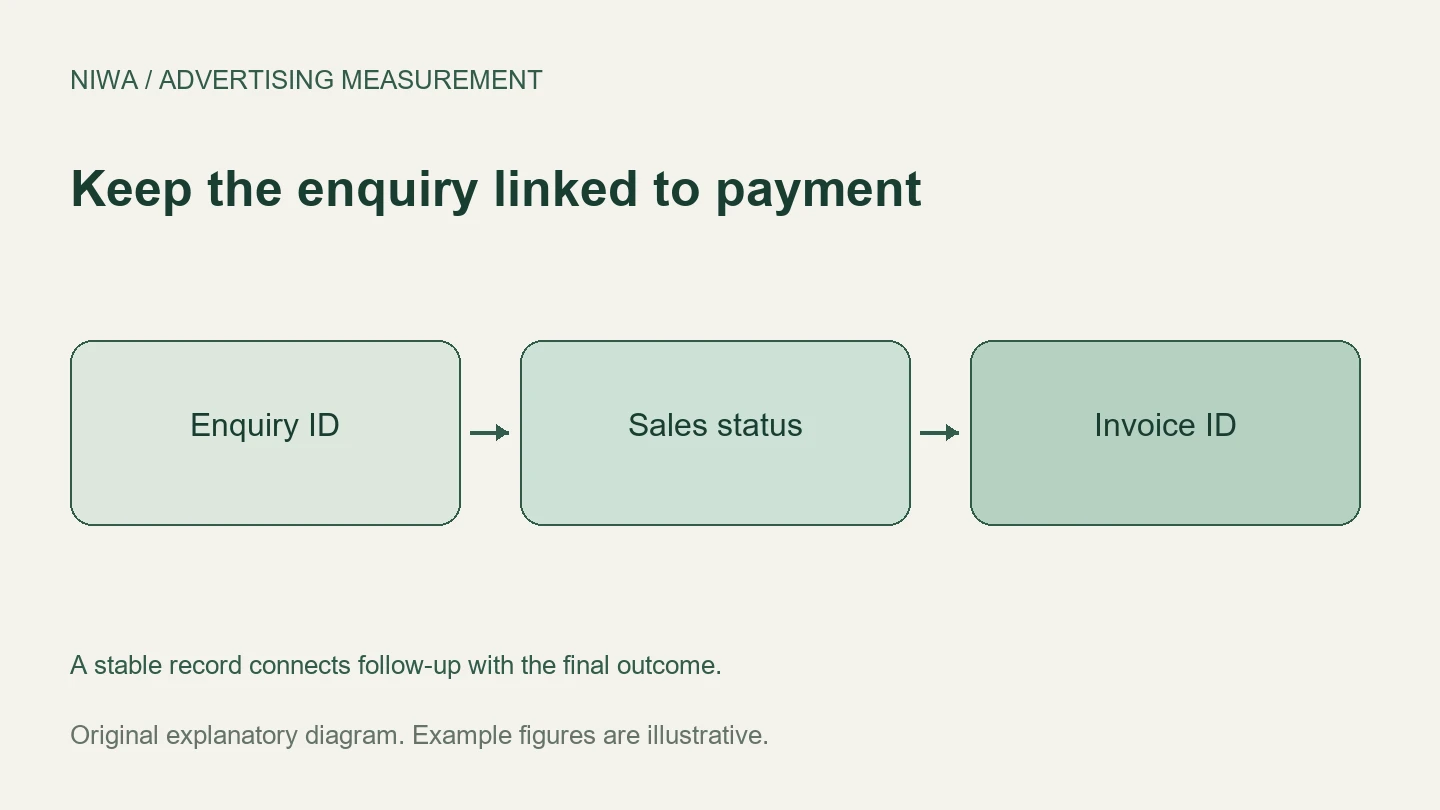
Connect website enquiries to paying customers by giving each genuine enquiry a stable ID, keeping it through qualification and follow-up, and attaching the resulting order or invoice when payment arrives. Preserve the enquiry’s original source and campaign in the same controlled record. A completed form is the start of that process, not proof of revenue.
Niwa can answer a visitor’s product or service questions and guide them toward an enquiry or booking on a WordPress website. How Niwa works describes the assisted journey. To understand its business value, connect the resulting record to your actual sales process rather than assuming that helpful conversations became customers.
Choose a record that can survive follow-up
A shared spreadsheet can work for a small team when access, ownership and updates are controlled. A CRM is useful when several people manage enquiries, reminders and sales stages. Choose the simplest system the team will maintain accurately.
The record should include an enquiry ID, creation date, contact reference, service or product requested, source, campaign, assigned owner and next action. Keep private contact details in that controlled system, not in an analytics URL or an ad report.
If the customer contacts you again, connect the new message to the correct existing record. Use a separate opportunity when the same person asks about a genuinely different job. One person can become several sales without becoming several newly acquired customers.
Define sales stages that everyone understands
Use stages describing events you can verify:
| Stage | Evidence |
|---|---|
| New enquiry | Successfully received request |
| Qualified | Meets the business’s agreed criteria |
| Quote sent | Actual quotation linked to the record |
| Agreed or booked | Accepted proposal or confirmed reservation |
| Paid | Payment linked to an order or invoice |
| Lost or unsuitable | Outcome recorded with a useful reason |
You may need fewer stages. Avoid a process so elaborate that staff skip it. But keep booked and paid separate when the customer can reserve without paying.
Niwa can complete a reservation directly in WhatsApp using your website’s services and availability. Keep that saved booking linked to the enquiry, then record attendance and payment against the same booking or opportunity. Mark the record as paid when the payment is confirmed, whether the sale happened on the website or through WhatsApp.
Retain source information at capture
Save the applicable source and campaign when the enquiry arrives. For tagged advertising visits, include the campaign labels and the click identifier your measurement setup supports. Store original source separately from later interactions so a follow-up email does not overwrite the ad that first produced the enquiry.
Record missing information honestly. An enquiry without a captured campaign is not automatically organic, direct or paid. A self-reported source can help, but label it as the customer’s answer rather than a technically observed fact.
Analytics is useful for aggregate behaviour. It should not be your only place to look up individual customer payments. Google’s PII policy prohibits sending identifying personal details in ordinary Analytics collection.
Give someone responsibility for the next step
Every genuine enquiry needs an owner and an action date. A source-labelled lead that receives no reply has not become a working sales process.
Review new enquiries, unanswered questions and overdue follow-ups. Keep the response relevant to what the person requested and follow the communication permissions that apply. A request about one service is not an automatic invitation to unrelated marketing.
When the customer discusses the proposal by phone or email, update the existing opportunity. Avoid separate notes in a personal inbox that cannot be found when the invoice is issued.
Join the payment using a dependable reference
Put the opportunity or customer reference on the invoice or order. When payment arrives, record the payment date, amount, currency and invoice/order ID against that opportunity. Use a stable reference first; review ambiguous contact matches rather than merging them automatically.
For an illustrative example, enquiry E104 comes from campaign autumn_service. The team issues quote Q55, then invoice I82. A $100 deposit arrives before the remaining $400. A cash-received report initially shows $100, while contracted value may show $500. Both can be useful, but they must not share an unlabeled revenue column.
If the job is cancelled or refunded, update the outcome consistently. Keep the audit trail needed to explain why a previously promising campaign’s final revenue changed.
Review cohorts as well as current payments
Group enquiries by the period they entered the business, then observe how many became qualified, booked and paid. Compare groups that have had similar time to close.
Also keep a current payment view for cash management. Payments received this month may come from last month’s enquiries. Dividing those payments by this month’s ad spend without explaining the timing can hide the actual acquisition economics.
Google’s offline conversion guidance explains how later sales outcomes can feed a supported advertising connection. Implement and test that separately; a CRM payment label does not automatically reach every ad account.
Test one enquiry through the whole process
Submit a clearly marked test request, confirm the source and owner, link a controlled test sales outcome, and verify that it appears once. Then inspect the follow-up steps the customer encounters.
Use the Niwa setup guidance to prepare accurate business answers and useful next steps. Existing WordPress owners can install the standalone plugin. Niwa Business is USD 150 for a custom WordPress website or migration, hosting, maintenance and AI adaptation. Contact Niwa with your current enquiry and payment process to discuss a website journey you can follow through to paid work.

