KaliCart Bridge vs Niwa AI: Catalog Feed or WordPress Agent?
Compare KaliCart Bridge and Niwa AI for WooCommerce agent discovery, MCP catalogs, WordPress operations, messaging, leads, reporting, and conversions.
KaliCart Bridge and Niwa AI both respond to the rise of AI agents in ecommerce, but they solve different problems. KaliCart Bridge makes a WooCommerce catalog easier for external AI systems to discover and read. Niwa AI is designed to help operate the WordPress business itself, from owner instructions and content publishing to customer conversations, reporting, and conversion workflows.
This fair comparison explains what KaliCart Bridge does well, where its scope stops, and when a broader WordPress AI agent such as Niwa is the better fit.
Quick verdict
Choose KaliCart Bridge if your immediate goal is to expose accurate, structured WooCommerce product data to ChatGPT-style shopping systems, MCP clients, chatbot services, and other external AI agents while keeping checkout on your own storefront.
Choose Niwa AI if you want a business-facing operator that can help manage WordPress and WooCommerce, publish content, work with the owner through Telegram or WhatsApp, produce business reports, capture leads, monitor competitors, and support conversion workflows.
The simplest distinction is:
KaliCart Bridge makes your catalog readable by AI agents. Niwa AI is designed to act as an AI agent for the business running on WordPress.
What is KaliCart Bridge?
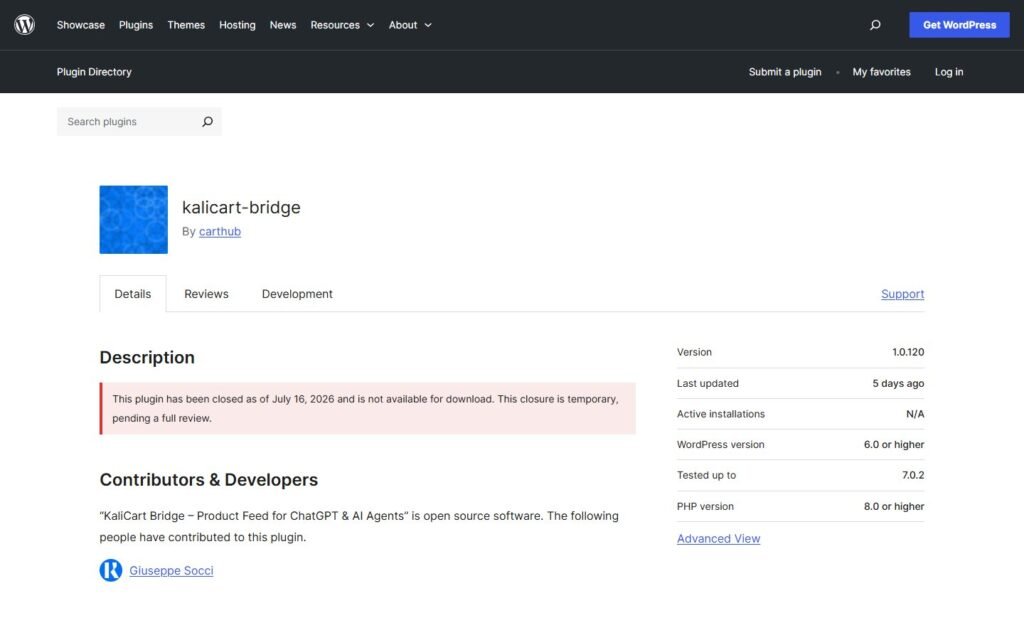
KaliCart Bridge is a free, standalone WooCommerce plugin focused on agent-readable product discovery. According to its official WordPress.org documentation, it creates public catalog endpoints, an OpenAPI description, discovery signals, and a keyless Model Context Protocol endpoint that compatible AI clients can use to search and inspect products.
Its documented catalog tools include product search, product details, category lists, catalog metadata, price and stock information, variants, identifiers, and selected coupon visibility. It also provides catalog-health and quality signals that help merchants identify issues such as missing descriptions, categories, prices, SKUs, images, or brand information.
KaliCart Bridge also offers an optional federated catalog. When a merchant explicitly activates it, KaliCart receives the public store URL so participating products can become discoverable through a cross-merchant agent-search network. The official documentation says this is opt-in and that customer, order, and private data are not sent as part of that feature.
A particularly important design decision is that KaliCart Bridge is discovery-only. It does not become the merchant of record, and it does not complete checkout. The customer is routed back to the WooCommerce storefront, where current price, availability, shipping, coupon eligibility, and payment remain authoritative.
What KaliCart Bridge does well
KaliCart Bridge is strongest when a merchant wants an infrastructure layer rather than another customer-facing chatbot.
Structured WooCommerce data for AI systems
Instead of asking an external assistant to scrape product pages, the plugin gives compatible systems a structured way to query catalog data. That can improve consistency when an agent needs to find products, compare variants, inspect availability, or retrieve category information.
MCP and REST access
The official plugin listing documents both plain REST endpoints and an MCP server. This gives developers and AI-tool builders more than one integration path without requiring KaliCart to provide the language model or conversation interface itself.
Merchant-owned checkout
KaliCart Bridge deliberately sends shoppers back to the store. For merchants who want AI-assisted discovery without handing the transaction to another platform, this is a meaningful advantage.
Local-first default
The plugin states that it runs on the merchant’s server and sends nothing externally by default. Its federated catalog is separately activated and revocable. That separation gives store owners a clearer choice between direct agent access and broader federated discovery.
Catalog-readiness diagnostics
Its quality and health tools can reveal weak product data before those weaknesses affect AI discovery. Missing images, short titles, absent descriptions, unclear brands, incomplete identifiers, or unavailable pricing can make a catalog less useful to both human shoppers and machine agents.
What is Niwa AI?
Niwa AI is positioned as a broader WordPress business operator. Rather than primarily publishing a machine-readable catalog, Niwa works across the operational and commercial layers of a website.
On the owner side, Niwa can receive natural-language instructions through Telegram or WhatsApp and support tasks involving WordPress, WooCommerce, content publishing, reporting, competitor research, and site operations. On the visitor side, Niwa can support product questions, lead capture, buying guidance, objection handling, and conversion-focused conversations.
That wider role is explained in How Niwa Works: the objective is not merely to add chat to a website, but to connect visitor attention, owner action, and measurable business outcomes.
KaliCart Bridge vs Niwa AI comparison
| Capability | KaliCart Bridge | Niwa AI |
|—|—|—|
| Primary purpose | Make a WooCommerce catalog readable and discoverable by external AI agents | Operate and grow a WordPress/WooCommerce business through conversational workflows |
| Structured product feed | Yes | Not the primary positioning |
| REST catalog endpoints | Yes | Not the primary positioning |
| MCP catalog tools | Yes | Broader operator tooling rather than a public catalog-only bridge |
| Catalog quality diagnostics | Yes | Can analyze business and website issues, but not positioned as a dedicated product-feed validator |
| Merchant-owned storefront checkout | Yes; discovery-only by design | Yes; conversion support stays connected to the merchant’s website |
| WordPress administration | No broad natural-language admin layer documented | Yes |
| WooCommerce operational actions | Catalog exposure and diagnostics; not an order-management agent | Yes, including product and store workflows |
| Telegram administration | Not documented | Yes |
| WhatsApp administration | Not documented | Yes |
| Content creation and publishing | Not documented | Yes |
| Business reporting | Agent-traffic and catalog-health insight are documented | Yes, with broader commercial reporting workflows |
| Lead capture | Not a customer-facing lead-capture system | Yes |
| Competitor monitoring | Not documented | Yes |
| Customer-facing sales assistance | Requires a separate chatbot or agent to consume the catalog | Yes |
| Conversion workflows | Supplies product data and selected coupon context; does not run the full conversion journey | Yes, including guided selling and checkout-focused workflows |
This comparison reflects publicly documented capabilities available on July 18, 2026. Product features can change, so merchants should confirm any deployment-critical requirement with the vendor’s current documentation.
The biggest difference: infrastructure versus operator
KaliCart Bridge is an enabling layer. It prepares WooCommerce data so another AI system can understand the store. That external system might be a chatbot, an MCP client, a shopping assistant, or a future agentic-commerce surface.
Niwa AI is the operator layer. The owner can ask for an outcome, publish a comparison article, update a product, review sales, investigate a competitor, summarize business activity, or act on a conversion opportunity, and Niwa is designed to carry the task through the relevant WordPress workflow.
This difference matters because discoverability and operation are complementary, not interchangeable.
A structured catalog can help an AI agent find the right product. It does not automatically create a landing page, update an offer, publish SEO content, message the owner, qualify a lead, investigate a drop in conversions, or prepare a business report. Those jobs require an operational agent or a connected set of additional tools.
WordPress and WooCommerce operations
KaliCart Bridge reads and presents WooCommerce catalog information. Its official scope is intentionally narrow: product discovery, machine-readable catalog access, quality signals, and related agent-commerce infrastructure.
Niwa’s scope is wider. It is built for store owners who want to request changes and receive completed work rather than only expose data. That can include product updates, pricing and stock workflows, coupons, WordPress content, site investigation, and recurring business analysis.
For a merchant, the practical question is whether the current bottleneck is AI visibility or business execution.
If external AI systems cannot reliably understand the catalog, KaliCart Bridge addresses a real technical gap. If the owner is still spending hours inside wp-admin, manually publishing content, reviewing store activity, and coordinating conversion tasks, Niwa addresses a different and broader gap.
Telegram and WhatsApp administration
KaliCart Bridge does not publicly position Telegram or WhatsApp as owner-control channels. A separate client could potentially consume its public catalog endpoints, but that is not the same as administering WordPress from a messaging conversation.
Niwa is designed around that owner experience. The founder can communicate from Telegram or WhatsApp instead of opening a laptop for every operational request. This is useful when the task involves more than product lookup, for example, changing an offer, checking store performance, publishing an article, or reviewing a competitor.
Messaging access is therefore not just another notification channel. It becomes the working interface between the business owner and the website.
Content publishing and competitor monitoring
KaliCart Bridge does not document content drafting, SEO research, article publishing, or competitor monitoring. Its job is to make existing catalog data usable by agents.
Niwa can connect research with publishing. A competitor-monitoring workflow can identify a relevant topic, check existing site coverage, verify current sources, produce an article, create the WordPress post, and report the result to the owner.
That matters for companies using organic search as a growth channel. Catalog discoverability helps products appear in agent-driven experiences, while content publishing helps the business compete for traditional search demand and comparison intent.
Lead capture and conversion workflows
KaliCart Bridge can make richer product information available to a separate chatbot or shopping agent. Its documentation explicitly notes that compatible chatbot services may ingest its discovery URL, API documents, REST endpoints, or MCP tools. This can give those systems cleaner product data than page scraping.
However, the Bridge itself does not add an LLM, decide how the chatbot behaves, or become a full lead-capture and conversion system. A merchant still needs the customer-facing agent, conversation logic, forms or CRM handoff, follow-up rules, and measurement layer.
Niwa covers more of that commercial journey. She can help answer buying questions, understand intent, guide product selection, capture contact information, and support the next action. The practical principles are covered in Niwa’s guide to turning website visitors into leads and its analysis of AI lead capture for ecommerce.
Niwa also supports direct conversion experiments. One example is the Niwa AI Conversion Booster, which connects live cart behavior with relevant checkout incentives rather than relying only on static banners or generic coupon exposure.
Can KaliCart Bridge and Niwa AI work together?
Potentially, yes. They are not exact substitutes.
A WooCommerce store could use KaliCart Bridge to expose structured catalog data to external AI clients while using Niwa for owner administration, publishing, reporting, lead capture, customer assistance, and conversion workflows.
That combined model separates two jobs:
- Make the catalog legible to outside agents.
- Give the business its own operating agent.
Whether the combination is necessary depends on the store’s channels and technical strategy. A merchant focused on agentic product discovery may value the Bridge immediately. A merchant focused on saving owner time and converting existing traffic may prioritize Niwa first.
Which one should you choose?
Choose KaliCart Bridge when:
- You need structured WooCommerce catalog endpoints.
- You want MCP-compatible product discovery.
- You want external assistants to query current product data instead of scraping pages.
- You prefer merchant-owned checkout.
- You want catalog-quality diagnostics and an optional federated discovery network.
- You already have, or plan to build, a separate customer-facing AI agent.
Choose Niwa AI when:
- You want to manage WordPress and WooCommerce through conversation.
- You want Telegram or WhatsApp to function as an owner command center.
- You need content creation and WordPress publishing workflows.
- You want business reporting rather than catalog-health data alone.
- You need lead capture, guided selling, or conversion support.
- You want competitor research connected to real site action.
KaliCart Bridge is a focused and technically useful plugin for making WooCommerce products more accessible to AI systems. Niwa AI is the better fit when the requirement extends beyond product data into daily business operations and revenue workflows.
Frequently asked questions
Is KaliCart Bridge an AI chatbot?
No. Its official documentation says the plugin does not add an LLM or decide how a chatbot works. It provides structured WooCommerce catalog data that compatible chatbots and AI agents can consume.
Does KaliCart Bridge process checkout?
No. It is discovery-only by design. Shoppers complete purchases on the merchant’s WooCommerce storefront, where live pricing, stock, shipping, coupons, and payment remain authoritative.
Does KaliCart Bridge require an account?
The official WordPress.org FAQ says no. The plugin is standalone and free. Its federated catalog is an optional, separately activated feature.
Does KaliCart Bridge support MCP?
Yes. Its documentation lists a keyless MCP endpoint with tools for product search, product details, categories, metadata, and product lists.
Is Niwa AI a product-feed plugin?
No. Niwa is positioned as a WordPress business agent rather than a dedicated catalog-feed validator. Its strengths are operational workflows, owner messaging, publishing, reporting, customer assistance, leads, and conversion work.
Which is better for WooCommerce?
It depends on the goal. KaliCart Bridge is better for structured catalog discovery by external agents. Niwa is better for owners who need a wider operational and conversion-focused assistant. Some stores may benefit from both layers.
Can I see Niwa in action?
Yes. You can book a Niwa demo to review the workflows most relevant to your WordPress or WooCommerce business.