

What Is a Good Average Order Value?
A good AOV depends on your products, margins and customers. Learn how to set a useful store target without copying an unrelated industry average.
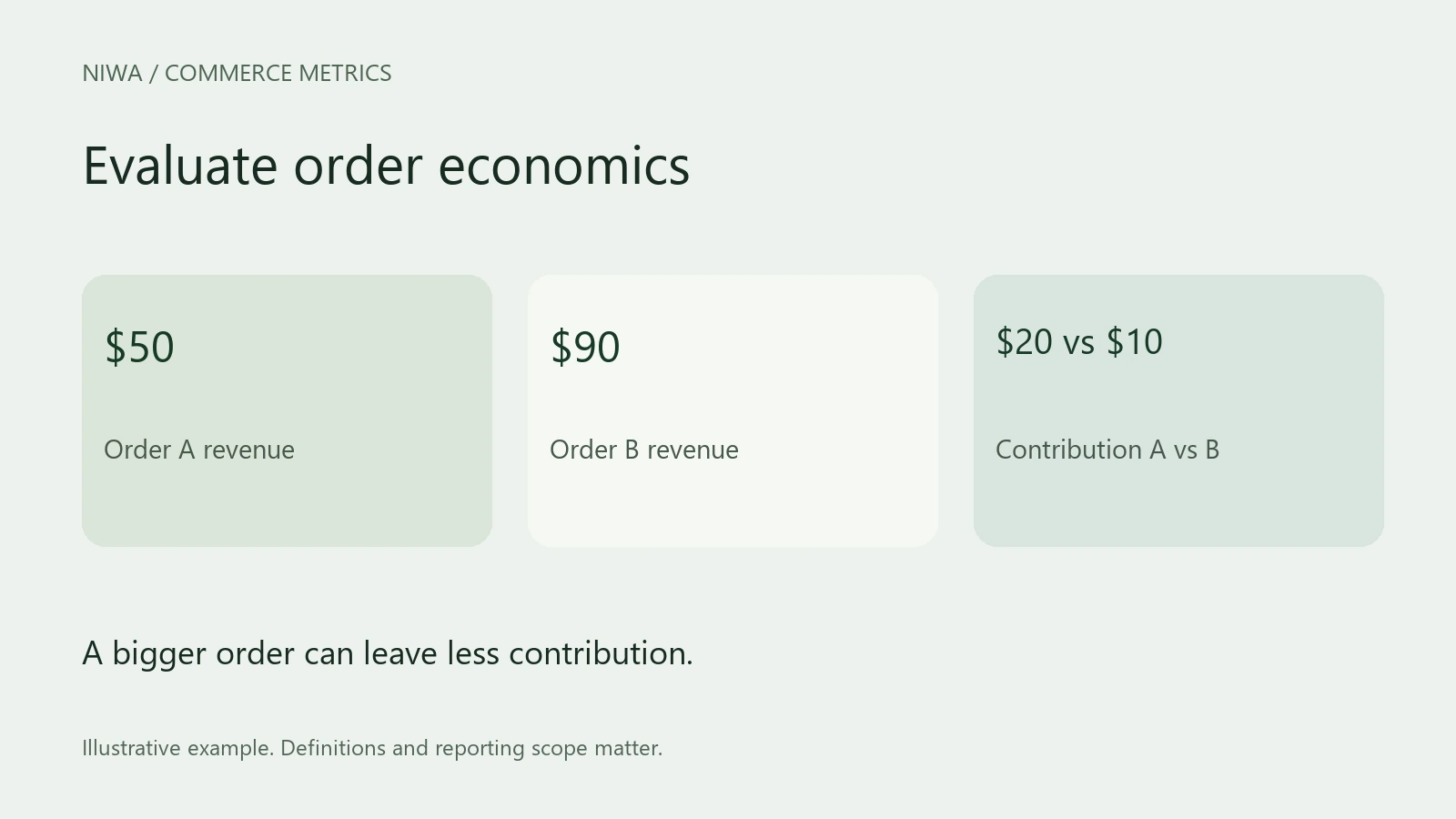
A good average order value is one that supports profitable orders for your store while customers continue buying products that fit their needs. There is no single dollar amount that is good for every business. A $40 basket can work for a replenishment store and be inadequate for a shop with expensive acquisition and delivery costs.
Your product prices, margins, repeat-purchase pattern and cost per order matter more than an unrelated store's headline average.
Niwa can help customers choose relevant products, but the goal should be an appropriate purchase with sustainable economics. A higher AOV by itself does not establish success.
Start with the economics of your own orders
Use a consistent revenue definition, then estimate what remains after variable costs. Include product cost, payment fees, packing, delivery costs you bear, and an allowance for returns. Review acquisition costs alongside that contribution.
Consider two illustrative orders before tax and shipping charges:
- A $50 order with $20 product cost and $10 other variable costs leaves $20 before acquisition and fixed expenses.
- A $90 order with $65 product cost and $15 other variable costs leaves $10 on the same basis.
The larger order produces less contribution. Raising the first store's basket to $90 would not automatically make its business healthier.
This is an operating comparison, not a substitute for accounting profit. Fixed expenses and the way you allocate acquisition costs still affect the final result.
Compare with a relevant baseline
Start with your own previous equivalent period. Then segment orders by product category, customer type, channel and promotion where your data supports it.
A store selling furniture and accessories can have a misleading blended average. An accessory-only order and a complete furniture order belong to very different buying decisions. Separate them before setting targets.
Seasonality matters too. A gift period, a clearance campaign and a normal replenishment month may produce different baskets for sensible reasons. A target that ignores those changes can push the team toward unnecessary discounts.
Also look at the spread of order values. One wholesale purchase can make a small store's monthly AOV appear much stronger than its typical retail basket.
Use external benchmarks carefully
Before using a benchmark, check its sample, reporting date, currency, product categories and treatment of refunds, tax and shipping. A median across stores is not the same as an order-weighted average across every purchase in the sample.
Platform differences matter. WooCommerce uses net sales divided by orders, while Shopify's documented AOV excludes adjustments made after an order is created. Do not rank stores using mismatched definitions.
If a source does not explain its methodology, use it as loose context rather than a performance target. Your store's complete economics provide a more useful starting point.
Set a target that protects the whole purchase
Choose a specific basket opportunity. For example, customers buying a leather product may also need suitable care equipment. Estimate the contribution of that addition and decide whether it deserves a recommendation at the normal price.
Prepare accurate compatibility and care information for Niwa. Test that the recommendation answers the customer's need and remains optional. Review customer questions for missing product details you can fix on the page itself.
Evaluate the result through completed orders, conversion, AOV, returns and contribution. If AOV rises but fewer people buy, calculate whether total revenue and total contribution also improved. Avoid choosing the winner from one metric.
A practical next step
Write down your current AOV, the revenue definition and the variable costs of a typical order. Then choose one product relationship worth testing.
Contact Niwa about that buying journey. Existing WordPress sites can use the standalone plugin. Niwa Business is USD 150 for a custom WordPress site or migration, hosting, maintenance and business-specific AI adaptation.

