Uncanny Agent vs Niwa AI: Automation or WordPress Business Operator?
Compare Uncanny Agent and Niwa AI for WordPress automation, WooCommerce, messaging, publishing, reporting, leads, and conversion workflows.
The search for a WordPress AI agent is quickly moving beyond text generation. Site owners now expect an agent to understand the website, perform approved actions, connect plugins, analyze business data, and turn a natural-language request into a verified result.
Uncanny Agent and Niwa AI are two serious interpretations of that future. Uncanny Agent adds conversational AI to the established Uncanny Automator workflow platform. Niwa AI is designed as a broader WordPress business operator that the owner can direct through Telegram or WhatsApp.
This is not a comparison between a basic chatbot and an advanced agent. Uncanny Agent can answer questions about site data, execute WordPress tasks, publish posts, create users, generate reports, and build automation recipes from plain-language instructions. Its underlying Automator platform also connects WordPress with hundreds of plugins and external applications.
The real distinction is therefore more useful:
Uncanny Agent combines a WordPress dashboard copilot with a powerful recipe-based automation platform. Niwa AI focuses on an ongoing owner-to-operator relationship that connects administration, research, publishing, reporting, monitoring, leads, and conversion work through messaging.
This comparison is based on public product information reviewed on July 17, 2026, including the official Uncanny Automator website, its WordPress.org plugin listing, and its official WooCommerce, Telegram, WhatsApp, and reporting integration pages. When a capability is not established in those sources, this article says “not documented” rather than claiming the product can never support it.
Quick verdict
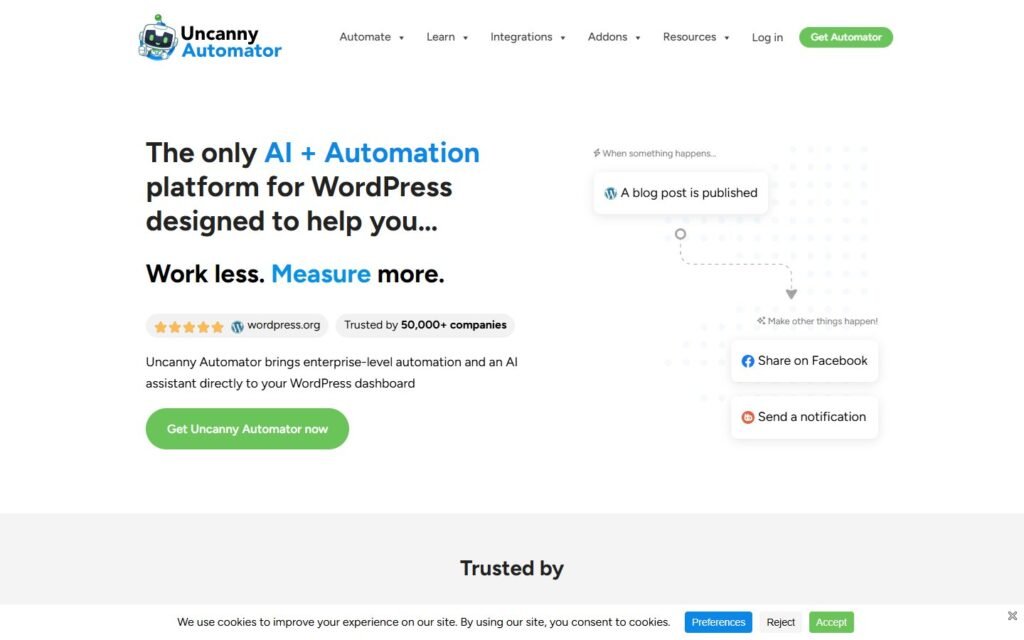
Choose Uncanny Agent if you want an AI copilot inside WordPress plus a mature no-code automation builder. It is especially compelling when your site relies on many plugins, repeatable event-driven workflows, e-learning, memberships, CRM connections, scheduled actions, or precise trigger-and-action recipes.
Choose Niwa AI if you want to delegate broader WordPress business outcomes through Telegram or WhatsApp. That includes authorized WordPress and WooCommerce operations, researched content publishing, founder-facing reporting, competitor monitoring, lead-context workflows, customer conversion support, and verification after the work is completed.
The products overlap more than many WordPress AI comparisons suggest. Both can work with WordPress data. Both can publish content. Both can support WooCommerce and reporting. Both can connect with Telegram and WhatsApp in some form.
The difference is mainly how the work is initiated, structured, and continued:
- Uncanny Agent is closely tied to the WordPress dashboard and Automator’s recipes.
- Niwa is designed around direct conversational delegation from the owner’s messaging app.
- Automator excels at predictable, reusable workflows.
- Niwa emphasizes flexible assignments that may require research, judgment, execution, verification, and follow-up.
What is Uncanny Agent?
Uncanny Automator is a long-established WordPress automation plugin. Its official website now presents Uncanny Agent as an AI assistant that works inside WordPress and can turn everyday language into action.
The public product page documents three particularly important agent capabilities:
- Execute operational tasks. Examples include creating users, generating reports, publishing posts, and completing other site-management work.
- Build automations from a description. The owner describes what should happen, and Uncanny Agent creates an Automator recipe for review and activation.
- Analyze WordPress and business information. The official site lists sales trends, customer demographics, content gaps, SEO, and course-completion rates as example topics.
Underneath the conversational agent is Automator’s recipe system. A recipe starts with one or more triggers and performs one or more actions. Conditions, delays, schedules, loops, dynamic tokens, data formatting, webhooks, and custom actions can make those workflows highly specific.
The official site currently advertises more than 230 integrations, over 920 triggers, over 790 actions, and more than 150 conditions. The WordPress.org listing reported 40,000+ active installations, version 7.4.0, and an update within the previous three days when reviewed on July 17, 2026.
Those numbers matter because Uncanny Agent is not starting from an empty agent shell. It sits on top of an established WordPress automation system with deep support for products such as WooCommerce, LearnDash, Gravity Forms, MemberPress, WPForms, FluentCRM, BuddyBoss, and many external services.
What is Niwa AI?
Niwa AI is designed as a WordPress business operator rather than only an in-dashboard assistant or automation builder.
The owner communicates with Niwa through Telegram or WhatsApp and assigns an outcome in natural language. Depending on authorization and the connected site, that work can involve WordPress, WooCommerce, content, research, reporting, monitoring, customer conversations, and conversion workflows.
Examples include:
- updating products, prices, stock, coupons, posts, or pages;
- researching a competitor and preparing a fair comparison article;
- checking existing content to avoid duplication;
- writing, internally linking, publishing, and verifying an SEO post;
- reviewing business or website signals and sending a concise founder report;
- monitoring competitors or search opportunities on a schedule;
- capturing the intent behind a customer inquiry;
- connecting shopper hesitation with an appropriate follow-up or website improvement;
- investigating a site issue and reporting what was changed.
The operating model is explained in more detail on How Niwa Works. The goal is not merely to add AI output to WordPress. It is to let the owner delegate work conversationally and receive a verified result without spending the day navigating dashboards.
Uncanny Agent vs Niwa AI comparison table
| Capability | Uncanny Agent / Automator | Niwa AI |
|—|—|—|
| Primary product model | WordPress dashboard AI copilot plus recipe-based automation platform | Messaging-first WordPress business operator with customer conversion workflows |
| Natural-language WordPress tasks | Yes | Yes |
| Build automations from a prompt | Yes; a central documented feature | Can create and operate scheduled or multi-step workflows through approved assignments |
| Deterministic trigger/action recipes | Major strength, with conditions, delays, loops, tokens, and schedules | Not the primary user-facing model; workflows are delegated conversationally |
| WordPress content publishing | Yes; publishing posts is explicitly documented | Yes; can combine research, writing, metadata, internal links, publication, and verification |
| WooCommerce support | Deep plugin integration and extensive automation recipes | Authorized store operations plus reporting and conversion-focused workflows |
| Sales and business analysis | Uncanny Agent documents sales trends and other conversational insights | Founder-facing reports connect data, interpretation, and suggested or approved actions |
| Telegram integration | Receives text and sends messages through Automator triggers/actions | Telegram is a primary owner administration channel |
| WhatsApp integration | Receives messages and sends regular or template messages through recipes | WhatsApp is a primary owner administration and continuity channel |
| Messaging-based free-form site administration | Potential workflows can be assembled; full agent administration from messaging is not clearly established in reviewed documentation | Core product model |
| Lead capture | Strong integrations with forms, CRMs, messaging, and marketing tools | Captures lead intent and context, with routing and follow-up workflows |
| Competitor monitoring | RSS and custom workflows can monitor sources; packaged agent-led competitor research is not prominently documented | Recurring competitor research and founder reporting are supported assignments |
| Customer-facing conversion assistant | Can power sophisticated recipes and GPT replies; a persistent storefront sales agent is not the main positioning | Customer questions, product guidance, objection context, lead capture, and conversion actions are part of the broader model |
| E-learning and membership automation | Exceptional depth and a major advantage | Not the primary positioning |
| External app ecosystem | Broad, mature integration catalog | Integrations are used in service of operator assignments rather than presented mainly as a recipe catalog |
| Best fit | Teams needing reliable automations across a complex WordPress stack | Owners wanting flexible business delegation through messaging, from request to verified outcome |
Where Uncanny Agent does especially well
1. It combines AI with a mature automation engine
Many WordPress AI plugins can generate text or call a model. Uncanny Agent has a more valuable foundation: Automator already knows how to connect events and actions across a large WordPress stack.
For example, a WooCommerce purchase can trigger CRM updates, course enrollment, membership access, Slack notifications, spreadsheet records, follow-up messages, and scheduled actions. The agent can help build that workflow from a plain-language description, but the activated recipe remains structured and repeatable.
This is one of Uncanny’s clearest advantages. Once a recipe is tested, the same business rule can run consistently without requiring the owner to repeat the instruction every time.
2. The integration breadth is difficult to ignore
The official integration directory covers major form plugins, CRMs, learning-management systems, membership plugins, ecommerce tools, social networks, spreadsheets, communication platforms, AI providers, and developer utilities.
Uncanny Automator also documents connections with OpenAI, Anthropic, Google Gemini, Perplexity, Mistral AI, Cohere, and other model providers. AI can therefore be inserted into a recipe for summarization, classification, translation, sentiment analysis, copy generation, or other transformations.
For businesses with an elaborate plugin stack, this breadth may be more important than having the most conversational interface.
3. WooCommerce automation is deep and practical
The official WooCommerce automation material covers abandoned-cart recovery, inventory workflows, customer segmentation, order-based campaigns, reporting, loyalty logic, review requests, and data synchronization.
Automator is especially strong when a store owner can express the requirement as a rule:
- when a customer buys a product, add a CRM tag;
- when an order reaches a status, notify a team;
- when a subscription event occurs, update access;
- when stock changes, synchronize another system;
- when a shopper meets conditions, send a targeted message;
- when a report is due, gather or route the relevant data.
Niwa can operate WooCommerce, but Automator deserves credit for the precision and reusability of its recipe architecture.
4. Telegram and WhatsApp are real integrations
It would be inaccurate to say that Uncanny Automator lacks Telegram or WhatsApp.
The official Telegram integration documents a trigger for receiving a text message and an action for sending a text message. Its sample recipes include creating a support ticket from a Telegram message and generating a GPT reply.
The official WhatsApp integration documents incoming-message triggers, delivery-status triggers, and actions for sending regular or template messages. Sample recipes connect WhatsApp with bookings, user lists, WooCommerce-related tools, email, and other applications.
This means a capable implementer can build meaningful two-way messaging workflows around WordPress events.
The important distinction is not “messaging versus no messaging.” It is integration channel versus primary operating interface. Uncanny’s reviewed material presents these channels mainly as components in recipes. Niwa presents Telegram and WhatsApp as the place where the founder directly delegates changing work.
5. E-learning and membership sites are a standout use case
Uncanny Automator’s history in the LearnDash ecosystem gives it unusual depth for courses, communities, credentials, enrollment, group management, completion tracking, and learner intervention.
A site can react to quiz performance, stalled progress, course completion, membership changes, or group activity. For a learning business with many repeatable rules, Uncanny may be the stronger specialist choice.
6. Developers can extend it without abandoning the platform
Custom triggers, custom actions, webhooks, database queries, WordPress hooks, custom functions, and structured data tools make Automator suitable for technical teams as well as no-code users.
That matters when a workflow begins as a simple recipe and later requires custom logic. The business can extend the existing automation layer rather than replace it.
Where Niwa AI has the broader operator advantage
1. Telegram and WhatsApp are the command center, not only workflow endpoints
With Niwa, the founder can send a request such as:
“Check our existing articles, research the current search results for this competitor, write a fair English comparison, publish it, verify the status, and send me the post ID.”
That request changes from run to run. The competitor changes. Search results change. Existing content changes. Sources must be checked. The article requires judgment, and publication must be verified.
A deterministic recipe can orchestrate parts of that process, but Niwa’s product model is built around receiving the complete assignment conversationally and carrying it through.
This is why website chat and WhatsApp continuity matter beyond notifications. Messaging becomes a working relationship with the operator, not simply another action inside an automation.
2. Flexible research is part of the work
Automator documents RSS triggers that can monitor competitor posts or news feeds, and custom recipes could certainly collect signals. That is valuable.
Niwa’s competitor-monitoring model is broader: search current sources, identify what changed, compare it with the owner’s site, avoid duplicate content, explain the commercial meaning, and produce or recommend an action.
The difference is between moving a detected item through a workflow and investigating an open-ended business question.
3. Publishing can be an end-to-end editorial assignment
Uncanny Agent explicitly documents post publishing, while Automator can generate summaries, descriptions, translations, social copy, and other content with AI. It is therefore a credible content-automation platform.
Niwa’s advantage appears when the assignment includes the entire editorial chain:
- inspect every existing post and page;
- identify a non-duplicate search intent;
- research current search results;
- verify a competitor’s present feature set;
- write a fair conversion-focused article;
- add verified internal links;
- create metadata, categories, tags, a table, and FAQs;
- publish the post;
- confirm that the final WordPress record is live.
The format is demonstrated in SiteGround AI Agent vs Niwa AI, where product capabilities are separated from unsupported assumptions.
4. Reporting can lead directly to a decision or change
Uncanny Agent’s ability to analyze sales trends, customer demographics, content gaps, SEO, and course completion is a genuine strength. Automator can also route reports to Google Sheets, Airtable, Slack, or email.
Niwa’s operator model adds continuity around the report. The owner can ask a follow-up, challenge a conclusion, request a deeper check, authorize a change, and receive confirmation in the same conversational relationship.
A report might therefore lead to a product edit, a new article, a coupon, a supplier check, a landing-page improvement, a recurring monitor, or a customer follow-up.
5. Lead capture is connected with meaning and follow-up
Automator has strong form, CRM, messaging, email, and marketing integrations. It can move submitted data, apply tags, enroll users in campaigns, notify teams, and schedule follow-up actions. For a defined lead process, that is excellent.
Niwa emphasizes the context surrounding the lead: what the visitor wants, which product or service interests them, what objection is blocking the decision, how urgent the request is, and what next step was promised.
That approach is explored in AI Lead Capture for Ecommerce. A lead record becomes more useful when the owner receives the buyer’s intent rather than only a name and email address.
6. Customer conversations can trigger broader conversion work
Uncanny Automator can connect messages, forms, purchases, CRM tags, and campaigns. It can support sophisticated conversion recipes.
Niwa’s broader conversion model links customer conversation with owner-side action. If visitors repeatedly ask the same shipping question, Niwa can identify the pattern and help improve the shipping page. If shoppers struggle to compare products, she can propose or create a buying guide. If a product objection keeps appearing, she can help revise the offer or content.
That creates a closed loop:
- observe customer intent;
- understand the conversion problem;
- report the pattern;
- perform an approved site or content action;
- verify the change;
- continue monitoring the result.
Which is better for WordPress automation?
Uncanny Agent and Uncanny Automator are stronger when “automation” means a reusable system of explicit triggers, actions, conditions, delays, loops, and integrations.
If the workflow must run thousands of times in exactly the same way, a tested recipe is often the right architecture. Examples include enrollment, onboarding, CRM synchronization, membership access, order notifications, review requests, scheduled messaging, and data transfer.
Niwa is stronger when the job changes each time and requires investigation or judgment before execution.
Examples include researching a new competitor, interpreting an unusual sales change, deciding which existing page should receive an internal link, troubleshooting a one-off site problem, preparing a founder brief, or turning several weak signals into one recommended action.
Many businesses will need both patterns: deterministic automation for stable processes and an adaptable operator for changing work.
Which is better for WooCommerce?
Choose Uncanny Agent and Automator when your main goal is to build durable WooCommerce workflows across CRM, email, messaging, memberships, spreadsheets, learning platforms, support tools, and other plugins.
Choose Niwa when the founder wants to manage store operations conversationally while connecting them with research, reporting, content, customer intent, and conversion decisions.
The overlap is real. Automator can support inventory workflows, abandoned-cart recovery, reporting, customer segmentation, and WhatsApp actions. Niwa can perform store operations and conversion workflows. The deciding question is whether the business primarily needs a workflow platform or a delegated operator relationship.
Can Uncanny Agent and Niwa AI work together?
Potentially, yes.
Uncanny Automator can serve as the deterministic workflow layer. Niwa can serve as the conversational operating layer that investigates changing conditions, directs approved work, and reports outcomes to the founder.
For example, Automator could reliably execute a tested post-purchase sequence while Niwa reviews performance, identifies an opportunity, and helps the owner decide whether to change the recipe, offer, content, or customer follow-up.
A combined implementation should define permissions carefully. The business should decide which system owns each workflow, which actions require approval, how duplicate actions are prevented, what data each system can access, and how failures are reported.
Frequently asked questions
Is Uncanny Agent the same as Uncanny Automator?
Uncanny Agent is the conversational AI assistant offered within the broader Uncanny Automator platform. Automator provides the trigger-and-action recipe engine, integrations, conditions, schedules, loops, and related automation tools. The agent can answer questions, perform tasks, analyze data, and help build recipes using natural language.
Can Uncanny Agent publish WordPress posts?
Yes. The official Uncanny Automator website explicitly lists publishing posts among the operational tasks Uncanny Agent can perform. Automator also supports AI-assisted content workflows such as summaries, translations, descriptions, email copy, social content, and images.
Does Uncanny Automator support WooCommerce?
Yes. WooCommerce is a major integration, with extensive triggers, actions, recipes, reporting, marketing, inventory, order, subscription, membership, and customer-workflow possibilities.
Does Uncanny Automator support Telegram?
Yes. Its official Telegram integration documents receiving text messages and sending text messages. Sample recipes include creating support tickets from messages and generating GPT replies. The reviewed documentation does not clearly establish Telegram as a complete free-form command interface for every Uncanny Agent capability.
Does Uncanny Automator support WhatsApp?
Yes. Its official WhatsApp integration documents incoming-message triggers, message-status triggers, and actions for sending regular or template messages. This is a meaningful integration, although the product’s agent experience is primarily presented inside the WordPress dashboard.
Can Uncanny Agent generate business reports?
Yes. The official product page documents report generation and conversational analysis of topics such as sales trends, customer demographics, content gaps, SEO, and course completion rates.
Can Uncanny Automator monitor competitors?
It can monitor RSS feeds and route detected items into workflows, and custom integrations can extend that scope. A packaged open-ended competitor-research workflow that searches, verifies, interprets, writes, publishes, and reports is not prominently documented in the reviewed official material.
Which is better for lead capture?
Uncanny Automator is strong for defined form-to-CRM, tagging, notification, campaign, and messaging workflows. Niwa is the stronger fit when the founder also wants conversational lead context, qualification, buyer objections, routing, and flexible follow-up tied to website actions.
Which is easier for a non-technical site owner?
That depends on the job. Uncanny Agent can simplify recipe creation by turning a description into an automation, while the visual recipe builder makes stable workflows inspectable. Niwa reduces dashboard dependence by letting the owner delegate changing tasks through Telegram or WhatsApp.
Do I have to choose only one?
No. Automator can provide reliable background workflows while Niwa handles flexible operating assignments, research, analysis, and founder communication. The systems should be configured with clear ownership and permissions.
Final verdict
Uncanny Agent is one of the more credible WordPress AI-agent competitors because it is backed by a mature automation platform rather than only a chat interface. It can perform WordPress tasks, build recipes from natural language, publish content, generate reports, analyze business data, connect hundreds of tools, and support deep WooCommerce, learning, membership, CRM, Telegram, and WhatsApp workflows.
For businesses that need stable automations across a complex WordPress stack, Uncanny Agent and Uncanny Automator deserve serious consideration. Their strongest advantage is the combination of conversational setup and deterministic execution.
Niwa AI takes a different approach. She is designed to be the founder’s ongoing WordPress business operator through Telegram or WhatsApp, handling changing assignments that can combine site administration, WooCommerce operations, current research, publishing, reporting, competitor monitoring, lead context, customer conversion work, and verified follow-through.
Choose Uncanny Agent when you want an AI-enhanced automation platform. Choose Niwa AI when you want a messaging-first business operator that can move from an open-ended request to an inspected and verified result.
If the second model fits how you want to run your site, book a Niwa demo and bring a real WordPress or WooCommerce task to the conversation.