WebToffee AI Content Generator vs Niwa AI: WooCommerce Agent Compared
Compare WebToffee AI Content Generator and Niwa AI for WooCommerce product copy, SEO, automation, messaging, reporting, leads, and conversions.
The search for a WordPress AI agent often leads to two very different product categories. One uses artificial intelligence to improve a specific job inside WordPress, such as generating WooCommerce product descriptions. The other acts as a broader operator that can carry out approved work across the website and business.
WebToffee AI Content Generator for WooCommerce belongs to the first category. It is a focused WooCommerce plugin for generating and improving product content at scale. Niwa AI belongs to the second: it is designed to let an owner delegate WordPress, WooCommerce, publishing, reporting, research, lead, and conversion work through a conversational interface.
This comparison reviews current public product information available on July 19, 2026. Competitor capabilities are based primarily on the official WordPress.org plugin listing and WebToffee documentation. Where the reviewed sources do not document a feature, this article says so rather than claiming the product can never support it.
Quick verdict
Choose WebToffee AI Content Generator if your main requirement is bulk-generating or improving WooCommerce product titles, descriptions, short descriptions, metadata, tags, categories, and attributes from inside WordPress.
Choose Niwa AI if you want a wider WordPress and WooCommerce operator that can combine product and content work with Telegram or WhatsApp administration, research, publishing, business reporting, competitor monitoring, lead context, and conversion workflows.
The simplest distinction is:
WebToffee is a specialized WooCommerce content-production plugin. Niwa is designed as a conversational business operator whose assignments can include content generation but do not stop there.
That makes the products more complementary than their shared use of AI might initially suggest.
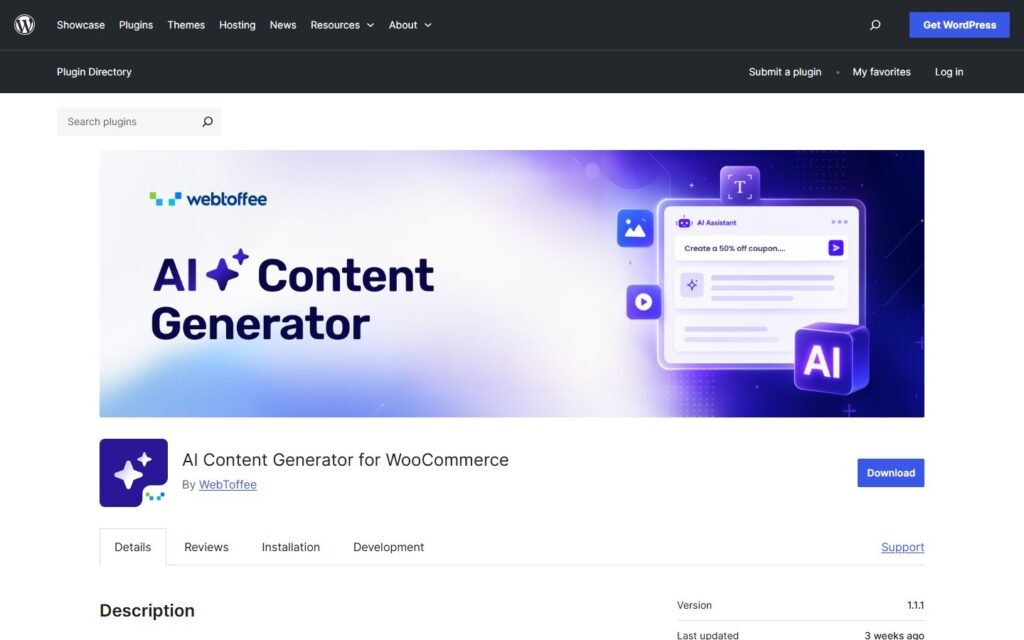
What is WebToffee AI Content Generator for WooCommerce?
WebToffee AI Content Generator is a WordPress plugin built specifically for WooCommerce product content. It connects to OpenAI or Google Gemini using the store owner’s own API key and can generate content for individual products or multiple products in bulk.
Its documented capabilities include:
- product titles, full descriptions, and short descriptions;
- SEO titles, meta descriptions, and focus keywords;
- WooCommerce tags and categories;
- product attributes extracted from descriptions;
- image alt text and captions;
- product review replies;
- spelling and grammar correction;
- text expansion, shortening, rewriting, and translation;
- custom prompts and saved prompt templates;
- bulk generation from the WooCommerce product list;
- automatic generation when a product is saved, scheduled, or imported;
- generation logs and prompt-level usage records.
The plugin supports both OpenAI and Gemini model families. Its WordPress.org listing also documents integration with popular SEO plugins, including Yoast SEO, Rank Math, SEOPress, All in One SEO, and WebToffee’s Smart SEO plugin.
This is a serious feature set for merchants with a large catalog. If a store has hundreds of incomplete product records, a purpose-built bulk workflow can save substantially more time than opening each product manually.
What is Niwa AI?
Niwa AI is designed as an operational layer for WordPress and WooCommerce. The owner can describe an outcome through Telegram or WhatsApp, and Niwa can use authorized tools to complete and verify the relevant work.
That can include:
- creating and updating posts, pages, products, prices, stock, coupons, and website content;
- researching search intent and competitors before publishing;
- checking existing website content to avoid substantial SEO duplication;
- producing and publishing conversion-focused articles;
- reviewing store or website activity and preparing owner-friendly reports;
- monitoring competitors or recurring business signals;
- investigating website problems and applying approved changes safely;
- connecting customer questions, lead context, objections, and next steps to conversion improvements.
The key difference is scope. Niwa is not primarily a product-description field generator. Its model is based on assignments that can cross several systems and stages: investigate, decide, execute, verify, and report.
The operating approach is explained in more detail on How Niwa Works.
WebToffee vs Niwa AI comparison table
| Capability | WebToffee AI Content Generator | Niwa AI |
|—|—|—|
| Primary role | WooCommerce product-content generator | WordPress and business operator |
| Installed as a WordPress plugin | Yes | Niwa uses a WordPress-connected operating layer |
| AI providers | Store connects its own OpenAI or Gemini API key | Managed through Niwa’s authorized agent workflows |
| Product titles and descriptions | Core capability, including bulk generation | Can create and update product content as part of wider assignments |
| Bulk catalog content | Strong dedicated bulk-generation interface | Can handle approved catalog work, but is not positioned as a field-by-field bulk generator UI |
| SEO metadata | Generates titles, descriptions, and focus keywords with documented SEO-plugin integrations | Can research intent and prepare metadata within an end-to-end publishing workflow |
| Product tags and categories | Yes | Can manage product and content taxonomy within authorized workflows |
| Attribute extraction | Can extract attributes from product descriptions | Can inspect and update product data, but a comparable dedicated extraction tool is not the core public proposition |
| Image alt text and captions | Yes | Can handle website and content media work as part of assignments |
| Translation and rewriting | Yes | Yes, within broader content workflows |
| Scheduled product-content generation | Yes | Supports recurring operational and monitoring workflows |
| Generation logs | Yes | Verifies completed actions and reports results to the owner |
| WooCommerce operational administration | Focused on product content; broader stock, coupon, order, and business operations are not its documented core | Core use case across catalog, content, pricing, stock, coupons, reporting, and related operations |
| Telegram administration | Not documented in the reviewed official product materials | Core owner channel |
| WhatsApp administration | Not documented in the reviewed official product materials | Core owner channel |
| SEO research before writing | The owner supplies product context and prompts; search-intent research is not the plugin’s documented core | Can combine search research, site inventory checks, writing, linking, publishing, and verification |
| Business reporting | Usage and generation logs are documented; commercial reporting is not the plugin’s core role | Owner-focused website and business reporting is a central workflow |
| Competitor monitoring | Not documented as a packaged capability | Supported as research and recurring monitoring work |
| Visitor lead capture | Not documented as a customer-facing capability | Can connect customer conversations and lead context to business workflows |
| Conversion workflows | Improves the content that can influence product-page performance | Can connect content, store operations, customer intent, objections, follow-up, and site changes |
| Best fit | Merchants needing high-volume WooCommerce content generation | Owners wanting to delegate broader website and business outcomes |
Where WebToffee is stronger
1. A purpose-built bulk product-content workflow
WebToffee’s strongest advantage is specialization. Its bulk interface lets a merchant select products, choose fields, add instructions, and generate content without building a custom automation.
That is especially valuable for imported catalogs, supplier feeds, multilingual stores, and older shops whose product records have inconsistent titles or thin descriptions.
A broader agent can also work through product data, but a dedicated product table and field-selection workflow may be faster for a catalog manager who wants direct control over a repetitive generation job.
2. Granular field coverage
The plugin does not stop at long descriptions. It covers short descriptions, SEO fields, categories, tags, image text, attributes, review replies, and several rewriting operations.
This field-level coverage matches common search intent around AI product description generators for WooCommerce. Store owners looking for that exact function are not forced to adopt a larger operating system.
3. Strong automation options
WebToffee documents three useful triggers: generating content when a product is saved, on a schedule, and during product import. Those options make it practical for stores that continuously receive new inventory.
The scheduler includes controls for product type, category, status, creation date, batch size, and overwrite behavior. That is a thoughtful setup for catalog maintenance because merchants can limit generation to specific product groups and avoid replacing existing fields unintentionally.
4. Bring-your-own-model flexibility
The plugin supports OpenAI and Google Gemini through API keys supplied by the merchant. Users can select models, configure creativity, and set token limits.
For technical teams, that offers useful control over model choice and direct visibility into provider usage. It also means the merchant is responsible for the relevant external API account, billing, model availability, and configuration.
5. Clear SEO-plugin integration
Generating metadata is more useful when it lands in the fields already used by the site’s SEO plugin. WebToffee explicitly documents integrations with several leading WordPress SEO products.
That gives it a practical advantage over generic text generators that produce a title and description but leave the merchant to paste each result into WordPress manually.
6. Logs and reusable prompts
The plugin records generated content, prompt information, token usage, and timestamps. It also lets merchants save custom prompt templates.
For repeatable product-content operations, this is important. Teams can standardize instructions, inspect results, and refine prompts rather than beginning from scratch for every batch.
Where Niwa AI is stronger
1. Telegram and WhatsApp administration
WebToffee works inside WordPress and is designed around product-editing and bulk-generation screens. Its reviewed official materials do not document Telegram or WhatsApp as owner administration channels.
Niwa is built around conversational delegation. A founder can request a store change, report, investigation, article, or follow-up task from a messaging application instead of navigating to the relevant WordPress screen.
For owners whose operations already run through mobile conversations, that is a substantial difference. It also allows the task to begin with a business outcome rather than a specific database field.
Niwa’s customer-side messaging and commerce model is explored in AI Website Chat and WhatsApp for Ecommerce.
2. WooCommerce operations beyond product copy
WebToffee’s official scope is product content. That is valuable, but writing better copy does not update stock, create a coupon, investigate a sales change, repair a site issue, or summarize store performance.
Niwa is designed to handle wider WooCommerce assignments. A request can connect product information with pricing, inventory, promotions, content, reporting, or customer objections.
For example, an owner could ask which products are underperforming, request a review of the relevant pages, approve changes, and receive a report after those changes are applied. That is an operational loop rather than a generation action.
3. Research before content production
WebToffee generates from available product data and the instructions supplied by the merchant. That makes it efficient, but the official documentation does not position the plugin as a search-intent or competitor-research system.
Niwa can research before writing. For SEO content, that may include checking current search results, examining existing site coverage, verifying competitor claims, selecting a non-duplicate angle, adding relevant internal links, publishing, and confirming the final WordPress status.
This difference matters when the business needs more than fluent copy. A well-written page can still fail if it targets the wrong intent, duplicates an existing article, or makes unsupported claims.
4. Business reporting and recommendations
WebToffee provides generation logs, which help users understand what content was produced and how the AI service was used. It is not presented as a broader sales or operational reporting product.
Niwa can connect website and WooCommerce data to a founder-friendly explanation. The goal is not only to retrieve numbers, but to identify what deserves attention and what action could follow.
That may include content opportunities, catalog issues, stock signals, repeated customer questions, conversion obstacles, or competitor changes.
5. Competitor monitoring connected to execution
Product descriptions exist in a competitive environment. Rivals may change pricing, positioning, offers, comparison pages, or category content.
Niwa can treat competitor research as an ongoing workflow and turn findings into a concrete website action. Depending on the assignment, that could mean preparing a comparison, revising an offer, improving a product page, or reporting that no safe change is justified.
WebToffee’s reviewed materials do not document competitor monitoring. Its role begins when the merchant has decided which product content should be generated or improved.
6. Lead capture and conversion context
WebToffee improves product content, and better content can support conversion. However, it is not documented as a customer-facing lead-capture or sales agent.
Niwa’s wider model can include visitor questions, product intent, objections, qualification, and handoff context. That information can then reveal why buyers hesitate and what website or offer changes may help.
The distinction is explained further in AI Lead Capture for Ecommerce: a useful lead record contains the buyer’s goal and decision context, not only contact details.
Which is better for WooCommerce product descriptions?
For a merchant whose immediate goal is to generate descriptions for dozens or hundreds of products, WebToffee is likely the more direct tool.
Its interface, field coverage, batch controls, prompt templates, SEO integrations, and automatic triggers are designed for precisely that job. A content manager can review the generated fields within familiar WooCommerce workflows.
Niwa becomes more relevant when the request is broader, such as:
- identify products with weak content and poor commercial performance;
- research the market before changing the positioning;
- update approved product and SEO content;
- prepare a supporting article or comparison page;
- review repeated shopper objections;
- report what changed and what should be tested next.
In short, WebToffee is optimized for content generation throughput. Niwa is optimized for delegating an outcome across multiple steps.
Which is better for WordPress administration?
Niwa is the clearer fit for general WordPress administration because WebToffee does not claim to be a general site operator.
WebToffee’s narrow scope is not a weakness when the task is product content. In fact, specialization is why its bulk interface is useful. But owners should not assume that an AI content plugin will also manage pages, diagnose errors, update unrelated settings, produce business reports, or run messaging-based administration.
Niwa is designed for those broader assignments, subject to site permissions and approval safeguards.
Which is better for SEO publishing?
WebToffee is strong for product-level SEO fields. Its integration with established SEO plugins and ability to generate focus keywords, SEO titles, and meta descriptions can accelerate catalog optimization.
Niwa is stronger when SEO publishing requires research and editorial judgment across the whole site. It can evaluate existing coverage, choose a differentiated intent, verify current sources, create a substantial article, link relevant pages, publish it, and confirm the result.
A useful example of that wider format is SiteGround AI Agent vs Niwa AI, which compares documented capabilities rather than merely generating generic competitor copy.
Can WebToffee and Niwa AI work together?
Yes. Their strongest use cases can be complementary.
A store could use WebToffee for high-volume generation of product descriptions, SEO fields, image text, and attributes. Niwa could then handle wider assignments around catalog review, reporting, editorial publishing, competitor monitoring, website operations, customer intent, and conversion follow-up.
The main requirement is governance. The owner should define:
- which tool may overwrite existing product fields;
- whether generated content requires review before publication;
- which system is responsible for scheduled changes;
- how prompts and brand rules are maintained;
- how duplicate or conflicting updates are prevented.
Automation works best when responsibility is explicit.
Frequently asked questions
Is WebToffee AI Content Generator a WordPress plugin?
Yes. It is installed on WordPress and works with WooCommerce product data. The current WordPress.org listing identifies WebToffee as the developer.
Does WebToffee generate WooCommerce product descriptions in bulk?
Yes. Bulk product-content generation is a core documented capability. Users can choose products and fields from the WooCommerce product list and provide additional generation instructions.
Which AI models does WebToffee support?
The current documentation supports OpenAI and Google Gemini integrations. The merchant supplies the relevant API key and can choose from supported models available through the plugin configuration.
Can WebToffee generate SEO metadata?
Yes. It can generate SEO titles, meta descriptions, and focus keywords, with documented integrations for several popular WordPress SEO plugins.
Can WebToffee create product attributes?
It can analyze a product description and extract key-value pairs that can be saved as product attributes. Merchants should still review generated attributes for catalog consistency and accuracy.
Can WebToffee automatically generate content for imported products?
Yes. Its documented automation options include generation during product import, when a product is saved, and through scheduled jobs.
Does WebToffee manage WooCommerce stock, coupons, customers, and orders?
The official materials reviewed for this comparison focus on AI-generated product content and related fields. They do not establish WebToffee AI Content Generator as a general conversational manager for stock, coupons, customers, or orders. Those broader WooCommerce operations are part of Niwa’s intended operating scope.
Can WebToffee administer WordPress through Telegram or WhatsApp?
Telegram and WhatsApp administration are not documented in the official WebToffee product materials reviewed on July 19, 2026. Niwa explicitly uses Telegram and WhatsApp as owner communication channels.
Does WebToffee capture leads from website visitors?
The reviewed documentation does not present it as a customer-facing lead-capture system. Its role is generating and improving WooCommerce product content.
Is WebToffee better than Niwa AI?
It is better for some specific jobs, particularly direct, high-volume generation of WooCommerce product fields through a dedicated interface. Niwa is better suited to broader delegated workflows involving WordPress administration, WooCommerce operations, messaging, research, publishing, reporting, monitoring, leads, and conversion work.
Final verdict
WebToffee AI Content Generator is a focused and capable WooCommerce content plugin. Its bulk controls, rich field support, SEO integrations, automation triggers, custom prompts, model selection, and logs make it a strong option for merchants who need to improve a large catalog efficiently.
Niwa AI addresses a different problem. It is designed for owners who want to delegate wider WordPress and business assignments through Telegram or WhatsApp and have the work carried through research, execution, verification, and reporting.
Choose WebToffee when the job is primarily generating product content at scale. Choose Niwa when product content is one part of a larger WooCommerce, publishing, reporting, competitor, lead, or conversion workflow.
If you want to test that broader operating model with a real website assignment, book a Niwa demo.