AICOM AI Commander vs Niwa AI: MCP Server or Business Operator?
Compare AICOM AI Commander and Niwa AI for WordPress MCP access, WooCommerce, publishing, security, messaging, reporting, leads, and conversions.
AICOM, AI Commander and Niwa AI both move WordPress beyond simple text generation. They let an AI system take useful action, but they approach that goal from different directions.
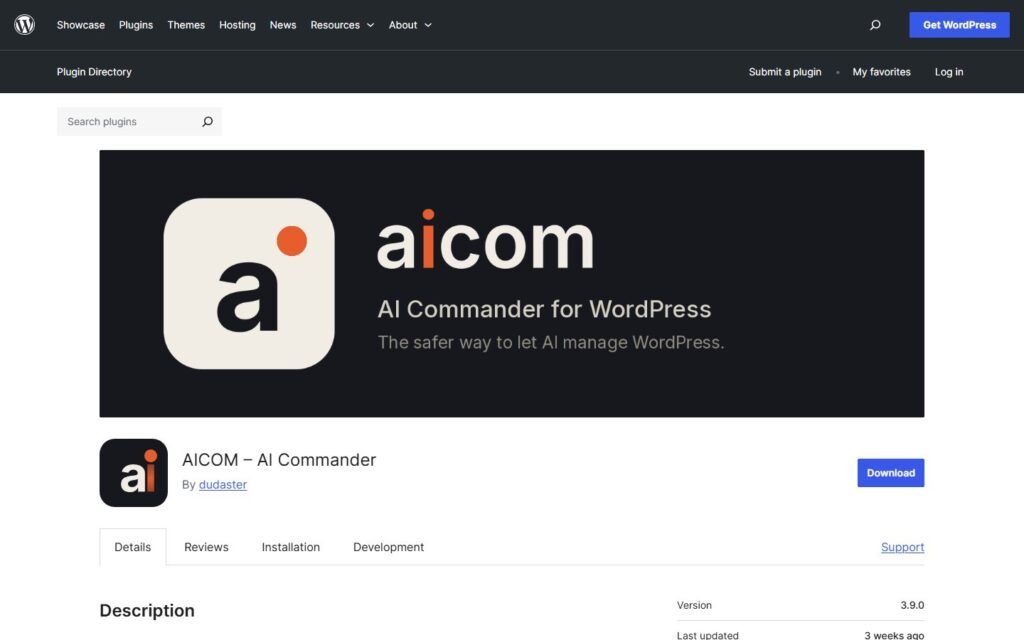
AICOM is primarily a secure MCP and OpenAPI control layer for WordPress. It connects external AI clients such as Claude Code, OpenAI Codex, ChatGPT Custom GPTs, Microsoft Copilot Studio, Dify, n8n, and other compatible tools to a WordPress site. Niwa AI is positioned as a WordPress business operator that combines site administration with WooCommerce work, messaging-based owner access, publishing, reporting, lead capture, monitoring, and conversion workflows.
This comparison examines their publicly documented capabilities as of July 18, 2026. It gives AICOM credit where it is strong and avoids treating undocumented features as if they exist.
Quick verdict
Choose AICOM if you want to connect your preferred AI client to WordPress through MCP or OpenAPI, define granular permissions, audit agent actions, test changes with dry-run mode, and manage technical or editorial workflows through a structured integration layer.
Choose Niwa AI if you want a more business-centered operator that can work with you through Telegram or WhatsApp, carry out WordPress and WooCommerce tasks, publish content, report on business activity, capture buyer intent, monitor competitors, and support conversion workflows.
The shortest distinction is:
AICOM gives external AI agents a governed way to operate WordPress. Niwa AI is designed to help the owner operate the business running on WordPress.
What AICOM, AI Commander does well
AICOM is a WordPress plugin that exposes a secure endpoint for AI agents. It supports MCP and OpenAPI, making it useful for developers, agencies, content teams, and technically comfortable site owners who already have an AI client they prefer.
Its official WordPress.org listing documents a broad set of WordPress operations:
- create, update, and publish posts, pages, and custom post types;
- manage media, menus, taxonomies, metadata, options, users, roles, and plugins;
- build or duplicate Elementor pages;
- manage Yoast SEO titles, descriptions, and social fields;
- work with Polylang translations;
- manage WooCommerce products, categories, and settings when WooCommerce is active;
- run accessibility audits and fix missing image alt text;
- define reusable agent skills and procedures;
- create backups and restore previous post or term states.
AICOM’s strongest differentiator is governance. API keys can be limited to specific scopes, resources, post types, taxonomies, file paths, languages, or modules. Soft Lock can block writes, Hard Lock can freeze almost all agent access, working-hours rules can restrict when agents operate, and destructive calls require explicit confirmation.
It also provides dry-run support and detailed audit logs. For agencies and technical teams, that record of what an agent attempted, which key it used, and what changed can be extremely valuable.
What Niwa AI is designed to do
Niwa AI starts from a different user: the founder or store owner who wants outcomes without assembling a separate AI client, protocol configuration, automation platform, and reporting process for every task.
As explained on How Niwa Works, Niwa is designed to turn website activity into purchases, leads, demos, and useful founder insight. The operational layer includes WordPress and WooCommerce work, while the commercial layer focuses on the questions and signals that affect revenue.
An owner can use Telegram or WhatsApp as a practical command center for requests such as updating products, changing prices, reviewing stock, creating content, publishing a post, checking business activity, researching a competitor, or preparing a conversion-focused workflow.
Niwa also works closer to the buyer journey. She can support product discovery, answer common buying questions, capture lead context, identify hesitation, and connect those signals with useful follow-up. That is the principle behind Niwa’s approach to AI lead capture for ecommerce: help first, understand intent, then capture contact details when follow-up has a clear purpose.
AICOM vs Niwa AI feature comparison
| Capability | AICOM, AI Commander | Niwa AI |
|—|—|—|
| Natural-language WordPress operations | Yes, through a connected MCP or OpenAPI AI client | Yes |
| Native MCP/OpenAPI server layer | Core strength | Not the primary product positioning |
| WordPress content creation and publishing | Yes | Yes |
| Media, menus, taxonomies, users, and settings | Broadly documented | Supported through operator workflows |
| Plugin management | Documented with dedicated permissions | Supported through governed site workflows |
| WooCommerce operations | Products, categories, and settings are documented | Product, stock, pricing, coupon, reporting, and store workflows |
| Elementor support | Explicitly documented | Not a primary differentiator |
| Yoast SEO field management | Explicitly documented | SEO research, content creation, publishing, and optimization workflows |
| Accessibility auditing and alt-text remediation | Explicitly documented | Not a primary differentiator |
| Dry-run mode | Yes | Safety and approval controls depend on the workflow |
| Scope-based API keys and resource boundaries | Major strength | Different owner-centered permission model |
| Backups, session restore, and audit logs | Explicitly documented | Operational reporting and execution records |
| Telegram administration | Not prominently documented as a native owner interface | Yes |
| WhatsApp administration | Not prominently documented as a native owner interface | Yes |
| Business reporting for the owner | Not the primary documented use case | Yes |
| Competitor research and monitoring | Not prominently documented as a built-in business workflow | Yes |
| Storefront lead capture | Not the primary documented use case | Yes |
| Buyer-facing conversion workflows | Not the primary documented use case | Yes |
| Abandoned-cart and hesitation workflows | Not prominently documented | Yes |
Public product capabilities change quickly. The comparison above reflects official public documentation available on July 18, 2026.
The biggest difference: infrastructure versus operating relationship
AICOM is strongest as infrastructure. It gives an AI agent a controlled set of WordPress tools and leaves the choice of agent, interface, prompts, and broader workflow to the user.
That flexibility is a real advantage. A developer can connect Claude Code, a team can expose selected actions to a Custom GPT, or an agency can issue different API keys for different clients and responsibilities. AICOM does not force the user into one AI provider or one interface.
The trade-off is that the user is responsible for assembling the operating experience. The plugin exposes capabilities, but a business still needs an agent that understands its goals, a communication channel, useful procedures, reporting logic, and conversion strategy.
Niwa’s value proposition is the assembled operating relationship. The owner does not begin with “Which MCP client should I configure?” The owner begins with “Update these prices,” “Publish this comparison,” “What changed in sales?”, “Watch this competitor,” or “Which visitors are asking high-intent questions?”
For a technical team, AICOM’s modularity may be preferable. For an owner who wants one business-facing operator, Niwa’s integrated approach may be easier to use consistently.
WordPress and content publishing
AICOM is highly capable in WordPress content administration. Its official feature set includes posts, pages, custom post types, media, menus, taxonomies, bulk SEO metadata, and Elementor workflows. It can be a strong choice for content teams that already work inside an external AI environment and want that environment to publish directly to WordPress.
Niwa also creates and publishes WordPress content, but the workflow is usually tied to a broader commercial purpose. A comparison article may come from competitor monitoring. A product guide may come from repeated buyer questions. A landing page may come from a lead-capture opportunity. Publishing is not treated only as a database action; it is connected to search intent, business context, and conversion.
WooCommerce operations
AICOM officially documents WooCommerce products, categories, and settings as an optional module. That makes it useful for structured catalog and configuration work, especially when a developer wants to call those operations from an MCP-compatible client.
Niwa’s WooCommerce positioning is broader and more owner-facing. It includes operational requests around products, stock, prices, coupons, reporting, and content, while also connecting store activity to shopper conversations and revenue opportunities.
That distinction matters when the issue is not simply “edit this product.” A shopper may be hesitating because of delivery, compatibility, price, or returns. Niwa’s conversion layer is designed to address those moments. The abandoned-cart recovery guide explains why useful answers before a shopper leaves can be more valuable than starting recovery only after the cart has been abandoned.
Telegram and WhatsApp administration
AICOM supports many external AI clients, but its public documentation does not present Telegram or WhatsApp as native owner-administration channels. A technical team could potentially build messaging workflows around its API, but that is different from the messaging channel being part of the product’s primary operating model.
Niwa is designed for the owner to work from Telegram or WhatsApp. That reduces the distance between noticing a problem and acting on it. A founder can send a request from a phone, receive the result, and continue the conversation without navigating wp-admin or configuring an MCP desktop client.
If the goal is maximum protocol flexibility, AICOM has the advantage. If the goal is a ready owner-to-site messaging relationship, Niwa has the advantage.
Reporting, competitor monitoring, and conversion workflows
AICOM’s logs are excellent for technical accountability. They show what the agent called, when it ran, which key was used, and what result came back. That is operational auditing.
Niwa’s reporting is aimed at a different question: what should the business owner know or do next? Sales movement, stock concerns, lead activity, recurring buyer objections, content opportunities, and competitor changes can become a founder-facing report rather than a raw action log.
AICOM does not prominently document built-in competitor monitoring, storefront lead capture, proactive buyer assistance, or conversion workflows. That does not make it weak; those tasks are outside its primary role as an AI-to-WordPress control layer.
Niwa is specifically positioned to connect those commercial signals with action. For example, repeated buyer questions can lead to a new FAQ, product-page improvement, campaign, lead follow-up, or conversion test. The Niwa Conversion Booster shows how live cart context can also support timely incentives instead of generic discounting.
Where AICOM is stronger
A fair comparison should make AICOM’s advantages clear.
AICOM is likely the better fit when you need:
- a standards-based MCP or OpenAPI connection;
- freedom to choose among many external AI clients;
- granular API-key scopes and resource boundaries;
- explicit Soft Lock, Hard Lock, and working-hours controls;
- dry-run simulation before changes;
- detailed technical audit trails;
- built-in snapshots and restore tools;
- Elementor, Polylang, Yoast SEO, and accessibility modules;
- a developer-friendly foundation for custom AI workflows.
These are serious strengths. AICOM may be especially attractive to agencies, developers, accessibility specialists, and teams that want to build their own agent experience on top of a governed WordPress tool layer.
Where Niwa AI is stronger
Niwa is the better fit when the priority is not only connecting an agent to WordPress, but giving the owner a consistent business operator.
Niwa’s advantages include:
- direct administration through Telegram and WhatsApp;
- WordPress and WooCommerce work in a founder-friendly conversation;
- content research, creation, and publishing tied to search and business goals;
- business reporting rather than only technical request logs;
- competitor research and monitoring;
- storefront lead and intent capture;
- buyer-facing product guidance and objection handling;
- conversion workflows around carts, checkout, recommendations, and follow-up.
These advantages matter most to small teams that do not want to design an AI operating stack themselves.
Which one should you choose?
Choose AICOM, AI Commander if you want a powerful, governable bridge between WordPress and the AI client of your choice. It is particularly compelling when protocol support, permissions, auditability, restore tools, technical integrations, and developer control are central requirements.
Choose Niwa AI if you want an integrated operator that works with the owner through familiar messaging apps and connects website administration with publishing, reporting, lead capture, competitor intelligence, and conversion activity.
They can also represent two layers of the same future. AICOM demonstrates how well-governed agent infrastructure can expose WordPress capabilities. Niwa demonstrates how those capabilities can be organized around the daily needs of a real business owner.
If you want to see the owner-centered workflow in practice, book a Niwa demo.
Frequently asked questions
Is AICOM an AI model?
No. AICOM is a WordPress plugin that connects a site to external AI agents through MCP or OpenAPI. You use a compatible AI client or automation platform to call its WordPress tools.
Does AICOM support WooCommerce?
Yes. Its official documentation lists an optional WooCommerce module for products, categories, and settings. The available tools depend on WooCommerce being active and on the permissions granted to the API key.
Can AICOM publish WordPress content?
Yes. AICOM documents the ability to create, update, and publish posts, pages, and custom post types, along with media, taxonomies, menus, and SEO fields.
Does AICOM include safety controls?
Yes. Its documented controls include granular API-key scopes, resource boundaries, Soft Lock, Hard Lock, working-hours scheduling, dry-run mode, explicit confirmation for destructive actions, audit logs, backups, and restore tools.
Does AICOM provide Telegram or WhatsApp WordPress administration?
Its public feature documentation does not prominently present Telegram or WhatsApp as native owner interfaces. It focuses on MCP and OpenAPI connections to compatible AI clients and automation systems.
What is the main advantage of Niwa AI over AICOM?
Niwa combines WordPress operations with an owner-facing business layer: Telegram and WhatsApp administration, reporting, competitor monitoring, lead capture, buyer assistance, and conversion workflows. The advantage is integration around business outcomes rather than protocol infrastructure alone.
Is AICOM better for developers?
It may be. Developers and agencies that want detailed scopes, direct endpoints, custom AI clients, module-level permissions, and technical auditability may prefer AICOM’s architecture.
Is Niwa AI better for WooCommerce founders?
Niwa is likely the stronger fit when a founder wants product and store operations combined with reporting, messaging access, lead context, buyer conversations, and conversion workflows. AICOM may be stronger when the founder has a technical team building a customized MCP-based operating system.