Angie vs Niwa AI: WordPress Developer Agent or Business Operator?
Compare Angie by Elementor and Niwa AI for WordPress development, WooCommerce operations, messaging, reporting, leads, and conversion workflows.
Angie by Elementor and Niwa AI both move WordPress beyond simple AI writing. Each can understand natural-language requests and take action, but they are designed around different centers of gravity.
Angie is strongest as an AI WordPress developer and site-management agent. It can generate custom widgets, PHP, CSS, JavaScript, custom post types, landing pages, backend enhancements, and broader site changes from a conversation inside WordPress.
Niwa AI is built as a WordPress business operator. It combines site and WooCommerce operations with owner access through Telegram or WhatsApp, content publishing, reporting, competitor monitoring, lead capture, customer-facing assistance, and conversion workflows.
This comparison uses Elementor’s current Angie product pages, help documentation, and WordPress.org listing as of July 16, 2026. Angie is still labeled as a beta product, so its capabilities and packaging may continue to evolve.
Quick Verdict
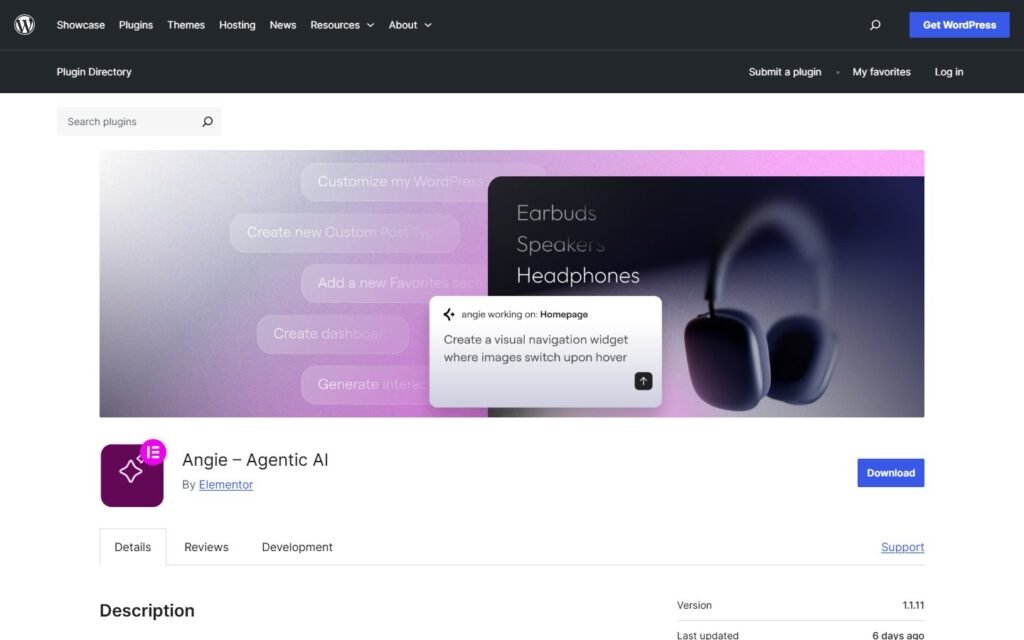
Choose Angie if your main goal is to build or modify WordPress functionality through conversation. It is particularly compelling for Elementor professionals, agencies, and site builders who want custom widgets, code snippets, visual apps, backend customizations, and site-wide technical work without starting from a blank code editor.
Choose Niwa AI if you want an agent that connects WordPress work to day-to-day business outcomes. Niwa is designed for owners who want to manage WordPress and WooCommerce from messaging apps, publish content, receive useful reports, monitor competitors, capture visitor intent, support shoppers, and run conversion-focused workflows.
The short version:
Angie is an AI developer and administrator inside WordPress. Niwa AI is a WordPress operator designed to work with both the owner and the customer.
What Is Angie by Elementor?
Angie is Elementor’s agentic AI plugin for WordPress. Unlike a conventional writing assistant, it is designed to understand the site’s architecture, installed plugins, data, content structure, and Elementor environment before producing or executing work.
Its most distinctive capability is Angie Code. According to Elementor’s official documentation, users can describe a feature and ask Angie to generate production-oriented WordPress assets such as:
- Custom Elementor widgets
- Extensions for existing Elementor widgets
- WordPress admin and backend snippets
- PHP, CSS, and JavaScript enhancements
- Custom post types and fields
- Interactive calculators, quizzes, and visual apps
- Complete landing pages for Elementor or Gutenberg
Angie also supports multimodal references. A user can describe an idea in text, upload a screenshot, or paste a URL to help communicate the desired result.
For higher-impact work, Angie documents a Plan Mode and an opt-in Super Admin Mode. Super Admin Mode can provide read-write access to the file system, database, and PHP layer for advanced operations such as bulk updates, debugging, and site-wide SEO fixes. Elementor states that Angie presents a plan before acting.
Another meaningful advantage is its testing workflow. Elementor says generated widgets and snippets can be previewed and refined in an isolated test environment before they affect the live site. Creations can also be saved to a cloud library for reuse across sites.
What Is Niwa AI?
Niwa AI approaches WordPress AI from the perspective of the person running the business.
A site owner can communicate with Niwa through Telegram or WhatsApp and request operational work without navigating WordPress menus. Examples include updating WooCommerce stock or prices, publishing content, managing products and coupons, reviewing sales signals, researching a competitor, or preparing a business report.
Niwa also works on the customer-facing side of the website. It can answer questions, help shoppers compare options, capture lead context, respond to objections, recommend relevant products, and support follow-up workflows when purchase intent would otherwise be lost.
That creates a broader operating model:
- Owner side: WordPress and WooCommerce operations, publishing, reporting, monitoring, and business workflows
- Storefront side: Buyer guidance, lead capture, product discovery, conversion assistance, and follow-up
The How Niwa Works page explains this owner-and-visitor model in more detail.
Angie vs Niwa AI: Feature Comparison
| Capability | Angie by Elementor | Niwa AI |
|—|—|—|
| Natural-language WordPress actions | Yes | Yes |
| Main working interface | Inside WordPress and Elementor | Telegram, WhatsApp, and WordPress-connected workflows |
| Custom Elementor widget generation | Core strength | Not the primary positioning |
| PHP, CSS, and JavaScript generation | Core strength | Available through developer/operator workflows, but not the primary product focus |
| Sandboxed preview for generated assets | Officially documented | Not positioned as the main workflow |
| Custom post types and fields | Officially documented | Can support WordPress operations; not a headline product-builder feature |
| Bulk WordPress operations | Documented through Super Admin Mode | Yes, through operational workflows |
| WooCommerce administration | Bulk updates and WooCommerce extensions are documented | Products, stock, prices, coupons, content, and store operations |
| Telegram or WhatsApp administration | Not described on the official Angie pages reviewed | Core differentiator |
| SEO content publishing | Site-wide SEO fixes and landing-page generation are documented | Research, drafting, WordPress publishing, and ongoing content workflows |
| Business reporting | Not prominently documented as a core workflow | Core owner-side use case |
| Competitor research and monitoring | Not prominently documented | Supported workflow |
| Customer-facing website assistant | Not the main documented focus | Core storefront use case |
| Lead and buyer-intent capture | Not prominently documented | Core conversion use case |
| Product recommendations and objection handling | Not the main documented focus | Supported storefront workflow |
| Conversion and follow-up workflows | Not prominently documented as a core product layer | Core product direction |
| Best fit | Developers, agencies, Elementor professionals, technical site builders | Owners, WooCommerce teams, service businesses, and growth-focused operators |
Product features can change quickly. This table reflects the public product information available on July 16, 2026 and avoids treating undocumented capabilities as confirmed absences.
The Biggest Difference: Building the Site vs Operating the Business
The clearest difference is not whether both products can take WordPress actions. They can. The difference is what each product considers the complete job.
For Angie, the job often starts with a technical or creative requirement:
- Build a custom pricing widget.
- Add controls to an existing Elementor component.
- Create a calculator or quiz.
- Add a custom post type.
- Diagnose a PHP or plugin conflict.
- Populate missing SEO metadata across the site.
Angie’s value is turning a specification into working WordPress functionality while keeping the user inside a familiar development and editing environment.
For Niwa, the request often begins with a business outcome:
- Update stock before a promotion starts.
- Change product prices and publish the campaign content.
- Summarize store performance for the owner.
- Monitor a competitor’s new offer.
- Capture a high-intent visitor who is not ready to buy.
- Answer a shopper’s objection before the cart is abandoned.
- Follow up with useful context after the visitor leaves.
The WordPress action is one part of a connected workflow rather than the final objective.
Where Angie Is Stronger
1. Custom WordPress development by conversation
Angie has a clearer public focus on generating bespoke WordPress functionality. If you need a custom widget, an admin screen, an interactive tool, or a targeted code enhancement, Angie is built directly around that use case.
Its ability to create PHP, CSS, and JavaScript gives it a different technical depth from AI tools limited to content generation or predefined administrative commands.
2. Elementor-native creation
Although Elementor says Angie can work on WordPress sites that do not use Elementor, its tight relationship with the Elementor ecosystem is a major advantage for Elementor professionals. Generated widgets can be refined through Elementor controls, which gives visual builders a practical path from an AI-generated starting point to a polished component.
3. Visual references
Screenshot and URL input can shorten the briefing process when the desired result is easier to show than explain. This is useful for agencies translating mockups or reference designs into reusable WordPress elements.
4. Test-before-live workflow
Angie’s documented isolated testing environment is important for code and custom components. Users can review and iterate before generated work reaches the live site.
5. Reusable asset library
Agencies that repeatedly build similar features may benefit from saving completed assets to a cloud library and importing them into other projects.
Where Niwa AI Is Stronger
1. Managing WordPress from Telegram or WhatsApp
Niwa is designed for owners who do not want every request to begin inside wp-admin. A founder can send an instruction from a phone, receive the result, and continue running the business from the same conversation.
This matters for frequent operational work: prices, inventory, products, coupons, publishing, reporting, research, and quick site changes.
2. Connecting WooCommerce work to business context
Angie officially documents bulk product-price updates and the ability to extend WooCommerce. Niwa’s emphasis is different: WooCommerce operations are connected with reporting, customer questions, product discovery, content, and conversion activity.
For example, a stock issue can become a supplier action, a product update, a customer response, and an owner report rather than remaining a single database edit.
3. Customer-facing conversion support
The official Angie materials reviewed focus on website creation, development, administration, debugging, and site-wide workflows. They do not prominently describe a customer-facing sales and lead-capture layer.
Niwa is designed to interact with visitors as well as the owner. It can help clarify needs, surface relevant products, answer objections, capture contact details and intent, and route the conversation toward a purchase or human follow-up.
Our practical guide to AI lead capture for ecommerce explains why useful context matters more than collecting an email address alone.
4. Business reporting and competitor monitoring
Niwa’s owner-side role includes interpreting operational and market signals. The goal is not merely to display data, but to tell the owner what changed, why it matters, and what action may be worth taking.
Competitor research and monitoring also fit this model. Niwa can investigate current public information, summarize relevant changes, and connect the finding to content or commercial action.
5. Conversion workflows beyond the WordPress dashboard
Niwa can support the moments surrounding a purchase: product questions, uncertainty, lead capture, relevant recommendations, checkout hesitation, and follow-up. The article on AI website chat and WhatsApp for ecommerce shows how connected conversations can reduce the need for shoppers to repeat themselves.
Which Is Better for WooCommerce?
The answer depends on what you want the AI to do.
Choose Angie for WooCommerce when the task is primarily technical: extending WooCommerce, changing custom functionality, updating records in bulk, debugging integrations, or creating a specialized interface around store data.
Choose Niwa AI when the task combines store administration with commercial execution: updating products and stock, publishing campaign content, reporting on the business, helping customers choose, capturing buyer intent, and supporting conversion or follow-up workflows.
A WooCommerce developer may reasonably prefer Angie. A store owner who wants one conversational operator across administration, reporting, content, and customer journeys may find Niwa a better fit.
Which Is Better for Agencies?
Angie is an attractive option for agencies whose core work is building and maintaining WordPress websites. Custom widgets, snippets, visual references, test environments, and reusable cloud assets directly address agency production work.
Niwa AI can be a better fit when the agency is responsible for ongoing growth operations rather than only site delivery. That includes publishing, campaign execution, store updates, reporting, lead handling, competitor monitoring, and conversion improvement.
Some teams may use the tools for different jobs: Angie for custom development and Niwa for recurring business operations. They are competitors in the broad WordPress AI agent category, but their strongest use cases are not identical.
Safety and Control
Both products involve actions that can affect a live WordPress site, so control matters.
Angie documents Plan Mode, explicit confirmation, an isolated testing environment for generated assets, and an opt-in Super Admin Mode for higher-impact access. Elementor also warns that Angie remains in beta and recommends maintaining backups.
Niwa’s operational model uses task context, permissions, confirmations where appropriate, reporting, and site-specific workflows. Owners should still maintain normal WordPress safeguards: current backups, staging for risky changes, limited credentials, and careful review of high-impact actions.
No AI agent should be treated as a reason to abandon basic site governance.
Balanced Verdict
Angie is the stronger choice for AI-assisted WordPress development. Its current public feature set is especially compelling for custom Elementor widgets, code snippets, visual apps, backend enhancements, bulk operations, debugging, and site-wide technical changes.
Niwa AI is the stronger choice for messaging-first business operations and conversion work. It is designed to connect WordPress and WooCommerce actions with publishing, reporting, competitor monitoring, customer assistance, lead capture, and revenue-focused workflows.
Choose based on the work you want to delegate:
- If you want to say, “Build this custom WordPress feature,” choose Angie.
- If you want to say, “Handle this website and business workflow,” choose Niwa AI.
To see how the owner-side and storefront-side pieces work together, visit How Niwa Works. You can also review Niwa’s verified capabilities and the current MCP access status. To evaluate Niwa with your own WordPress or WooCommerce workflows, book a focused 30-minute demo.
Frequently Asked Questions
Is Angie the same as Elementor AI?
No. Elementor’s help documentation describes Angie as a separate agentic AI product. Elementor AI is focused on generative assistance within the Elementor creation experience, while Angie is positioned as a context-aware WordPress agent that can build and manage broader functionality.
Does Angie work without Elementor?
Elementor states that Angie can work on WordPress websites whether or not they use Elementor. However, custom Elementor widget creation and native Elementor refinement remain important strengths.
Can Angie manage WooCommerce?
Yes, its official materials document WooCommerce-related capabilities, including extending WooCommerce and performing bulk operations such as product-price updates. Exact support may depend on the requested task, installed plugins, permissions, and the evolving beta feature set.
Can Angie manage WordPress through Telegram or WhatsApp?
The official Angie product pages and WordPress.org listing reviewed for this comparison describe interaction inside WordPress and Elementor. They do not prominently document Telegram or WhatsApp as owner administration channels.
Is Niwa AI only a chatbot?
No. Niwa includes customer-facing assistance, but its broader purpose is WordPress business operation. It can support owner requests involving WordPress, WooCommerce, publishing, reporting, monitoring, leads, and conversion workflows.
Which tool is better for custom code?
Angie has the clearer and more specialized public offering for generating custom WordPress code, widgets, snippets, and interactive functionality.
Which tool is better for ecommerce conversion?
Niwa AI is more directly positioned around buyer guidance, lead capture, product recommendations, objection handling, connected messaging, and conversion workflows. Angie’s current official positioning centers more heavily on building, managing, debugging, and extending the WordPress site itself.
Are Angie and Niwa AI direct replacements for each other?
Not always. They overlap in natural-language WordPress operations, but Angie is strongest as an AI developer and site-management agent, while Niwa is strongest as a business and conversion operator. A technical team could use them for complementary purposes.